How to Prevent Wrong-Dose Errors with Liquid Medications: A Practical Guide for Patients and Providers
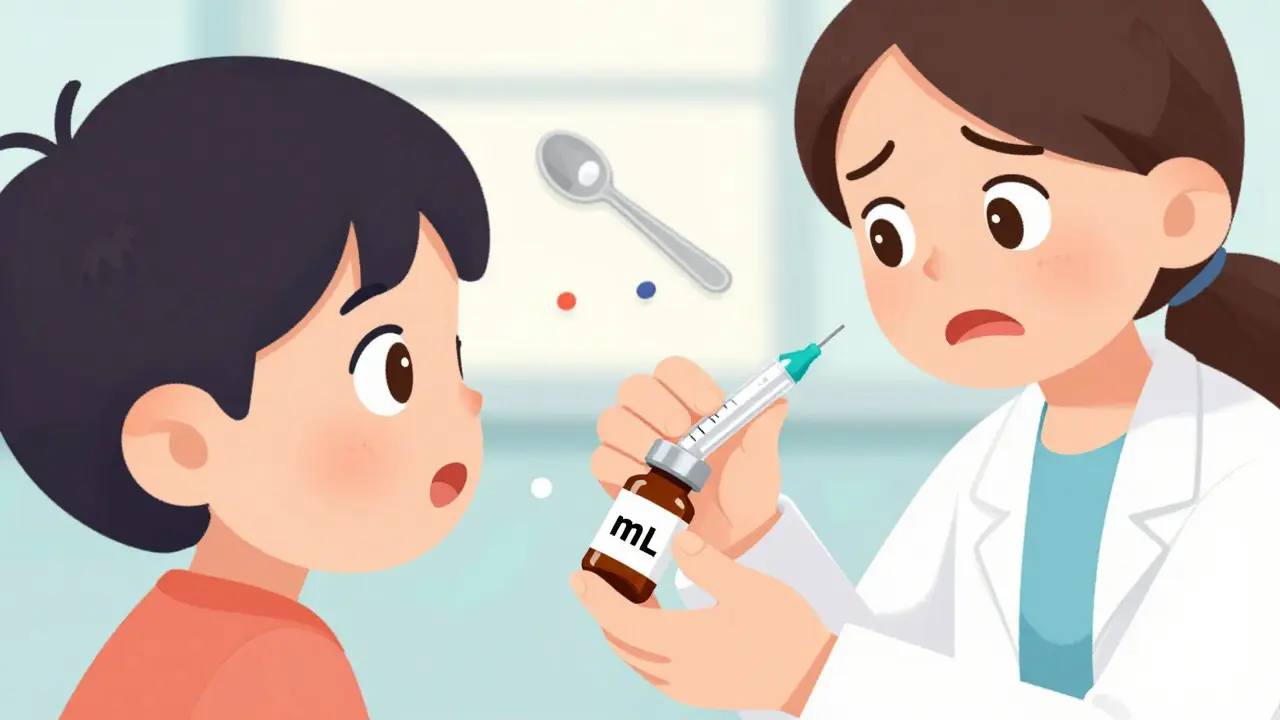
Getting the right dose of liquid medication isn’t just about following instructions-it’s about survival. In homes and hospitals alike, wrong-dose errors with liquid medications are one of the most common and dangerous mistakes in healthcare. A 2023 study in the Journal of Pediatrics found that 80% of pediatric home medication errors involve incorrect liquid doses. That’s not a small risk-it’s a life-or-death issue. And it’s not just parents making mistakes. Nurses, pharmacists, and doctors miss doses too. The good news? Most of these errors are preventable with simple, proven steps.
Why Liquid Medications Are So Risky
Liquid medications are tricky because they’re measured in tiny amounts. A child’s dose might be 2.5 mL. An adult’s might be 15 mL. But if you use a kitchen spoon, a dosing cup with unclear markings, or misread a prescription, you’re off by half-or double. That’s not a typo. That’s an overdose.One of the biggest problems? Non-metric units. Prescriptions still sometimes say “teaspoon” or “tablespoon.” But a teaspoon from your kitchen isn’t the same as a medical teaspoon. Studies show that 28% of preventable pediatric errors come from this confusion alone. The American Academy of Pediatrics has banned these terms since 2015. Yet, many pharmacies still print them on labels. And caregivers? They’re using spoons because they don’t have a proper tool.
Another issue: look-alike packaging. Two different medications can come in nearly identical bottles. One is for fever, another for allergies. Both are red, both have child-resistant caps. Without clear labeling, it’s easy to grab the wrong one-or the wrong dose.
The Tools That Actually Work
Forget the dosing cup. Forget the spoon. The single most effective tool for accurate dosing is the oral syringe.
Here’s what the data says: oral syringes are 37% more accurate than dosing cups for doses under 5 mL. For a 2.5 mL dose, syringes are 94% accurate. Dosing cups? Only 76%. Household spoons? A dismal 62%. That’s not a close call-it’s a clear winner.
Oral syringes come in different sizes. For doses under 1 mL, use a 1 mL syringe with 0.1 mL markings. For 1-5 mL, use a 5 mL syringe with 0.5 mL markings. These aren’t fancy gadgets. They cost less than a dollar each. Yet, only 54% of caregivers receive one with their child’s prescription, according to HealthyChildren.org. That’s unacceptable.
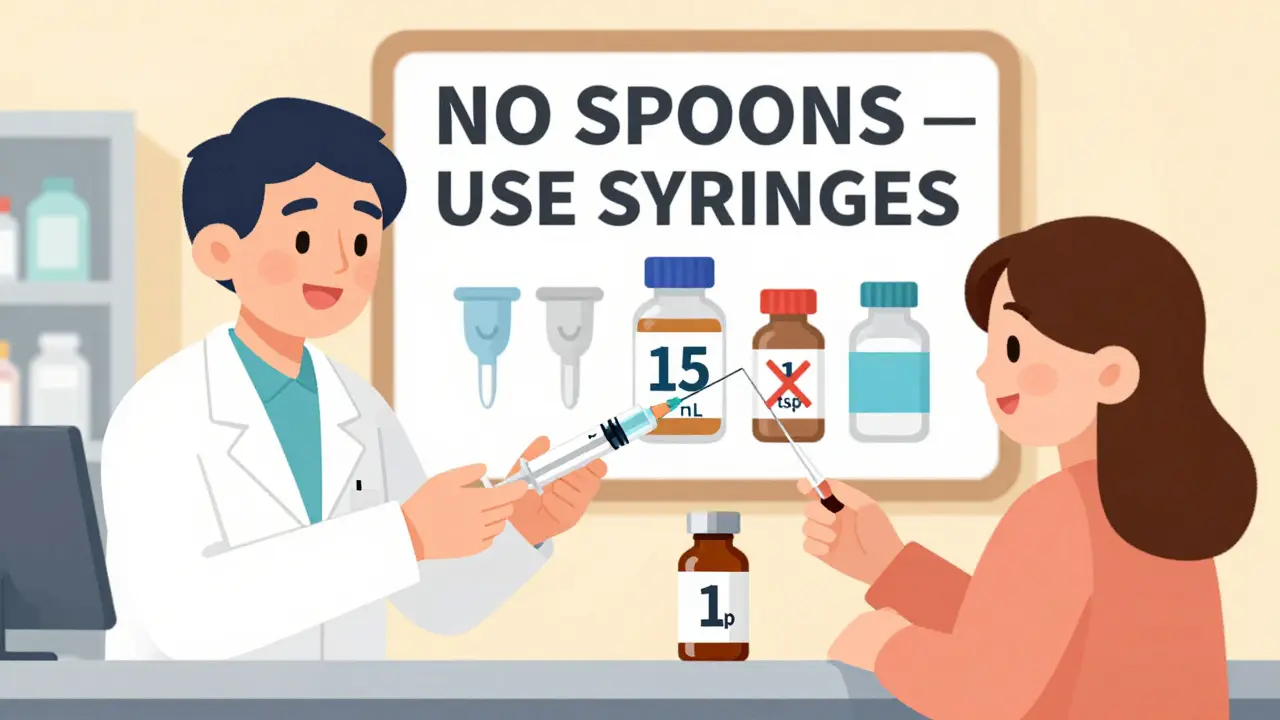
Pharmacies should hand out a syringe with every liquid prescription. No exceptions. If they don’t, ask for one. If they say no, go elsewhere. There’s no excuse. The American Academy of Family Physicians has recommended syringe-only distribution since 2020. Hospitals that follow this rule cut dosing errors by more than half.
What to Look for on the Label
When you pick up a liquid medication, check the label. It should say the dose in milliliters (mL) only. Not teaspoons. Not tablespoons. Not cc’s. Just mL.
The container should be amber-colored to protect the medicine from light, and it must have a bold “FOR ORAL USE ONLY” label. This isn’t just for show. According to the Institute for Healthcare Improvement, this simple change reduces look-alike errors by 42%. If the label says “give 1 tsp,” ask the pharmacist to rewrite it in mL. They’re required to do it.
Also check the cap. Is it child-resistant? Good. But is it also designed to prevent wrong-route errors? If it’s a hospital or long-term care setting, the bottle should have an ENFit connector. This is a special screw-top that only fits with enteral feeding tubes-not IV lines. Before 2016, many liquid meds were accidentally given through IVs, causing deadly reactions. Since ENFit became an international standard, wrong-route errors dropped by 98% in hospitals that adopted it.
How Pharmacies and Hospitals Are Fixing This
Big hospitals aren’t waiting for patients to speak up. They’re changing systems.
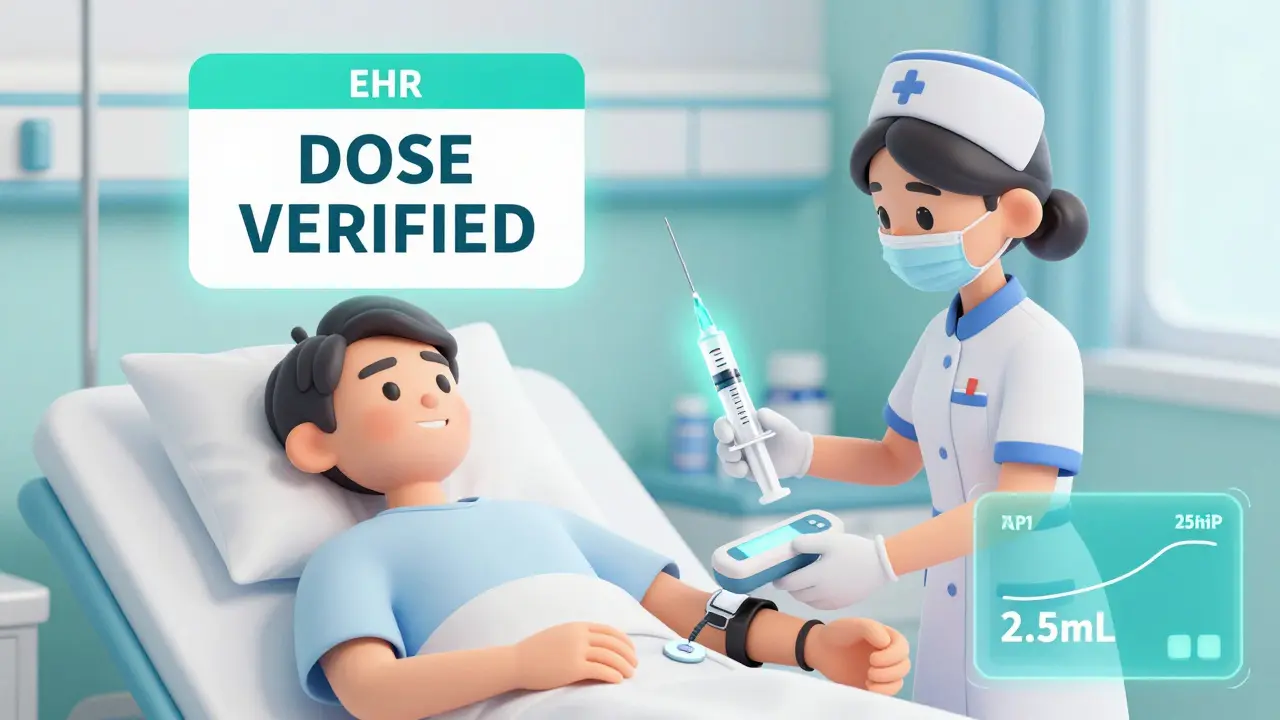
Electronic health records (EHRs) now flag doses that fall outside safe weight-based ranges. If a doctor orders 15 mL for a 10-pound baby, the system says “STOP.” That’s not a suggestion-it’s a hard stop. A 2023 Cochrane Review found this cuts pediatric liquid errors by 58%.
Barcode scanning at the bedside? That’s another game-changer. Nurses scan the patient’s wristband, the medication, and the syringe. If anything doesn’t match, the system alerts them. Hospitals using this system reduce wrong-dose errors by 48%.
Some pharmacies now offer pre-measured doses. You get a small, sealed cup with exactly 3.2 mL inside. No measuring needed. One study found 94% of parents were satisfied with this method. It’s not available everywhere yet, but it’s growing.
And then there’s training. Nurses and pharmacists now go through 16-24 hours of medication safety training. It’s not optional. Kaiser Permanente’s program, which includes mandatory syringe distribution, EHR alerts, and pharmacist-led caregiver education, reduced liquid medication errors by 92% in 18 months.
What You Can Do at Home
You don’t need a hospital system to keep your child safe. Here’s your checklist:
- Always ask for an oral syringe when picking up liquid medication. If they don’t give you one, ask why.
- Never use a kitchen spoon, measuring cup, or shot glass. Even if it says “1 tsp” on the side-it’s not accurate.
- Write down the dose in mL on a sticky note and keep it next to the medicine.
- Double-check the label: Is it in mL? Does it match what the doctor said?
- Store the syringe with the medicine. Don’t throw it away. Use it every time.
- If you’re unsure, call the pharmacy. Don’t guess.
And if you’re caring for an elderly person on liquid meds? Same rules apply. Dosing errors don’t care about age. A 70-year-old on a heart medication can overdose just as easily as a toddler.
What’s Changing Soon
The FDA is pushing hard for change. Starting in 2025, all over-the-counter liquid medications-like children’s Tylenol or cough syrup-must include a dosing device that meets ASTM F3100-23 standards. That means metric-only markings and a syringe or cup designed for accuracy.
By 2026, all certified electronic health records in the U.S. must include automatic pediatric dose checking. That means even if a doctor types in the wrong number, the system will catch it.
Future tech is even more exciting. Boston Children’s Hospital is testing smartphone apps that use augmented reality to show you exactly how much to pour. Johns Hopkins is piloting RFID-tagged syringes that talk to the hospital’s computer system and confirm the right dose was given. These aren’t sci-fi-they’re coming fast.
Why This Matters Beyond the Numbers
Every wrong dose isn’t just a statistic. It’s a child who gets sick. A parent who panics. A hospital stay that could’ve been avoided. Medication errors cost the U.S. healthcare system $8.3 billion a year-mostly from liquid meds. And 14% of these errors lead to permanent harm or death.
But the solution isn’t complicated. It’s consistent. It’s clear. Use a syringe. Read mL. Ask questions. Demand better.
There’s no magic pill. No app that replaces human care. But if every pharmacy handed out a syringe, every label said mL, and every caregiver knew to check twice-we could cut these errors by 65% or more. That’s not a dream. That’s what’s already working in hospitals that did it right.
You don’t need to wait for a system change. Start today. Grab the syringe. Read the mL. Trust your gut. If something doesn’t look right-it probably isn’t.

15 Comments

Greg Quinn
It’s wild how something so simple-like using a syringe-can save lives, but we treat it like a luxury instead of a standard. We’ve got the tech, the data, the guidelines… yet we still let people wing it with kitchen spoons. It’s not negligence, it’s systemic laziness. We optimize everything else-phones, cars, coffee machines-but not the thing that keeps kids alive.

Lisa Dore
I’m so glad this got posted. My niece almost got double-dosed last year because the label said ‘1 tsp’ and we used a regular spoon. We didn’t even know it was wrong until the pharmacist called us back. Now I carry a syringe everywhere with her meds. It’s a tiny thing that feels like armor.

Sharleen Luciano
Let’s be honest-most caregivers are functionally illiterate when it comes to metric units. You can’t blame the system entirely when the primary actors can’t differentiate between mL and tsp. This isn’t a design flaw-it’s a cognitive deficit masked as ‘convenience.’ The solution isn’t more syringes. It’s mandatory basic numeracy training for parents. Or at least, don’t let them near medicine without a certification.

Henriette Barrows
I’m a nurse, and I see this every shift. Parents are terrified they’ll mess up. They’re not careless-they’re overwhelmed. The real tragedy isn’t the spoon, it’s that we don’t hand out syringes like we hand out bandaids. I keep a box in my bag. If you’re leaving with liquid meds, I slip one in. No questions asked. It’s not heroism. It’s just… right.

Alex Ronald
Oral syringes are the unsung heroes of pediatric safety. I’ve seen the data. I’ve used them. They’re cheap, accurate, and foolproof. The only reason they’re not standard is because pharmacies don’t want the extra step. But if you ask for one, and they say no-tell them you’ll take your business to the one that does. Market pressure works.

Teresa Rodriguez leon
My mom died because someone confused her heart med with her blood pressure med. Same bottle. Same color. Different dose. No ENFit. No barcode. No warning. This isn’t theory. It’s my funeral photo on the wall.

Manan Pandya
As someone from India where liquid dosing is often done with improvised tools, I can confirm this is a global issue. We use medicine droppers from old bottles, or even eyedroppers from eye drops. But the solution is universal: syringes, mL, and education. No cultural exception applies when life is on the line.

Aliza Efraimov
They’re still printing ‘teaspoon’ on labels? Are you kidding me? This isn’t 1998. This is 2025. We have digital prescriptions, AI alerts, and robot pharmacists-and we’re still letting people use spoons? I’m calling my pharmacy right now. If they don’t give me a syringe, I’m posting their name on Reddit with a photo of the label. This is criminal negligence.

Nisha Marwaha
From a clinical pharmacy standpoint, the ENFit connector is a paradigm shift in enteral safety. The ISO 80369-3 standardization has been instrumental in reducing misconnections. However, the adoption curve remains fragmented due to legacy infrastructure and procurement inertia. Mandatory syringe distribution must be codified in CMS reimbursement policy to achieve scalability.

Paige Shipe
Why do we even need a guide for this? It’s basic math. 1 tsp = 5 ml. If you can’t do that, maybe you shouldn’t be giving medicine. I’m not saying people are dumb. I’m saying the system is enabling dumb. And now we have to write a 2000-word essay to fix what should be common sense?

Tamar Dunlop
While the imperative for precision in liquid medication administration is undeniably paramount, one must also acknowledge the cultural and socioeconomic disparities that impede uniform adherence to these protocols. In many households, the acquisition of a dedicated oral syringe is not merely an inconvenience-it is a financial burden. Policy interventions must therefore be coupled with equitable distribution mechanisms.

David Chase
AMERICA IS THE ONLY COUNTRY THAT STILL USES TEASPOONS FOR MEDICINE?!?!?!!!???!? I’m so sick of this. We have the best tech in the world, but we let our kids die because someone’s too lazy to buy a $0.99 syringe? This is why the rest of the world laughs at us. Fix this. Now. Or I’m moving to Canada. 🇨🇦💣

Emma Duquemin
I used to think this was just a ‘parent thing’-until my grandpa took his blood thinner wrong because the label said ‘1 tbsp’ and he used a soup spoon. He ended up in the ER with internal bleeding. That syringe? It’s now taped to his fridge next to his insulin pen. I bought him 10. He calls them his ‘lifesavers.’ I don’t care if it’s overkill. I’d rather be overprepared than under-protected.

Kevin Lopez
Oral syringes > dosing cups. End of story. If you’re still using anything else, you’re part of the problem. No nuance. No exceptions. Just facts.

Duncan Careless
Just had a chat with my local pharmacist. She said they’ve started handing out syringes with all pediatric scripts-no charge. Said it was a quiet change, but it’s made a difference. Small steps, right? Still, it’s a start. Thought I’d share, in case others are wondering if it’s even possible.

Write a comment