Otitis Media: When to Use Antibiotics for Middle Ear Infections
What Is Otitis Media?
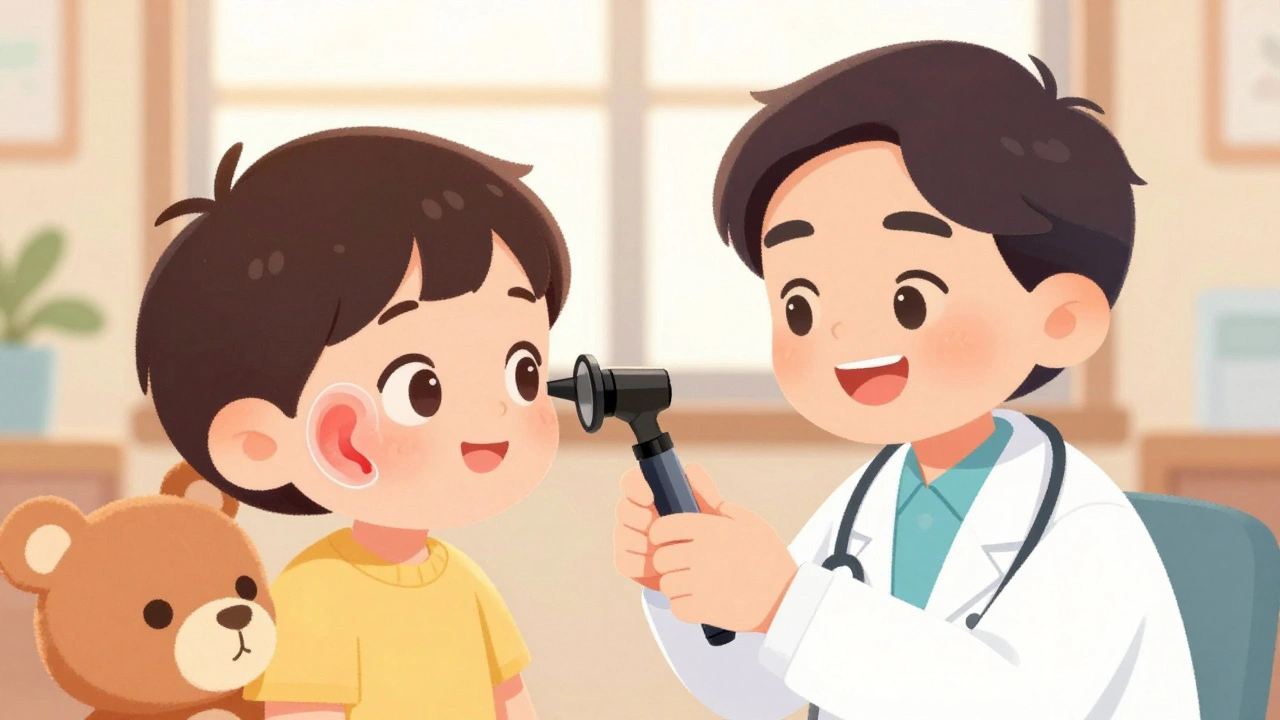
Otitis media is an infection or inflammation of the middle ear, the space behind the eardrum that’s filled with air and connected to the throat by the Eustachian tube. It’s one of the most common childhood illnesses, with over 80% of kids getting at least one by age 3. But adults can get it too - especially after a bad cold or sinus infection.
The problem starts when the Eustachian tube, which normally drains fluid and balances pressure, gets blocked. That happens during colds, allergies, or exposure to smoke. Fluid builds up behind the eardrum, creating a perfect breeding ground for bacteria or viruses. The most common bacterial culprits are Streptococcus pneumoniae, Haemophilus influenzae (non-typeable), and Moraxella catarrhalis. Viruses like RSV, rhinovirus, and influenza can also trigger it.
How Do You Know It’s an Ear Infection?
Not every ear tug or fuss means otitis media. Kids can’t always say their ear hurts, so parents watch for signs: pulling at the ear, crying more than usual, trouble sleeping, fever (especially over 102.2°F), or draining fluid from the ear. In adults, it’s often sharp pain, muffled hearing, or a feeling of fullness in the ear.
Doctors use a tool called a pinna otoscope - a lighted device with a tiny air puff - to check the eardrum. If it’s red, bulging, and doesn’t move when puffed, that’s a clear sign of acute infection. Hearing tests may show a temporary drop of 15-40 decibels, which is why kids might seem to ignore you or turn up the TV.
When Do You Need Antibiotics?
This is where things get tricky. For years, antibiotics were handed out like candy for ear infections. But now, doctors know better. 80% of uncomplicated ear infections clear up on their own within 3 days. That’s why guidelines from the American Academy of Pediatrics and the American Academy of Family Physicians now recommend watchful waiting for many cases.
Antibiotics are still needed in specific situations:
- Children under 6 months with confirmed infection
- Kids 6-23 months with severe symptoms (fever over 39°C or ear pain lasting 48+ hours)
- Children 2 years and older with severe pain or high fever
- Anyone with a ruptured eardrum and pus drainage
- Children with weakened immune systems or other health conditions
For mild cases in older kids, doctors often suggest waiting 48-72 hours. If symptoms don’t improve, then antibiotics kick in. This approach cuts down on side effects and helps fight antibiotic resistance.
Which Antibiotics Work Best?
When antibiotics are needed, amoxicillin is still the top choice. The standard dose is 80-90 mg per kg of body weight, split into two daily doses. It’s effective, affordable, and safe for most kids. For kids under 2 with bilateral infections, a full 10-day course is standard.
For children with penicillin allergies, alternatives include:
- Ceftriaxone - a single shot
- Cefdinir - oral, once or twice daily
- Azithromycin - 5-day course, useful if there’s vomiting or poor compliance
Amoxicillin-clavulanate (Augmentin) is used if the infection doesn’t respond to amoxicillin or if there’s a history of recurrent infections. But it’s not first-line because it’s stronger and increases the risk of diarrhea.
Resistance is a real concern. About 30-50% of Streptococcus pneumoniae strains in the U.S. are partially resistant to penicillin. Still, high-dose amoxicillin works in most cases. Resistance in Haemophilus influenzae to amoxicillin-clavulanate has risen from 7.2% in 2010 to 12.4% in 2022 - a warning sign.
Pain Management Is Just as Important
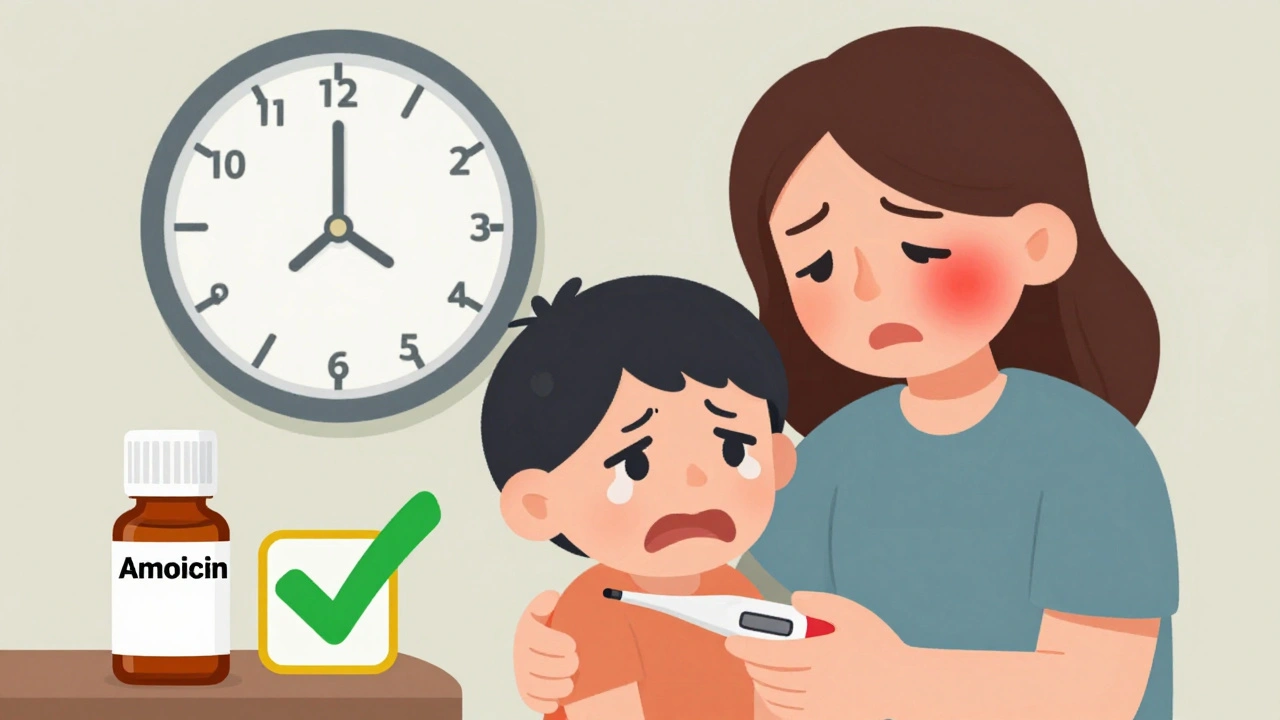
Antibiotics don’t relieve pain right away. That’s why pain control is the first step - even before deciding on antibiotics. Ibuprofen (5-10 mg/kg every 6-8 hours) or acetaminophen (10-15 mg/kg every 4-6 hours) are both effective. Many parents report that ibuprofen makes the biggest difference in calming a crying child.
Warm compresses on the ear help too. Some doctors recommend otic analgesic drops like Auralgan, but only if the eardrum isn’t ruptured. Never put oil, alcohol, or home remedies into the ear - that can cause more harm.
What About Watchful Waiting?
Watchful waiting isn’t ignoring the problem - it’s a smart, evidence-based strategy. In the Netherlands, doctors have used it for over 30 years with great success. In the U.S., prescribing rates dropped from 68% in 2010 to 59% in 2016 as guidelines changed.
Parents who try it often report:
- Less diarrhea and rash from antibiotics
- Reduced risk of antibiotic-resistant infections later
- Lower overall costs
But it’s not for everyone. Some kids get worse fast. One parent shared on Healthgrades that after 72 hours of waiting, their child’s fever spiked to 104°F and the eardrum ruptured. That’s why you need a clear plan: know the red flags.
Red Flags - When to Go to the ER
Watch for these signs - they mean you need help now:
- Fever above 104°F
- Pain that doesn’t improve with ibuprofen or acetaminophen
- Drainage of pus or blood from the ear
- Dizziness, vomiting, or neck stiffness
- Facial weakness or drooping
These could mean the infection has spread beyond the middle ear - to the brain, bones, or nerves. That’s rare, but serious.
Recurrent Infections and Long-Term Issues
One in five kids has three or more ear infections in six months. That’s called recurrent otitis media. It can lead to hearing loss, speech delays, or fluid that lingers for months - called otitis media with effusion (OME).
Here’s the key: OME doesn’t need antibiotics. The fluid usually clears on its own within 3 months. If it doesn’t, doctors may suggest ear tubes. These tiny cylinders placed in the eardrum help drain fluid and prevent future infections. They’re common, safe, and often life-changing for kids who keep getting infections.

Prevention: Vaccines and Lifestyle
You can lower the risk - a lot - with a few smart moves:
- PCV13 vaccine (pneumococcal conjugate) reduces vaccine-type ear infections by 34%
- Flu shot every year lowers viral triggers
- Don’t smoke around kids - secondhand smoke increases risk by 50%
- Breastfeed upright - bottle-feeding while lying down lets milk flow into the Eustachian tube
- Limit daycare exposure if possible - kids in group care get infections 2-3 times more often
The new 15-valent pneumococcal vaccine (Vaxneuvance), approved in 2021, shows even better protection in trials. More kids getting vaccinated means fewer infections overall.
What’s Changing in Treatment?
Technology is helping. The FDA approved a smartphone otoscope called CellScope Oto that lets parents take pictures of the eardrum and send them to the doctor. Studies show it’s 85% accurate. Some clinics now use tympanometry - a quick test that measures eardrum movement - to reduce unnecessary antibiotic use by 22%.
Doctors are also looking ahead. In the next five years, point-of-care tests may identify exactly which bacteria are causing the infection. That means targeted antibiotics instead of broad-spectrum ones - cutting resistance and side effects.
Why Antibiotic Overuse Matters
Every time we use an antibiotic when it’s not needed, we help bacteria become stronger. The CDC lists penicillin-resistant Streptococcus pneumoniae as a "serious threat." Otitis media accounts for 15 million antibiotic prescriptions a year in the U.S. - the second most common reason after sore throats.
That’s why choosing antibiotics wisely isn’t just about your child. It’s about protecting the next generation from untreatable infections.
What Parents Are Saying
On Reddit, one parent wrote: "My 18-month-old had a fever and cried for two days. We waited. Pain meds helped. By day 4, he was back to playing. No antibiotics needed." Another said: "We started antibiotics right away - and got diarrhea for two weeks. I wish we’d waited."
The takeaway? There’s no one-size-fits-all. Work with your doctor. Know the signs. Trust your gut - but back it up with facts.

11 Comments

Scott Butler
This is why America's healthcare is broken. Antibiotics? For an ear infection? In my day, we just sucked it up. Now parents treat their kids like fragile glass figurines. You want to save antibiotics? Then stop being a hypochondriac. I've seen kids with ear infections running around like normal for days. Stop overmedicating.
And don't even get me started on that 'watchful waiting' nonsense. That's just lazy medicine. If your kid's crying, FIX IT. Not wait 72 hours like you're playing Russian roulette.

Deborah Andrich
I wish I'd read this 2 years ago. My daughter had three ear infections in 6 months. We started antibiotics every time. She got diarrhea every single time. We were so stressed. Then our pediatrician said try waiting. We did. Pain meds. Warm compress. Cuddles. She got better by day 3. No antibiotics. No mess. No stress.
It's not about being lazy. It's about trusting your kid's body. And your gut. You know when they're really sick. And you know when they're just uncomfortable. This post saved us.

John Fred
Dude this is GOLD 🚀 🎯
Amoxicillin at 80-90 mg/kg? Yep. That’s the sweet spot. And don’t forget tympanometry - it’s a game-changer. My kid’s ENT uses CellScope Oto now. I snap a pic, doc reviews it in 20 mins. No drive. No wait. No guesswork.
Also - ibuprofen > acetaminophen. Full stop. My son went from screaming to smiling in 20 min with Advil. Never going back.
And yes - PCV13? Get it. Flu shot? Get it. Smoke-free home? NON-NEGOTIABLE. These aren’t options. They’re armor.

Hamza Laassili
I'm sick of this 'watchful waiting' crap. You think your kid's gonna be fine? Nah. They're gonna get worse. And then you're gonna be begging for antibiotics at 3am. I've been there. My son's eardrum ruptured. Pus everywhere. ER. IV antibiotics. 3 days in the hospital. All because some 'expert' said 'wait 48 hours'.
Antibiotics. Now. Always. It's not a gamble. It's a guarantee. And if you're worried about resistance? Then don't use them for strep throat. But ear infections? They're bacterial. Always. Always. Always.

Cole Newman
You know what's really happening? Big Pharma is pushing this 'watchful waiting' stuff because they want you to buy more expensive drugs later. Amoxicillin? Cheap. Augmentin? More $$$, more profit. And don't get me started on those ear tubes - those are $10k procedures. They want you hooked.
And the vaccine? PCV13? That's just a cash grab. I read a study - it only cuts infections by 34%. So what? 66% still get sick. And now you're paying $200 for a shot that doesn't even work?
My kid gets antibiotics at the first sign. No waiting. No games. Just fix it.

Casey Mellish
As an Aussie, I’ve got to say - we’ve been doing watchful waiting since the 90s. It works. Our antibiotic resistance rates are lower than yours. We don’t panic. We don’t rush. We manage pain. We monitor. We wait. And guess what? Most kids heal.
Also - breastfeeding upright? Yes. Bottle-feeding lying down? That’s a recipe for ear infections. My niece had 5 infections by age 1 because her mum fed her flat on the couch. We fixed it. No meds needed after.
And Vaxneuvance? Brilliant. Australia rolled it out last year. Already seeing fewer cases. Science wins. Panic loses.

Tyrone Marshall
There’s a deeper layer here that rarely gets discussed. Otitis media isn’t just a medical event - it’s a cultural one. We’ve built a society that equates discomfort with danger. We can’t tolerate a child crying. So we reach for the pill bottle.
But pain is a signal. Not a crisis. The body is not broken when it’s inflamed - it’s healing. Antibiotics don’t cure inflammation. They kill bacteria. And sometimes, the bacteria aren’t even the problem.
Letting a child feel discomfort - and sitting with it - is an act of trust. In their body. In nature. In time. That’s the real medicine.

Emily Haworth
Wait… you know that ‘smartphone otoscope’? CellScope? I think the government is using it to track kids’ ear infections… for the vaccine registry… and then they’re linking it to school enrollment… and soon they’ll know EVERYTHING about your child’s health… and then they’ll mandate shots… and then… they’ll control your parenting…
Also… why is there no mention of fluoride in the ear? I heard it kills biofilms… and the CDC is hiding it… because Big Pharma doesn’t want you using something that costs 2 bucks… 🤔👁️

Tom Zerkoff
The clinical guidelines referenced are evidence-based, peer-reviewed, and endorsed by the American Academy of Pediatrics and the American Academy of Family Physicians. The recommendation for watchful waiting in non-severe cases is grounded in multiple randomized controlled trials, including those published in JAMA Pediatrics and The Lancet.
Antibiotic overuse contributes to the global crisis of antimicrobial resistance, which the WHO has classified as one of the top ten global public health threats. Reducing unnecessary prescriptions for otitis media - which accounts for approximately 15 million annual U.S. prescriptions - is not merely prudent; it is ethically imperative.
Parental anxiety is understandable. But informed patience is not negligence. It is responsible stewardship.

Yatendra S
Sometimes I think we forget… the ear is not just a body part. It’s a portal. Between the outside world and the inner silence. When it hurts… it’s not just bacteria. It’s the child’s soul crying out for safety.
Antibiotics are a tool. But so is silence. So is warmth. So is holding them close.
Maybe… the real infection… is our fear. And the cure? Not a pill. But presence.

Lara Tobin
I just want to say thank you for writing this. I was so guilty of rushing to antibiotics. My daughter had her first ear infection at 8 months. I panicked. Gave her amoxicillin. Got diarrhea. Then she got another. Then another. I felt like a failure.
This post made me breathe. I waited. Used ibuprofen. Held her. She got better. We didn’t need it. I’m not ashamed anymore. We’re learning. And that’s okay.


Write a comment