Patient Trust: How to Build Confidence in Generic Medications
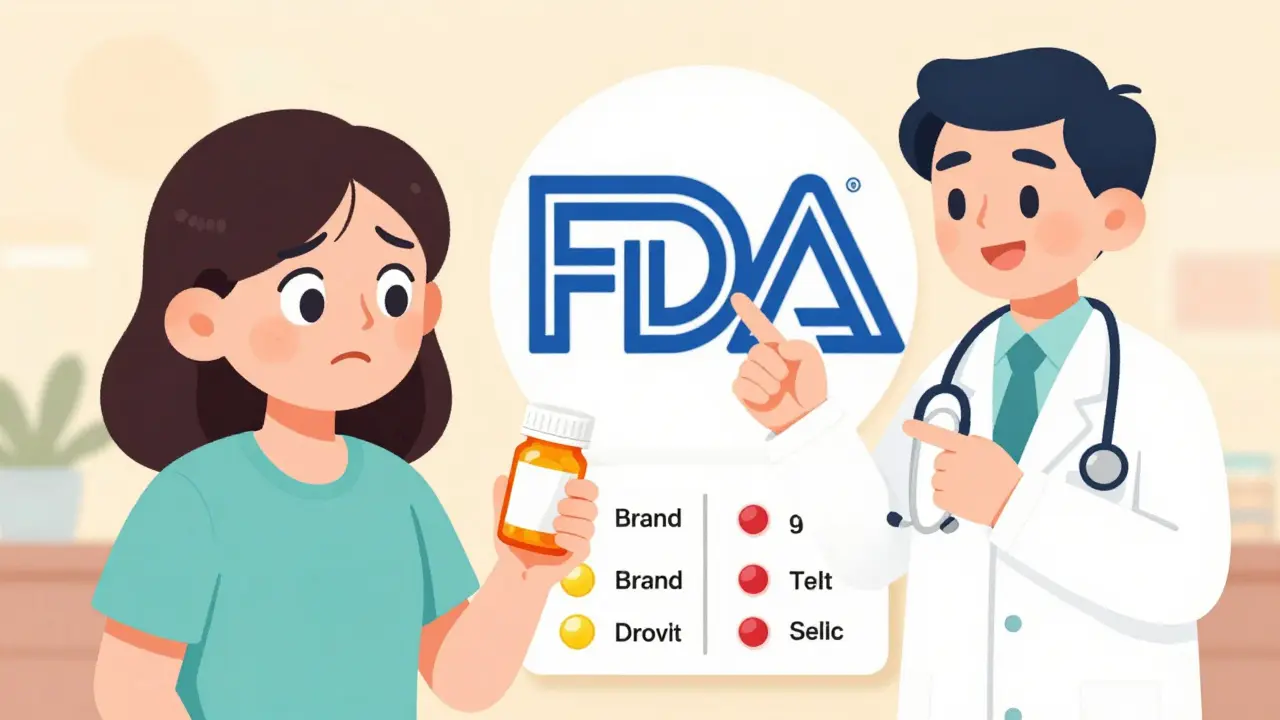
When you pick up a prescription, you might not think twice about the pill in your hand-until you notice it looks different. Smaller. A different color. Maybe even a weird lettering on the side. That’s when doubt creeps in: Is this really the same? For millions of people, this moment of confusion is the first step in a deeper question: Can I trust a generic medication?
Why Generic Medications Are Just as Effective
Generic drugs aren’t cheap knockoffs. They’re exact copies in active ingredients, strength, and how they work in your body. The FDA requires them to deliver the same therapeutic effect as the brand-name version-within 80% to 125% of the original’s absorption rate. That’s not a guess. It’s backed by real blood tests, clinical trials, and years of data. If a generic drug doesn’t meet this standard, it doesn’t get approved.Take levothyroxine, the drug used to treat hypothyroidism. A patient in Ohio switched from Synthroid to the generic version and tracked her TSH levels for two years. Nothing changed. Her energy stayed up. Her weight stayed stable. She saved $300 a year. That’s not luck. That’s science.
Same goes for apixaban. The brand-name version, Eliquis, costs over $500 a month. The generic? Around $15. A Medicare recipient in Florida switched and saw no difference in his blood clotting tests. He’s now saving $1,200 a year. These aren’t outliers. They’re common outcomes.
The Real Reason People Don’t Trust Generics
It’s not about the science. It’s about perception.Studies show that nearly half of patients in Greece believe brand-name drugs are more effective-even though the data says otherwise. In the U.S., 94% of people say generics are just as safe and effective. But that doesn’t mean everyone believes it.
The biggest fear? Side effects. Almost 30% of patients worry that a generic will make them feel worse. Why? Because the pill looks different. Inactive ingredients-like dyes, fillers, or coatings-can change the shape, color, or even taste. But they don’t change how the drug works. A blue tablet and a white one with the same active ingredient do the same job. It’s like two different brands of aspirin: one’s round, one’s oval. Both relieve pain.
Another issue? Consistency. If your generic pill changes color every refill, it’s easy to think something’s wrong. One month it’s white, next month it’s yellow. That’s not a defect. It’s because different manufacturers make the same generic. The FDA doesn’t require them to look the same. But patients don’t know that.
Doctors and Pharmacists Are the Missing Link
Patients trust their doctors more than any brochure or website. If your doctor says, “This generic is just as good,” you’re far more likely to accept it. But too often, that conversation never happens.A study from Harvard found that when doctors took just 10 minutes to explain bioequivalence, patient acceptance of generics jumped by 40%. Simple phrases like “This has the same active ingredient as your old pill” or “The FDA tests these the same way” make a difference.
Pharmacists are even more critical. At Mayo Clinic, pharmacists sit down with patients to review substitutions. They show them side-by-side images of brand and generic pills. They explain why the color changed. They answer questions before the patient even leaves the pharmacy. Result? 92% patient satisfaction. Nationwide, the average is 68%.
That gap isn’t about knowledge. It’s about effort. Most pharmacies don’t have the time or resources to do this. But when they do, trust follows.

What You Need to Know Before Switching
If you’re considering a generic, here’s what actually matters:- Active ingredient must match. Check the label. It’s the only thing that affects how the drug works.
- Dosage must be identical. 10 mg is 10 mg, no matter the brand.
- Form matters too. A tablet and a capsule with the same ingredient aren’t interchangeable. Same goes for extended-release vs. immediate-release.
- Appearance changes are normal. Don’t panic if your pill looks different next refill. Call your pharmacy if you’re unsure.
- Monitor how you feel. Give it 30 to 90 days. If you notice new side effects, tell your doctor. But don’t assume it’s the generic. Sometimes, your body just reacts differently over time.
One myth that won’t die: “Generics have less active ingredient.” That’s false. The FDA requires 90-110% of the brand’s active ingredient. Not 80%. Not 70%. 90-110%. That’s tighter than many brand-name drugs are allowed to vary.
How the System Is Changing to Build Trust
The FDA launched its “Know Your Options” campaign in January 2024 with $15 million to fight misinformation. They’re putting out clear, visual guides showing how generics are tested. They’re even working with pharmacies to include QR codes on packaging that link to FDA-approved info about the drug’s equivalence.Companies like CVS Health are testing AI tools that analyze your prescription history and send personalized messages: “You’ve been on this medication for 3 years. The generic version has the same active ingredient and saved patients like you an average of $400/year.”
And AARP partnered with generic drug makers to create simple, large-print guides for seniors-because older adults are the most likely to stick with brand-name drugs, even when they can’t afford them. In pilot programs, this cut refusal rates by 22%.
By 2025, 78% of major generic manufacturers will include QR codes on every bottle. Scan it. See the FDA approval number. See the bioequivalence data. See the manufacturer. No guesswork.
When You Should Stick with the Brand
There are rare cases where sticking with the brand makes sense. For drugs with a narrow therapeutic index-like warfarin, lithium, or some seizure meds-small changes in absorption can matter. Even though generics are required to be bioequivalent, some doctors prefer to keep patients on the same version long-term to avoid any risk of fluctuation.But here’s the key: It’s not about the generic being worse. It’s about consistency. If you’ve been stable on a brand for years, switching might not be worth the risk of disruption. Talk to your doctor. Don’t assume you have to switch.
But if you’re paying hundreds a month for a drug that’s available as a generic? You’re not saving money-you’re paying for branding. And that’s not a medical choice. It’s a marketing one.
What to Do Next
If you’re on a brand-name drug and wondering if you could switch:- Ask your doctor: “Is there a generic version available?”
- Ask your pharmacist: “Will the generic look different? What’s the manufacturer?”
- Check your insurance formulary. Many plans require you to try the generic first.
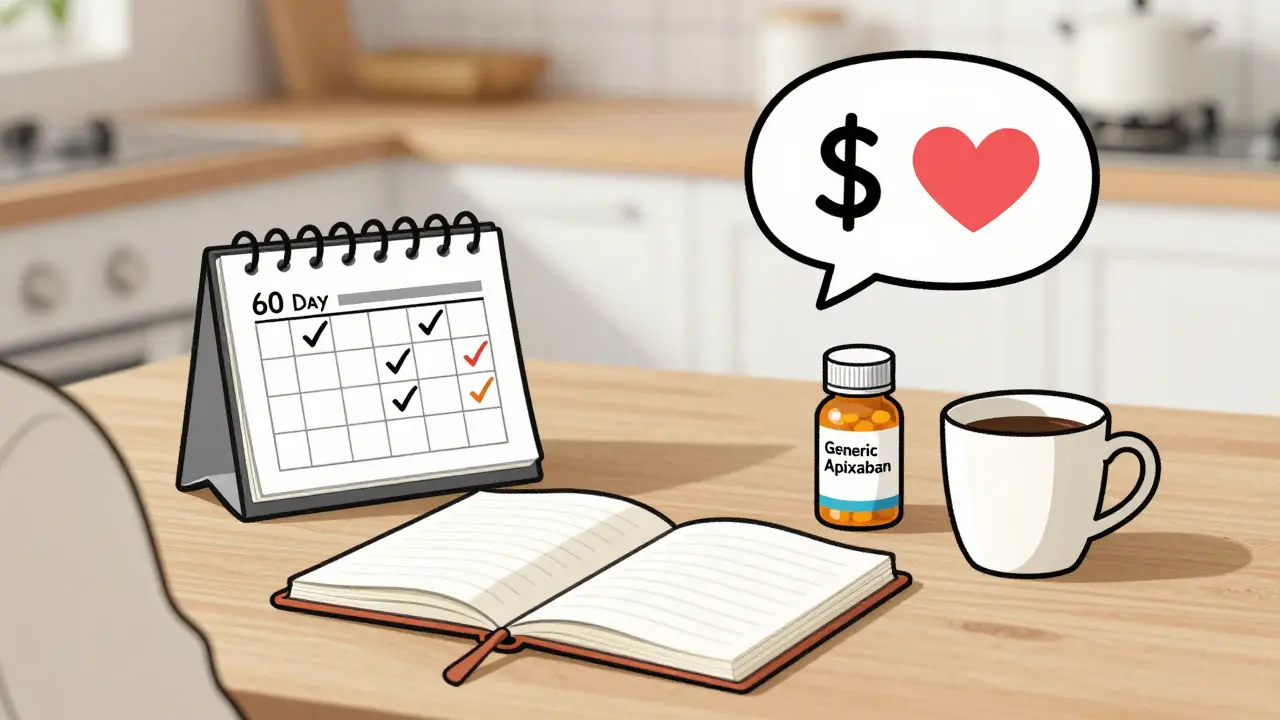
- Track your symptoms for 60 days after switching. Keep a simple log: energy, side effects, mood.
- If you feel worse, don’t blame the generic immediately. Talk to your provider. It might be something else.
Most people who switch never look back. They save money. They feel the same. And they wonder why they waited so long.
Are generic medications really as effective as brand-name drugs?
Yes. The FDA requires generic drugs to have the same active ingredients, strength, dosage form, and bioequivalence as the brand-name version. They must be absorbed into the bloodstream at the same rate and to the same extent. Studies show no meaningful difference in effectiveness for the vast majority of medications.
Why do generic pills look different from brand-name ones?
Generic manufacturers aren’t required to copy the appearance of brand-name pills. Differences in color, shape, or markings come from different inactive ingredients-like dyes or fillers-that don’t affect how the drug works. These changes are legal and safe, but they can cause confusion. Always check the label for the active ingredient name to confirm it’s the same.
Can switching to a generic cause new side effects?
It’s possible, but rare. Side effects are usually caused by the active ingredient, which is identical in both versions. However, differences in inactive ingredients can rarely trigger allergies or sensitivities-like a dye or preservative. If you notice new side effects after switching, talk to your doctor. Don’t assume it’s the generic’s fault without checking.
Why do some doctors hesitate to prescribe generics?
Some doctors are trained to stick with brands out of habit or because they’ve seen rare cases where switching caused instability-especially with drugs like warfarin or epilepsy medications. But most doctors now support generics. The real barrier isn’t medical-it’s that many haven’t had time to learn how to explain bioequivalence clearly to patients.
How much money can I save by switching to a generic?
On average, generics cost 80-85% less than brand-name drugs. For example, Eliquis (brand) costs around $500/month; the generic apixaban costs about $15. That’s over $1,200 saved per year. For chronic conditions, the savings can be thousands annually.

8 Comments

Alec Amiri
Bro I switched my blood pressure med to generic and thought I was gonna die. Sweating, heart racing, felt like my brain was melting. Turned out I was just anxious. Stayed on it for 3 months. Zero issues. Saved $400. Don’t let your mind play tricks on you.
Also, the pill looked like a neon green pebble. I still laugh about it.

Daphne Mallari - Tolentino
While the empirical data presented is statistically sound, one cannot overlook the epistemological dissonance between perceived efficacy and pharmacological equivalence. The placebo effect, though often dismissed as anecdotal, remains a clinically validated phenomenon with measurable neurochemical correlates. To conflate bioequivalence with therapeutic indistinguishability is to reduce patient experience to a mere arithmetic equation.

Neil Ellis
Man, I used to think generics were like buying a knockoff sneaker-looks similar, but your feet know the difference. Then I switched my cholesterol med and realized… nothing changed. Not my energy, not my mood, not even how my socks felt. Just cheaper.
Now I tell my grandma: ‘It’s not the label, it’s the liver.’ She thinks I’m a wizard now. And she’s saving $500 a year. That’s not science, that’s magic with receipts.

Ryan Riesterer
Per FDA 21 CFR 314.94, bioequivalence is established via AUC and Cmax parameters with 90% confidence intervals constrained within 80–125%. The variability in inactive excipients is regulated under 21 CFR 314.70, but not standardized for visual consistency. This regulatory framework ensures pharmacological equivalence while permitting manufacturing flexibility.
Patients’ perceptual dissonance stems from cognitive bias, not pharmacokinetic variance. The absence of standardized pill morphology across manufacturers is a design feature, not a flaw.

Sarvesh CK
It is fascinating how deeply our cultural conditioning shapes our relationship with medicine. In India, where generics are the norm due to economic necessity, there is less stigma attached to them-yet there is also less education about why they work. We accept them out of necessity, but not always out of understanding. Perhaps the real breakthrough isn’t in the pill, but in the conversation between pharmacist and patient. When someone takes the time to explain, ‘This is not a lesser version-it is the same medicine, just without the marketing,’ trust grows organically. It is not about the color or the shape. It is about being seen, heard, and respected in your fear.
And isn’t that what healing really is?

Hilary Miller
Switched my thyroid med. Same energy. Same sleep. $300 saved. Done.

Margaret Khaemba
I had the same worry when I switched my antidepressant. I even kept the old bottle just in case. But after 6 weeks, I realized I hadn’t thought about the pill color once. My mood was stable. My anxiety was down. I threw out the old bottle and felt weirdly proud.
Now I tell my friends: ‘If your doctor says it’s the same, and the FDA says it’s the same, maybe your brain is just being dramatic.’
Also, my generic pill is purple. I call it my ‘chill pill.’

Malik Ronquillo
So you're telling me I've been paying $500 a month for a blue pill that's literally the same as a $15 white one?
Pharma is laughing all the way to the bank.
I'm never buying a brand name again. Ever.


Write a comment