Chronic Insomnia: Why Sleep Hygiene Alone Fails and What Actually Works
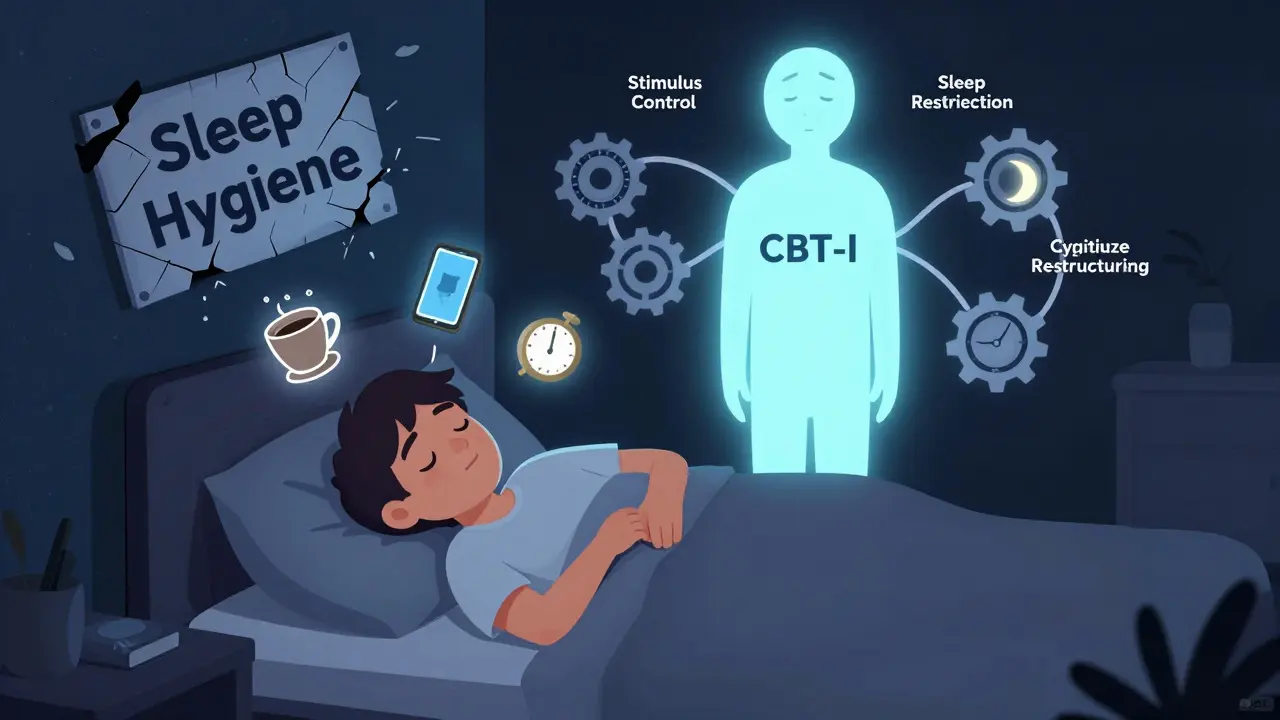
Let’s be honest: if you’ve been lying awake for hours night after night, you’ve probably tried everything. No caffeine after noon. Cool room. Blackout curtains. Warm tea. Meditation apps. Yet here you are again - staring at the ceiling, heart racing, mind spinning. You’re not broken. You’re not lazy. You’re dealing with chronic insomnia, and most of what you’ve been told to do simply doesn’t work long-term.
Chronic insomnia isn’t just bad sleep. It’s defined by the American Academy of Sleep Medicine as trouble falling asleep, staying asleep, or not feeling rested - happening at least three nights a week for three months or more. It’s not a phase. It’s a condition. And the truth? Sleep hygiene alone won’t fix it.
Why Your Sleep Routine Isn’t Working
You’ve heard the advice: avoid screens before bed, keep your bedroom cool, don’t drink coffee after 2 p.m. These are called sleep hygiene tips. They sound sensible. But here’s the hard truth: research shows sleep hygiene alone has only moderate effectiveness. In fact, experts like Dr. Jack D. Edinger say it’s minimally effective for chronic insomnia. That’s not an opinion - it’s backed by clinical trials.
Think of sleep hygiene like cleaning your kitchen. Sure, a clean kitchen helps. But if your fridge is leaking and the pipes are busted, no amount of wiping down counters will fix the flood. That’s what sleep hygiene does for chronic insomnia - it tidies up the surface, but doesn’t fix the core problem.
Studies show that people who only follow sleep hygiene tips rarely see lasting improvement. One 2021 review found that sleep hygiene alone improved sleep efficiency by less than 5%. Meanwhile, people using CBT-I saw gains of 20-30%. That’s not a small difference - it’s the difference between tossing and turning and actually sleeping.
What Is CBT-I? The Only Treatment That Changes Your Brain’s Sleep Pattern
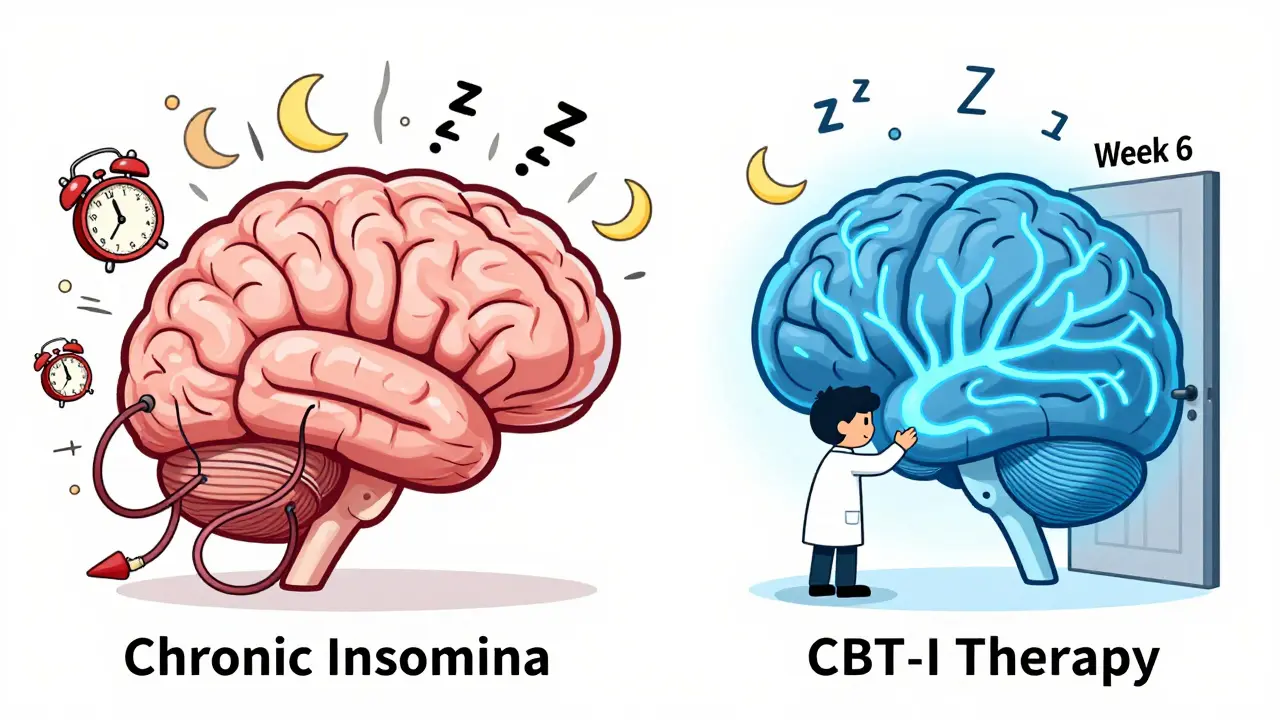
CBT-I stands for Cognitive Behavioral Therapy for Insomnia. It’s not a pill. It’s not a gadget. It’s a structured, evidence-based therapy that rewires how your brain thinks about sleep. Developed over decades and refined through hundreds of clinical trials, it’s now the first-line treatment recommended by the American College of Physicians, the American Academy of Sleep Medicine, and the National Institutes of Health.
Unlike sleeping pills - which work for a few weeks, then lose effectiveness or create dependence - CBT-I changes your long-term sleep behavior. A 2020 meta-analysis found that CBT-I reduced the time it takes to fall asleep by an average of 18.2 minutes and cut nighttime wakefulness by 27.4 minutes. Those gains lasted a full year after treatment ended. Sleep meds? Their effects vanished as soon as people stopped taking them.
CBT-I isn’t one thing - it’s five core strategies working together:
- Stimulus control: Your bed is only for sleep and sex. No reading, no scrolling, no lying there worrying. If you’re not asleep in 15-20 minutes, get up. Go sit in another room. Do something quiet. Come back only when sleepy. This rebuilds the mental link between bed and sleep.
- Sleep restriction: You think you need 8 hours? Maybe not. If you’re only sleeping 5 hours a night, spending 8 hours in bed is training your brain to associate bed with wakefulness. CBT-I cuts your time in bed to match your actual sleep - say, 5 hours. You’ll be tired. Really tired. But that’s the point. It rebuilds your sleep drive. After a few weeks, you slowly add time back in.
- Cognitive restructuring: This tackles the thoughts that keep you awake: “If I don’t sleep 8 hours, I’ll fail at work.” “I’ll never get better.” “Everyone else sleeps fine - why can’t I?” CBT-I helps you challenge these beliefs. A 2019 study showed 65% of patients saw a major drop in sleep-related anxiety after just 6 sessions.
- Relaxation training: Tension is the enemy of sleep. CBT-I teaches breathing techniques, progressive muscle relaxation, and mindfulness to calm your nervous system - not just before bed, but during the day.
- Sleep hygiene: Yes, it’s still part of CBT-I - but only as a small piece. You’ll still avoid caffeine 6 hours before bed, limit alcohol, and keep your room at 65°F (18.3°C). But now, it’s not the main tool. It’s the supporting actor.
The Numbers Don’t Lie: CBT-I Works - Even When Nothing Else Did
Here’s what real people experience:
- A Reddit user wrote: “After 8 weeks of CBT-I, my sleep efficiency jumped from 68% to 89%. I fall asleep in 15 minutes now, not 2 hours.”
- Another said: “The first two weeks of sleep restriction were brutal. I was a zombie. But by week 6, I slept through the night for the first time in years.”
These aren’t outliers. A 2021 JAMA Internal Medicine study tracked 300 people using an online CBT-I program. After 12 weeks, 55% had their insomnia go into remission. Only 17% in the control group did. That’s a 3.5x improvement.
And it works across age groups. Dr. Daniel Buysse’s research shows CBT-I is just as effective for older adults as for younger people. For people over 65, the improvement on the Insomnia Severity Index was as strong as for those in their 30s. That’s huge - because most medications become riskier with age.
Even people with depression, anxiety, or chronic pain see better sleep with CBT-I. That’s because it doesn’t treat sleep as a separate issue - it treats it as part of your whole nervous system.
Why Don’t More People Get CBT-I?
If it’s so effective, why aren’t you seeing it in your doctor’s office?
Here’s the ugly truth: there aren’t enough trained therapists. In the U.S., there are only 0.5 CBT-I-certified professionals per 100,000 people. In rural areas, 78% of counties have no sleep specialist at all. Insurance often covers only 3 of the recommended 6-8 sessions. Many patients quit before they get to the real breakthroughs.
And then there’s the stigma. People think, “If I had a real problem, I’d be on medication.” But CBT-I isn’t a last resort - it’s the first choice. And it’s not just for “mental” insomnia. It works for insomnia caused by chronic pain, menopause, shift work, or even long-term stress.
Thankfully, digital options are filling the gap. Apps like Sleepio and SHUTi are FDA-cleared, clinically proven, and accessible. One 2022 study found 60% of users saw clinically meaningful improvement after just 6 weeks. And they cost less than one month’s supply of sleep meds.
What to Expect - The Real, Unfiltered Experience
CBT-I isn’t magic. It’s hard work. And it’s not linear.
Week 1-2: You’ll feel worse. Sleep restriction means you’re sleep-deprived on purpose. You’ll be tired. Irritable. Maybe even depressed. But this is normal. Your body is recalibrating.
Week 3-4: You start noticing small wins. Maybe you fall asleep in 45 minutes instead of 90. Maybe you wake up once instead of three times. You’ll feel a flicker of hope.
Week 5-8: The real shift happens. Your brain starts to associate bed with sleep again. You stop checking the clock. You stop dreading bedtime. You begin sleeping without effort.
And here’s the kicker: you don’t need to be perfect. Missing a session? Not ideal, but not fatal. Waking up at 3 a.m. one night? That’s okay. CBT-I teaches you to respond differently - not to panic, not to force sleep, but to wait it out.
How to Start - Even If Your Doctor Doesn’t Mention It
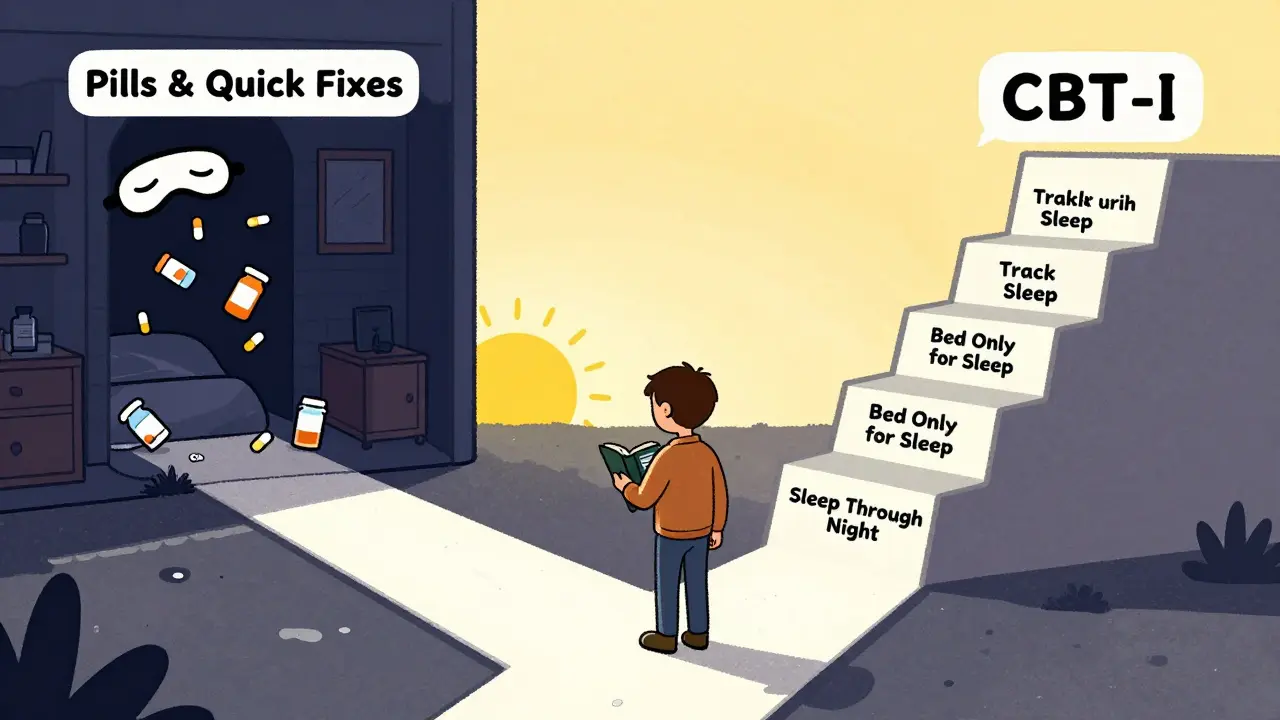
You don’t need a referral to begin. Here’s how to take action:
- Track your sleep for 7-14 days. Use a notebook or app. Note when you get in bed, when you fall asleep, when you wake, and how many times you’re awake. This gives you baseline data.
- Calculate your sleep efficiency. Divide total sleep time by time in bed. Multiply by 100. If you’re at 70% or lower, you’re a candidate for sleep restriction.
- Start stimulus control. No more TV in bed. No phone scrolling. If you’re awake over 20 minutes, get up. Go read in dim light. Return only when sleepy.
- Try a digital CBT-I program. Sleepio, SHUTi, and Somryst are all clinically validated. Many are covered by insurance. Some cost less than $50 for 6 weeks.
- Find a therapist. Search the Society of Behavioral Sleep Medicine’s directory. Look for “CBT-I certified.” Even one session can help you get started.
Don’t wait for perfection. Don’t wait for your doctor to bring it up. You’re already suffering. The solution exists. And it’s not another pill.
The Future of Sleep: Why CBT-I Will Be the Standard
By 2030, experts predict CBT-I will be the standard treatment for 90% of chronic insomnia cases. That’s not speculation - it’s based on the data. The FDA has already cleared digital CBT-I apps. Major employers like 37% of Fortune 500 companies now offer it as part of health benefits. Wearables like Fitbit are starting to integrate CBT-I principles into their sleep tracking.
Pharmaceutical companies are shifting too. New sleep drugs are being developed not as replacements for CBT-I, but as short-term bridges - used only while someone starts therapy.
And the evidence keeps growing. A 2023 Lancet commentary called CBT-I “the most effective non-pharmacological intervention in all of sleep medicine.”
So if you’re tired of chasing sleep - and tired of being told to just “relax” - here’s the real message: you don’t need to relax. You need to retrain.
Chronic insomnia isn’t a failure of willpower. It’s a learned pattern. And like any learned pattern, it can be unlearned.
Is sleep hygiene useless for chronic insomnia?
No, sleep hygiene isn’t useless - but it’s not enough on its own. Studies show it improves sleep by less than 5% when used alone. It’s meant to support CBT-I, not replace it. Experts like Dr. Jack D. Edinger warn that offering sleep hygiene as a standalone treatment gives people false hope. Think of it like brushing your teeth: important, but won’t fix a cavity.
Can I do CBT-I on my own without a therapist?
Yes - and many people do. FDA-cleared digital programs like Sleepio, SHUTi, and Somryst have been tested in clinical trials and show 50-60% success rates. These programs guide you through all five components of CBT-I with structured lessons, tracking tools, and feedback. You don’t need a therapist to get results - though having one can improve adherence and outcomes.
How long does CBT-I take to work?
Most people notice small improvements in 2-4 weeks. The real changes happen between weeks 6 and 12. Sleep restriction, for example, often makes sleep worse before it gets better. Stick with it. The average person sees a 70-80% improvement in sleep quality by the end of an 8-week program. Results last - unlike medication.
Why is CBT-I better than sleeping pills?
Sleeping pills work for a few weeks, then lose effectiveness. They can cause dependence, memory issues, and next-day grogginess. CBT-I doesn’t just mask symptoms - it changes how your brain responds to sleep. A 2020 meta-analysis found CBT-I reduced sleep onset latency by 18.2 minutes and wake after sleep onset by 27.4 minutes - and those gains lasted over a year. Medication effects vanished after stopping.
Is CBT-I covered by insurance?
Some plans cover it - especially if delivered by a licensed therapist. Many digital programs are now covered under mental health benefits. Check with your insurer. If not covered, programs like Sleepio cost around $40-$80 for a full course - far less than months of prescriptions. Some employers offer it free through wellness programs.
Chronic insomnia doesn’t have to be your life. You don’t need to accept it. The science is clear. The tools exist. And the path - though not easy - is well-trodden. Start with one step. Track your sleep. Try one CBT-I principle. And remember: you’re not failing sleep. Sleep has been failing you. It’s time to take it back.

10 Comments

Ian Kiplagat
Been there. Tried everything. CBT-I was the game-changer. Not easy, but worth every sleep-deprived minute. 🙌

Amina Aminkhuslen
Ugh. People still think ‘just relax’ fixes this? 🤦♀️ Sleep hygiene is like putting a bandaid on a broken leg. CBT-I is the damn surgery. Why is this still not standard??

amber carrillo
I appreciate how clearly this breaks down the science. For anyone struggling, please know you’re not alone. Progress isn’t linear, but it’s real. You’ve got this.

Tim Hnatko
I started CBT-I six months ago. Week 2 was brutal. I cried. I thought I’d failed. But by week 10? I slept through the night. Twice. It’s not magic. It’s muscle memory for your brain. And yeah, it’s harder than popping a pill. But it lasts.

Aaron Pace
Wait, so you’re saying I should get up at 3 a.m. and sit in the living room?? 😅 I tried that once and ended up eating a whole pizza. My brain now thinks bed = snack time. Help?? 🍕

Joey Pearson
You’re not broken. You’re just stuck in a loop. CBT-I rewires that. One step. One night. One less clock-check. You’re doing better than you think.

Roland Silber
There’s a myth that CBT-I is only for ‘psychological’ insomnia. Not true. My chronic pain made sleep impossible. CBT-I didn’t fix the pain. But it stopped my brain from screaming ‘YOU’LL NEVER SLEEP’ every time I lay down. That’s half the battle.

Adebayo Muhammad
Let’s be real: this is just another capitalist solution to a systemic problem. You’re being sold a $80 app while healthcare remains broken. Who benefits? The sleep-tech industrial complex. And what about those without Wi-Fi? Or stable housing? Or basic mental healthcare? This isn’t empowerment-it’s privilege wrapped in clinical jargon.

Bridget Verwey
Wow. Someone actually wrote a novel about insomnia and didn’t say ‘just meditate.’ 🙏 I’m so tired of being told to ‘breathe’ while my heart hammers like a drumline. CBT-I > vibes. I did the digital program. It sucked. Then I slept. For real. You’re not lazy. You’re just misinformed.

Joe Prism
It’s not about sleep. It’s about safety. Your brain won’t let you rest if it thinks the world is dangerous. CBT-I doesn’t just change habits-it rebuilds trust. Between you. And your bed.



Write a comment