Cough and Cold Medicine Safety for All Ages: What Actually Works and What to Avoid
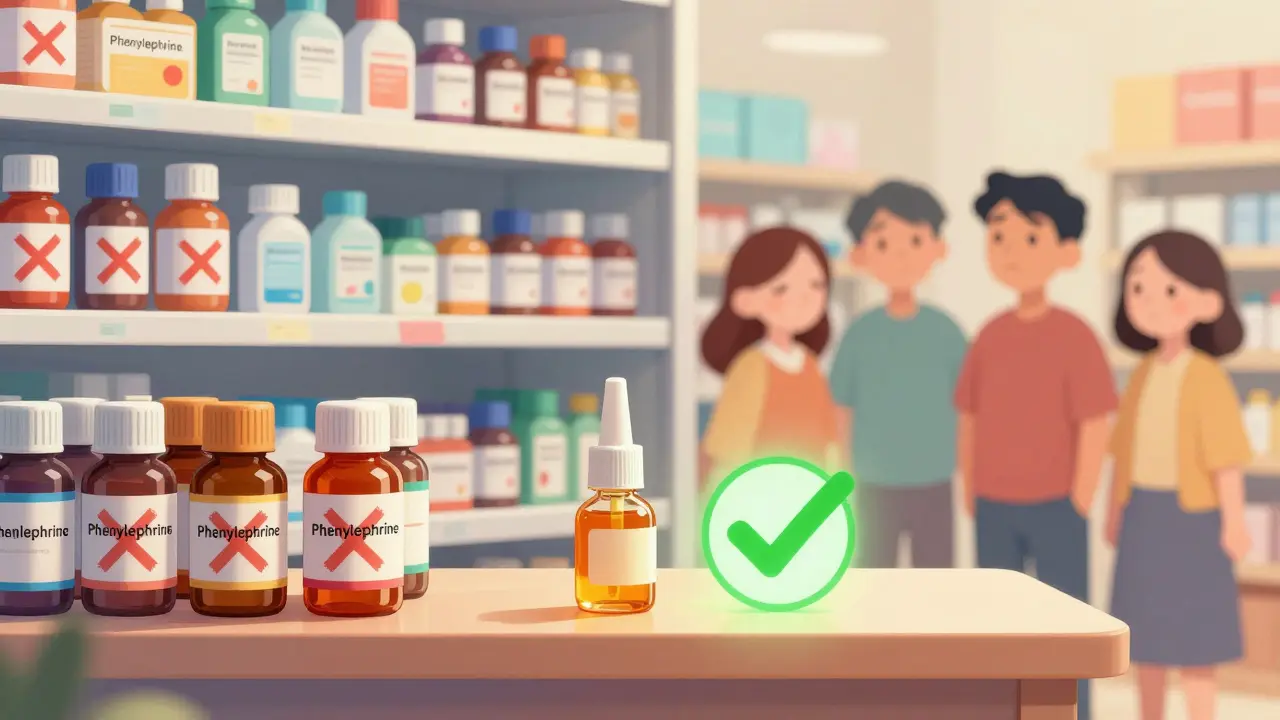
Every winter, millions of people reach for OTC cough and cold medicines thinking they’ll feel better faster. But what if most of those bottles on the shelf don’t actually work-and some might even be risky? The truth is, the science behind many common cold remedies has changed dramatically in the last few years. What was once considered harmless relief is now under serious scrutiny by health regulators and doctors alike.
Oral Phenylephrine Doesn’t Work-And It’s Still Everywhere
Look at any shelf in the pharmacy. Chances are, you’ll see phenylephrine listed as the main decongestant in products like Sudafed PE, DayQuil, and Robitussin Cold. It’s in over 100 brands. But here’s the problem: it doesn’t work.
In September 2023, the FDA’s expert panel reviewed decades of clinical data and concluded that oral phenylephrine (the kind you swallow in pills or syrup) at the standard 10mg dose has no meaningful effect on nasal congestion. Not even close. A 2007 study found it performed no better than a sugar pill. Even at higher doses-doses not sold to the public-it only reduced congestion by about 28%, and patients didn’t even feel better.
So why is it still in stores? Because the FDA hasn’t pulled it yet. They’ve proposed removing it from the list of approved OTC ingredients, but the final decision won’t come until mid-2024. Manufacturers have until late 2025 to reformulate. Until then, you’re paying for placebo. And you’re not alone-consumer reviews on Amazon for phenylephrine products have dropped from 4.1 stars in 2020 to just 3.2 stars today. People are noticing. They’re frustrated. And they’re spending money on something that does nothing.
What About Dextromethorphan and Guaifenesin?
Then there’s dextromethorphan (DXM), the cough suppressant in NyQuil, Robitussin, and many others. It’s supposed to quiet a cough. But a 2014 review of 29 clinical trials found no consistent proof it works better than nothing for acute coughs. The same goes for guaifenesin, the expectorant meant to thin mucus. Studies show it doesn’t speed up recovery or make breathing easier in any meaningful way.
And here’s the kicker: these ingredients are often mixed together in multi-symptom products. That means you’re not just taking something useless-you’re taking a cocktail of ineffective drugs. And that increases your risk of accidental overdose, especially if you’re also taking a pain reliever like acetaminophen. Many cold medicines already contain it. Take two products? You could hit a toxic dose without realizing it.
Children Under 6: Don’t Give Them OTC Cold Medicine
If you have a toddler or preschooler with a cold, the safest thing you can do is not give them any OTC cough or cold medicine. Period.
The FDA has warned since 2008 that these products shouldn’t be used in children under 2. In 2023, that warning was expanded to include kids under 6. Why? Because there’s zero proof they help-and plenty of proof they hurt.
Between 2000 and 2007, 20 children in the U.S. died after ingesting OTC cold medicines. Thirteen of them were under two. Side effects include rapid heart rate, seizures, and even coma. Even when no death occurs, kids can get agitated, dizzy, or vomit. The American Academy of Pediatrics says the risks far outweigh any imagined benefits.
Parents are catching on. A survey from What to Expect found 73% of parents have stopped giving OTC cold medicine to kids under 6. And they’re not just stopping-they’re switching to safer, proven alternatives.
What Actually Works? Honey, Saline, and Humid Air
There’s a quiet revolution happening in cold care. It’s not in pharmacies. It’s in kitchens and medicine cabinets.
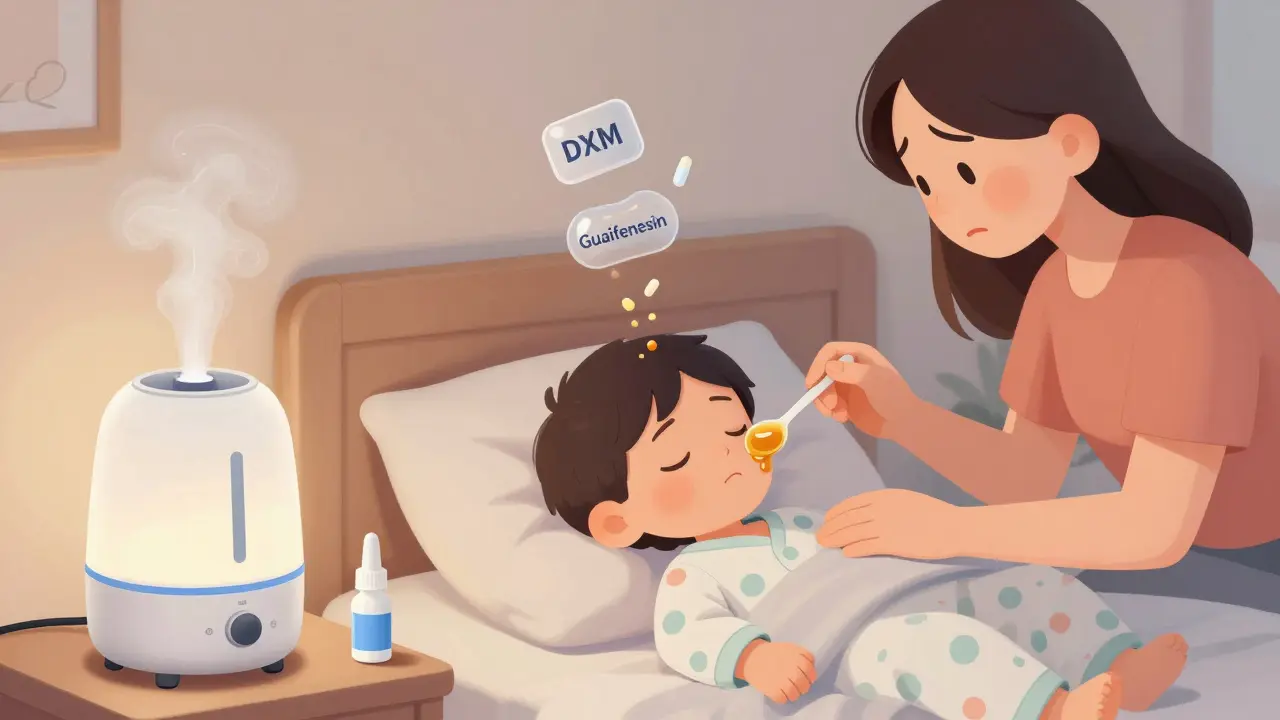
Honey is now the gold standard for cough relief in children over 12 months. A 2023 study from the American Medical Association found that a half-teaspoon of honey before bed reduced nighttime coughing as well as, or better than, dextromethorphan. And it’s safe. It’s cheap. And you probably already have it.
For nasal congestion, saline nose drops and a bulb syringe work better than any decongestant. They loosen mucus without chemicals. For babies, this is the only safe way to clear their noses. For adults, a saline spray is gentler than sprays with drugs and doesn’t cause rebound congestion.
Humidified air helps too. A cool-mist humidifier in the bedroom keeps the air moist, which soothes irritated throats and loosens mucus. No drugs. No side effects. Just relief.
And don’t forget fluids. Drinking water, broth, or warm tea keeps you hydrated and helps thin secretions. It’s simple, but it’s science-backed.
Pseudoephedrine: The Real Decongestant (But It’s Harder to Get)
If you need a decongestant that actually works, look for pseudoephedrine. It’s in Sudafed (not Sudafed PE), and it’s proven to reduce nasal swelling. But you won’t find it on the shelf. You have to ask the pharmacist, show ID, and sign a logbook. Why? Because it’s used to make methamphetamine.
But here’s the upside: it works. And users notice. On Amazon, products with pseudoephedrine get 68% of positive reviews mentioning “actual congestion relief.” Only 22% of phenylephrine products get that same praise.
If you’re okay with the extra step, pseudoephedrine is your best bet. Just don’t take it if you have high blood pressure, heart problems, or are on certain antidepressants. It can spike your blood pressure dangerously.
What to Do Instead: A Simple Action Plan
You don’t need a pharmacy full of bottles. Here’s what to do, by age:
- Babies under 1 year: Saline drops + bulb suction. Humidifier. Lots of fluids. No medicine.
- Children 1-5 years: Honey (2.5 mL before bed). Saline spray. Humidifier. Avoid all OTC cough/cold meds.
- Children 6-12 years: Honey if coughing at night. Saline spray. Rest and fluids. Only use single-ingredient medicines if absolutely needed-and only after checking with a doctor.
- Adults: Skip phenylephrine. Try pseudoephedrine if you can get it. Use honey for cough. Saline spray for congestion. Rest. Hydrate.
And always, always read the Drug Facts label. Look for active ingredients. Don’t take two products with the same one. Acetaminophen, dextromethorphan, and antihistamines are common in multiple formulas. Overdosing on any of them is easy-and dangerous.
The Future of Cold Care Is Simpler
The OTC cold medicine market is worth over $6 billion in the U.S. But that’s starting to crack. The FDA’s move to remove phenylephrine is the biggest shake-up since phenylpropanolamine was banned in 2000 after causing strokes.
By 2026, analysts expect 25% of cold remedy sales to shift toward honey, saline, and steam-based solutions. Sales of these alternatives are growing at over 12% a year. People are tired of wasting money. They’re tired of risking side effects for no benefit.
The real win? You don’t need a prescription. You don’t need a pharmacy. You just need to know what works-and what doesn’t.
Next time you’re sick, skip the shelf full of colorful bottles. Go straight to your kitchen. Grab the honey. Fill the humidifier. Use the saline spray. Rest. You’ll feel better-and you won’t be taking a single useless pill.
Is phenylephrine dangerous?
Phenylephrine at the standard 10mg dose isn’t dangerous-it just doesn’t work. It won’t cause serious side effects at recommended levels. But it’s a waste of money. Higher doses, which aren’t sold over the counter, can raise blood pressure and cause heart rhythm issues. The bigger risk is believing it works and delaying better care.
Can I give my 3-year-old cough medicine?
No. The FDA and the American Academy of Pediatrics strongly advise against giving any OTC cough or cold medicine to children under 6. These products don’t help and can cause serious side effects like rapid heart rate, seizures, or even coma. Use honey (if they’re over 12 months), saline drops, and a humidifier instead.
What’s the best OTC cold medicine for adults?
There’s no single best product, but the best ingredients are: pseudoephedrine for congestion (if you can get it), honey for cough, and saline spray for nasal relief. Avoid multi-symptom formulas-they often include useless or overlapping ingredients. Stick to single-ingredient options and only use what you need.
Are natural remedies like echinacea or zinc effective?
There’s no strong evidence that echinacea, zinc lozenges, or vitamin C prevent or shorten colds in most people. Some studies show tiny benefits, but they’re inconsistent and often not clinically meaningful. Honey and saline are proven. Stick with those.
Why do pharmacies still sell these ineffective medicines?
Because they’re still legal-and profitable. The FDA proposed removing phenylephrine in 2023, but the process takes time. Manufacturers have until 2025 to reformulate. Until then, they keep selling. Consumer demand is also high. People want something to do when they’re sick, even if it doesn’t work. That’s why education matters.
Can I use OTC cold medicine if I’m on other medications?
Be very careful. Many OTC cold medicines interact with antidepressants, blood pressure meds, and MAO inhibitors. Decongestants like pseudoephedrine can raise blood pressure dangerously if taken with certain drugs. Always check with a pharmacist before mixing OTC meds with prescriptions.

15 Comments

Glenda Marínez Granados
So we’re telling people to skip the pharmacy and go straight to the honey jar like we’re living in 1820? 🤦♀️
Meanwhile, Big Pharma is just sitting there sipping their $800 coffee, laughing all the way to the bank.
At least when you buy a bottle labeled ‘Cough-X’, you get a *feeling* that you’re doing something. Even if it’s just placebo. Even if it’s just vibes.
Science says honey works? Cool. But I still want the colorful bottle with the cartoon germs screaming ‘I’M BEATEN!’
Also, why does every ‘natural remedy’ sound like a yoga retreat ad? ‘Breathe in the earth’s essence, dear one…’
Meanwhile, my 3-year-old is coughing like a chainsaw and I’m Googling ‘how to make honey less sticky.’
It’s not about efficacy. It’s about ritual.
We’re not treating colds-we’re performing grief.
And if I don’t give my kid *something*, I feel like a bad parent.
Even if that something is just sugar water with a fancy label.
So yeah, phenylephrine doesn’t work.
But neither does guilt.
And I’m out here buying both.
😂

Yuri Hyuga
This is one of the most important public health pieces I’ve read in years. 🙌
Thank you for cutting through the noise and delivering clarity with compassion.
Too many of us have been misled by marketing, not medicine.
The shift from chemical cocktails to simple, proven remedies isn’t regression-it’s evolution.
Honey for cough? Yes. Saline for congestion? Absolutely.
Humidifiers? Lifesavers for babies and adults alike.
We need more of this-no hype, no profit motive, just science and sanity.
Let’s stop normalizing the unnecessary.
Let’s empower people with knowledge, not bottles.
And let’s stop pretending that ‘more ingredients’ means ‘better results.’
Real health is often quiet, humble, and found in your kitchen.
Bravo to the author-and to every parent who’s already made this switch.
You’re not just healing your child-you’re redefining care.
👏🌍

MARILYN ONEILL
OMG I KNEW IT.
I told my sister last week, ‘Honey is the only thing that works.’
And now science says it? DUH.
Why do we even have pharmacies if we’re just gonna use kitchen stuff?
Also, phenylephrine? I’ve been saying that for YEARS.
It’s a scam.
And don’t get me started on those ‘multi-symptom’ bottles.
It’s like buying a car that has a radio, AC, and GPS… but the engine doesn’t work.
And kids under 6? My niece got hospitalized once because her mom gave her ‘just a little’ NyQuil.
So yeah.
Don’t be that mom.
And stop spending $15 on sugar water.
😂

Coral Bosley
I’ve been sick for three weeks.
Three.
Weeks.
I took every single one of those bottles.
Every. Single. One.
And I felt worse.
Not because of the medicine-because of the *hope*.
Hope that this time, it would work.
Hope that the label meant something.
Hope that if I took enough, I’d wake up normal.
But I didn’t.
I just got dizzy.
And nauseous.
And guilty.
Because I thought I was doing the right thing.
And now I’m sitting here, staring at a jar of honey like it’s a miracle.
And maybe it is.
Maybe the real drug was never in the bottle.
Maybe it was in the quiet.
And the rest.
And the tea.
And the tears.
And the fact that I finally stopped fighting my body.
And just… let it be sick.
And now I’m crying.
Because I’m not mad.
I’m just… tired.
Of being lied to.
By companies.
By doctors.
By myself.
💔

Steve Hesketh
Brothers and sisters, I see you.
You’re tired. You’re overwhelmed. You’re trying to do the right thing.
And this post? It’s not just information-it’s liberation.
You don’t need to be a scientist to know what’s real.
Honey? Free. Safe. Delicious.
Saline spray? Under $5. Works like magic.
Humidifier? A little investment, but your sinuses will thank you for decades.
And pseudoephedrine? Yeah, it’s a pain to get-but it’s the real deal.
Don’t let the system make you feel dumb for not knowing this.
You’re not lazy.
You’re not naive.
You were just sold a lie.
Now you know.
And now you’re free.
Go hug your kid.
Give them honey.
Turn on the humidifier.
And breathe.
You’ve got this.
❤️

shubham rathee
i think the fda is being controlled by big pharma and they just want to keep selling useless stuff so people keep buying it and then when they get worse they go to the doctor and get more pills and then the cycle continues and also i think the honey thing is just a distraction because if you really think about it the real problem is that we live in a polluted world and our immune systems are broken and we need to stop eating processed food and start meditating and maybe the government is hiding the cure for colds because it would make them lose money on antibiotics and vaccines and also i read somewhere that colds are caused by 5g signals so maybe the humidifier is just a placebo for the real issue which is electromagnetic warfare and also i think phenylephrine works if you take it with lemon juice and i dont trust anything the fda says because they approved aspartame and that kills people and also my cousin took phenylephrine and his hair turned green so i think its a mind control thing

Kevin Narvaes
So we’re supposed to believe honey is better than science?
That’s wild.
Like… what’s next?
Chewing on garlic for pneumonia?
Wearing a tin foil hat to block the flu?
And why is everyone acting like this is new info?
I’ve been telling my friends for years: skip the shelf.
But now it’s ‘science says’ so it’s legit?
That’s the problem.
We don’t trust our own experience.
We need a lab report to believe our grandma’s advice.
And now we’re supposed to feel smart for using honey?
It’s not wisdom.
It’s just… retro.
And also, pseudoephedrine? Yeah, I get it.
But I don’t wanna show ID to a pharmacist like I’m buying ammo.
So I’ll just keep buying the placebo.
At least it makes me feel like I’m trying.
🤷♂️

Alex Carletti Gouvea
Why are we letting a bunch of scientists tell us what to do?
My grandpa used to say, ‘If it’s in a bottle, it’s for sale.’
And he was right.
But now we’re supposed to trust honey because some study says so?
What’s next? Drinking vinegar for cancer?
And why is everyone acting like this is a revelation?
People have been using honey for coughs since before the U.S. was a country.
So why is this suddenly ‘science’?
Because it’s profitable to sell it as new.
Meanwhile, real medicine-like rest, fluids, sleep-is free.
And it’s always worked.
But you can’t sell that on TV.
So we get pills.
And we pay.
And we feel stupid.
And then we blame ourselves.
Not the system.
Not the ads.
Just us.
Classic.
🇺🇸

Ben McKibbin
This is exactly the kind of calm, evidence-based clarity we need in a world drowning in noise.
It’s not about rejecting medicine-it’s about rejecting *misinformation*.
Phenylephrine isn’t dangerous-it’s just a waste.
And that’s a subtle but critical distinction.
We’re not being asked to return to the Stone Age.
We’re being asked to return to *common sense*.
Honey isn’t a ‘natural remedy’-it’s a *proven* cough suppressant.
Saline isn’t ‘alternative’-it’s *physiologically appropriate*.
And pseudoephedrine? It’s not ‘hard to get’-it’s *regulated*, which is a feature, not a bug.
The real tragedy isn’t that we’re using ineffective drugs.
It’s that we’ve forgotten how to trust our own bodies.
Rest. Hydrate. Breathe.
These aren’t hacks.
They’re fundamentals.
And they’ve always worked.
Thank you for reminding us.
👏

Rod Wheatley
Okay, I need to say this: YOU ARE NOT ALONE.
If you’ve ever bought a cold medicine and thought, ‘Wait… I don’t feel any better…’-you’re not crazy.
It’s not you. It’s the system.
And now you know the truth.
So here’s your action plan:
1. Go to your kitchen right now.
2. Find the honey.
3. Put a spoonful in a cup of warm tea.
4. Sit down.
5. Breathe.
6. Don’t reach for the bottle.
7. Repeat tomorrow.
That’s it.
You don’t need more.
You don’t need fancy.
You just need patience.
And maybe a humidifier.
And a little bit of trust-in yourself, in nature, in time.
You’ve got this.
I believe in you.
And I’m rooting for you.
❤️🫂

Malvina Tomja
Let me be blunt.
You people are ridiculous.
Honey? For a cough? That’s like using a Band-Aid on a bullet wound.
And you’re calling this ‘science’?
It’s anecdote wrapped in a bow.
Meanwhile, the FDA is trying to remove a useless ingredient-and you’re celebrating like it’s the moon landing.
But you still won’t read the label.
You still won’t check for acetaminophen.
You still won’t stop mixing three different ‘cold remedies’ because ‘they all help.’
And you wonder why kids end up in the ER?
It’s not the medicine.
It’s the *ignorance*.
And now you’re glorifying honey like it’s a miracle cure?
It’s sugar.
With a story.
And you’re buying it.
Again.
Because you’d rather feel like a ‘natural parent’ than actually learn what works.
Pathetic.
And yes-I’m judging you.
Because someone has to.
💅

Samuel Mendoza
Honey doesn’t work.
It’s sugar.
And you’re all being manipulated.
Phenylephrine is fine.
It’s just not as strong as pseudoephedrine.
Big deal.
And why are you telling parents to skip medicine?
Because you think you’re smarter?
Newsflash: kids get worse.
And when they do, you’ll be the one Googling ‘when to go to ER.’
Stop pretending you know better.
You don’t.
And you’re risking lives.
Just buy the damn bottle.
It’s easier.
And you’ll sleep better.
At least until the next ‘revolution.’
🙄

MAHENDRA MEGHWAL
Thank you for this comprehensive and meticulously researched exposition.
It is indeed a matter of profound public health significance that the pharmacological landscape has been so thoroughly saturated with agents lacking demonstrable efficacy.
The regulatory inertia surrounding phenylephrine is emblematic of systemic dysfunction in consumer health governance.
Conversely, the re-emergence of evidence-supported, low-intervention modalities-honey, saline irrigation, and environmental humidification-represents not regression, but epistemic maturation.
It is a return to the primacy of physiological principles over commercial expediency.
One must also acknowledge the cultural dimension: the psychological comfort derived from ritualistic ingestion, however inert, is not negligible in the context of subjective illness experience.
Nevertheless, the imperative remains: prioritize safety, efficacy, and simplicity.
Let us not confuse the aesthetics of pharmaceutical packaging with therapeutic validity.
With due respect to all stakeholders, the path forward is clear.
And it is humble.
And it is right.
🙏

Dee Monroe
I’ve been thinking about this a lot lately.
Not just about cold medicine.
But about how we treat ourselves when we’re broken.
We’re taught to fix things.
To solve.
To take something.
To push through.
But what if healing isn’t about doing more?
What if it’s about letting go?
Honey doesn’t cure a cough.
It just makes it bearable.
Saline doesn’t kill germs.
It just lets you breathe.
Humid air doesn’t fight the virus.
It just gives your body space to do its job.
And maybe… that’s enough.
Maybe we don’t need to conquer sickness.
Maybe we just need to sit with it.
Rest with it.
Hold it gently.
Like a baby.
Like a friend.
Like something that doesn’t need to be fixed.
Just held.
And maybe… that’s the real medicine.
Not in a bottle.
But in the quiet.
And the care.
And the patience.
And the love.
That’s what I’m choosing now.
Not because science says so.
But because my soul finally whispered it.
💛
Ben McKibbin
Just read the comment above mine.
And I want to say: that’s exactly it.
Not the honey.
Not the saline.
But the *presence*.
The willingness to stop fighting and start caring.
That’s what’s missing.
We treat illness like an enemy to defeat.
But what if it’s just a signal?
A sign that we’ve been running too hard?
That we need to slow down?
That we need to be held?
Maybe the real ‘cure’ isn’t in the kitchen.
It’s in the pause.
And the permission.
To rest.
Without guilt.
Without shame.
Without buying anything.
Just… being.
Thank you, Dee.
That’s the truth.
And it’s beautiful.
❤️


Write a comment