Carbamazepine and Oral Contraceptives: Why Breakthrough Bleeding Means Your Birth Control May Be Failing
Birth Control Failure Risk Calculator
How Carbamazepine Affects Your Birth Control
Carbamazepine increases your risk of unintended pregnancy by accelerating the breakdown of birth control hormones. Your actual risk depends on your method and whether you're experiencing breakthrough bleeding.
Input Your Details
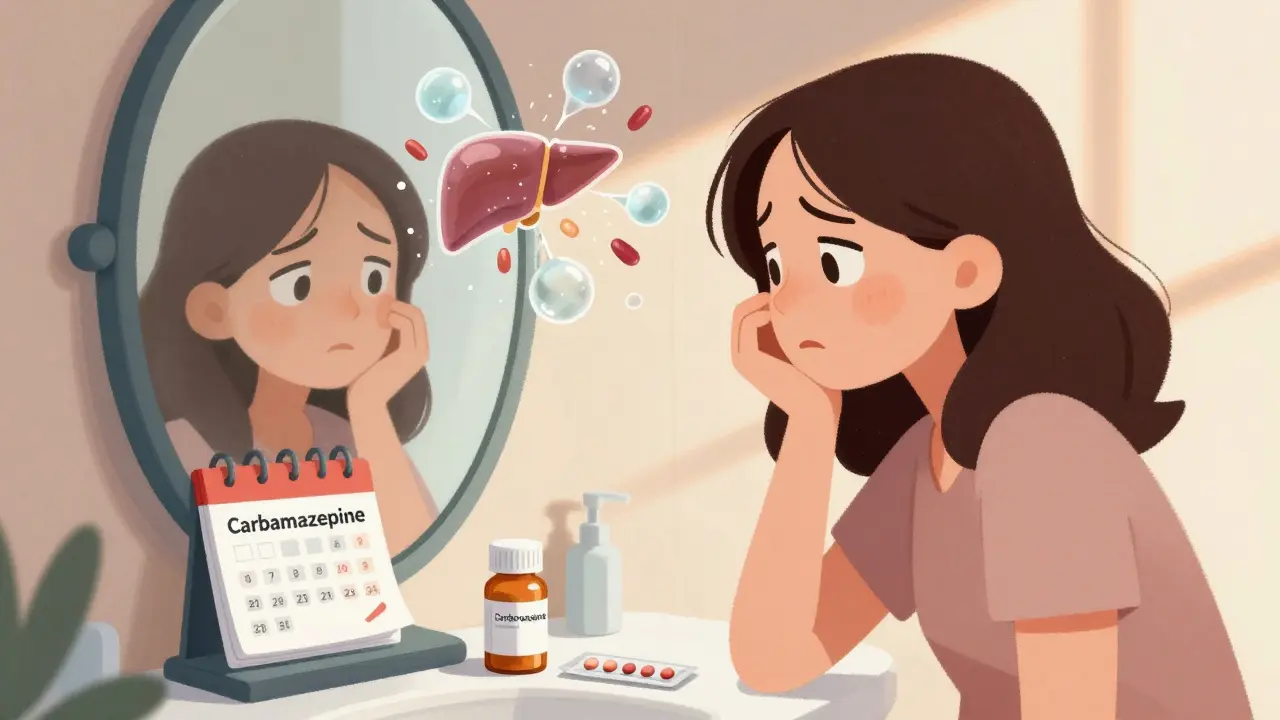
Imagine you’ve been taking your birth control pill every day without missing one. You’re careful. You’re consistent. Then, out of nowhere, you start spotting between periods. You think it’s just stress, or maybe your body’s adjusting. But what if that bleeding isn’t just a nuisance-it’s a red flag that your birth control isn’t working at all?
If you’re taking carbamazepine for epilepsy or nerve pain, that breakthrough bleeding could be the first sign your contraceptive is failing. Carbamazepine-sold under brand names like Tegretol, Carbatrol, and Equetro-doesn’t just treat seizures. It also messes with how your body processes hormones. And that can turn a 99% effective birth control method into one with a 25% chance of failure.
How Carbamazepine Breaks Down Your Birth Control
Carbamazepine is an enzyme inducer. That means it wakes up your liver enzymes-specifically CYP3A4-and tells them to work overtime. These enzymes are supposed to break down toxins. But they don’t know the difference between a toxin and your birth control hormones. So when you take carbamazepine, your liver starts chewing up ethinyl estradiol and progestins like they’re garbage.
Studies show this isn’t theoretical. In one 1987 trial, women taking carbamazepine saw their ethinyl estradiol levels drop by 42%. Progestin levels fell by 40%. That’s not a small dip. That’s below the threshold needed to stop ovulation. Your body thinks it’s not getting enough hormone. So it ovulates anyway.
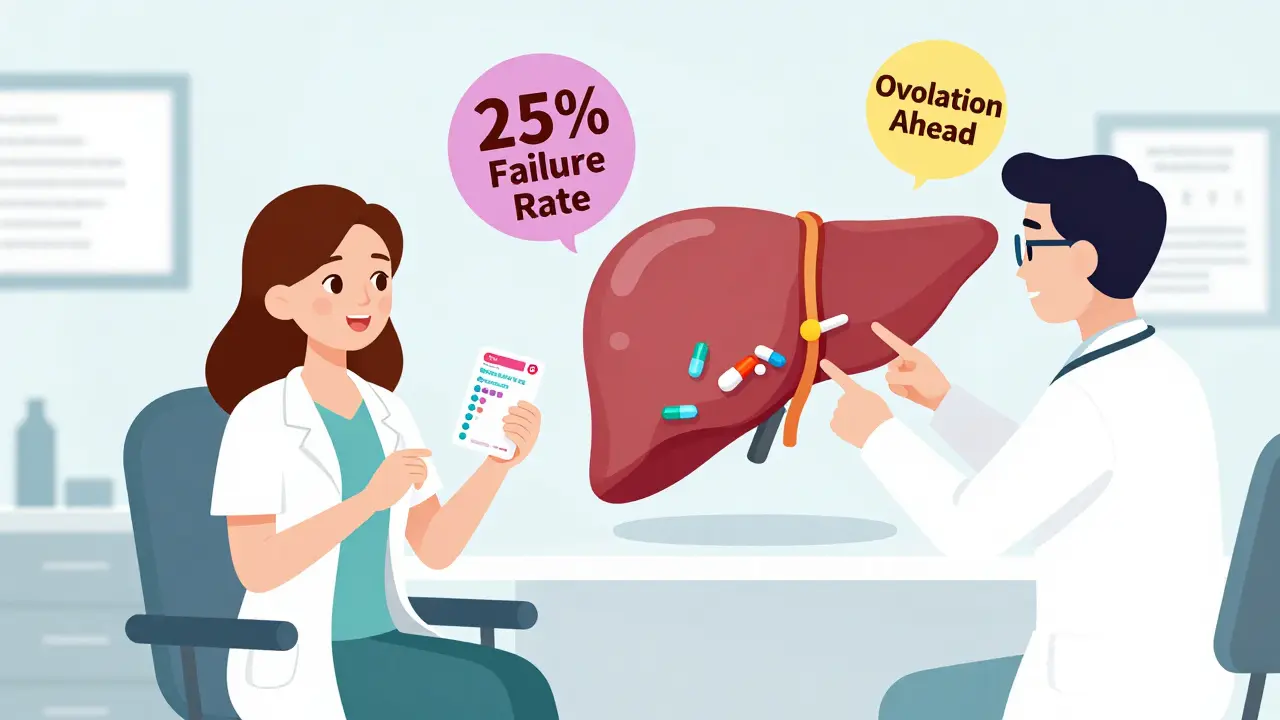
Even if you take your pill perfectly, the numbers don’t lie. The typical failure rate for oral contraceptives is about 7%. With carbamazepine? That jumps to 20-30% per year. That’s one in five women getting pregnant-not because they forgot a pill, but because the pill stopped working inside their body.
Breakthrough Bleeding Isn’t Just an Annoyance-It’s a Warning Sign
Spotting between periods? It’s common. But when you’re on carbamazepine, it’s not normal. It’s a signal. Around 25-35% of women on hormonal birth control while taking carbamazepine report breakthrough bleeding. That’s not random. It’s the lining of your uterus destabilizing because hormone levels are too low to hold it together.
And here’s the dangerous part: absence of bleeding doesn’t mean safety. Just because you’re not spotting doesn’t mean you’re not ovulating. The body doesn’t always scream before it fails. Some women get pregnant without any warning signs at all.
One woman on Reddit shared her story: ‘I was on 1000mg Tegretol daily and got pregnant on Loestrin despite never missing a pill.’ Her neurologist never warned her. She wasn’t careless. She was uninformed. And she’s not alone. A 2021 survey from the Cleveland Clinic found that 72% of women prescribed carbamazepine received no counseling about birth control risks.
Why Higher-Dose Pills Won’t Save You
You might think: ‘If low doses don’t work, what if I switch to a higher-dose pill?’ Some doctors have tried this. Pills with 50 mcg of ethinyl estradiol instead of 30-35 mcg. But here’s the catch: doubling the estrogen doesn’t double protection. It doubles the risk.
Carbamazepine already increases your chance of blood clots. Add more estrogen, and that risk jumps by 2.5 times. For women over 35, smokers, or anyone with a history of clotting, the danger becomes severe. The American Academy of Neurology says this approach is unsafe-and they mean it. The risk of venous thromboembolism goes up 4.3-fold. That’s not worth it for a contraceptive that still might not work.
There’s no magic pill dose that overcomes carbamazepine’s enzyme induction. The math doesn’t add up. And pushing estrogen higher doesn’t fix the problem-it just adds new ones.
What Actually Works: The Real Alternatives
If your birth control pill is unreliable with carbamazepine, what should you use instead? The answer isn’t complicated: go non-hormonal or non-metabolized.
- Copper IUD (Paragard): 99.2% effective. No hormones. No interaction. Lasts up to 10 years. This is the gold standard. It works whether you’re on carbamazepine, phenytoin, or topiramate.
- Hormonal IUD (Mirena, Kyleena, Liletta): Releases progestin directly into the uterus. Less than 0.1% failure rate. Your liver barely touches the hormone, so carbamazepine can’t break it down. Works for up to 5-8 years depending on the brand.
- Contraceptive implant (Nexplanon): A tiny rod placed under your skin. Releases etonogestrel slowly. Also under 0.1% failure rate. Not affected by liver enzymes.
- Depo-Provera shot: The monthly or quarterly injection of medroxyprogesterone. Still effective with carbamazepine. Failure rate stays below 1%.
Even the patch-applied weekly-has a better shot than the pill. Because it delivers hormones through the skin, it avoids the first-pass liver metabolism. But it’s still reduced by 20-25%. Not ideal. But better than nothing if you can’t get an IUD.
And what about the mini-pill? Skip it. Progestin-only pills are just as vulnerable to enzyme induction. They’re not safer-they’re just less effective.
Why This Matters Beyond Pregnancy
Carbamazepine isn’t just a problem for birth control. It’s a problem for babies.
If you get pregnant while on carbamazepine, your baby’s risk of neural tube defects-like spina bifida-goes from 0.1% in the general population to about 1%. That’s a tenfold increase. That’s not rare. That’s preventable.
And here’s the kicker: most women don’t know this. They’re told, ‘Take your seizure meds.’ But no one says, ‘Your birth control won’t work. And if you get pregnant, your baby could be born with a serious defect.’
That’s why the Cleveland Clinic now recommends that women on carbamazepine use at least two forms of contraception-one hormonal and one non-hormonal-like an IUD plus condoms. Not because condoms are the main defense. But because they’re a backup when things go wrong.

What to Do Right Now
If you’re on carbamazepine and using birth control pills, patches, or rings:
- Don’t panic. But don’t wait.
- Check your last period. If you’ve had breakthrough bleeding, you’re already at higher risk.
- Call your doctor or gynecologist. Ask: ‘Is my birth control safe with carbamazepine?’ Don’t accept a vague answer. Ask for specifics.
- Request a copper IUD or hormonal IUD. These are the only methods proven to work reliably.
- If you can’t get an IUD yet, use condoms every time. No exceptions.
And if you’re thinking about switching your seizure medication? Talk to your neurologist. Newer drugs like lacosamide (Vimpat) and brivaracetam (Briviact) don’t interfere with birth control. They’re not perfect for everyone-but for women who need both seizure control and reliable contraception, they’re worth exploring.
What Patients Are Saying
On MyEpilepsyTeam, 65% of women reported breakthrough bleeding within three months of starting carbamazepine. Nearly 40% had an unintended pregnancy-even when they never missed a pill.
But those who switched to IUDs? 98% said they felt safe. No more anxiety. No more spotting. No more wondering if today’s pill was enough.
The problem isn’t the drugs. It’s the silence. The lack of warning. The assumption that if you’re taking your pill, you’re protected. That’s not true. And it’s time we stopped pretending it is.

15 Comments

Michelle M
Spotting isn't just annoying-it's your body screaming that the pill isn't doing its job. I was on carbamazepine for years and never knew this. No one told me. I got pregnant on Loestrin. Perfect pill habits. Zero luck. The system failed me, not me.

Melissa Taylor
This is exactly why we need better patient education. Not everyone has a neurologist who doubles as a gynecologist. If you're on carbamazepine, assume your pill is broken until proven otherwise. Copper IUD changed my life-no more panic every time I saw a spot.

Cassie Henriques
Let’s be clear: CYP3A4 induction is a pharmacokinetic nightmare. Carbamazepine increases hepatic metabolism of ethinyl estradiol via glucuronidation and hydroxylation pathways, reducing AUC by up to 50% in some studies. Progestin clearance spikes too. The 20-30% failure rate isn’t anecdotal-it’s evidence-based. This isn’t ‘maybe’-it’s ‘definitely’.
And yes, higher-dose pills are a trap. Estrogen doesn’t linearly compensate for enzyme induction. You’re just increasing VTE risk without fixing ovulation suppression. The data is crystal clear.
Non-hormonal IUDs bypass hepatic metabolism entirely. Hormonal IUDs deliver progestin locally at microgram doses-systemic exposure is negligible. That’s why failure rates are <0.1%. It’s not magic. It’s physiology.
Why is this still not standard counseling? Because medicine still treats contraception as an afterthought for women with chronic illness. We need protocols. Mandatory counseling. A checklist. This is preventable harm.
And for anyone saying ‘I just use condoms’-congrats, you’re doing better than 72% of providers who never mentioned this risk. But condoms fail. They’re not a primary solution. They’re a backup. Use both.
I’m a pharmacist. I’ve seen this too many times. Don’t wait for bleeding. Don’t wait for pregnancy. Get an IUD. Now.

Jake Sinatra
Thank you for this comprehensive and clinically accurate breakdown. As a physician, I’ve seen too many patients suffer preventable outcomes due to lack of provider awareness. The American Academy of Neurology’s 2019 guidelines explicitly state that enzyme-inducing antiseizure medications require non-oral contraception. Yet, I still encounter cases where patients are prescribed higher-dose pills. This is not safe practice.
I urge all clinicians to integrate contraceptive counseling into every visit for patients on carbamazepine, phenytoin, or topiramate. A simple flowchart: pill? → avoid. patch/ring? → avoid. IUD or implant? → recommend. Done.
And to patients: your health is your priority. If your doctor doesn’t know this, ask for a referral to a reproductive endocrinologist or a neurologist who specializes in women’s health.

Raj Kumar
bro i was on tegretol and birth control for 2 years and never knew this. i thought i was safe cause i never missed a pill. then i got pregnant. no warning. no spotting even. just… baby. my doc never said a word. now i got a copper iud and feel like a new person. no more stress. no more guessing. just peace.

John Brown
One of the most important posts I’ve read in a long time. This isn’t just about birth control-it’s about how medicine fails women with chronic conditions. We’re told to take our meds, but no one tells us how those meds might wreck other parts of our lives. The silence is dangerous.
I’m a guy, but my sister went through this. She cried for weeks after realizing she’d been at risk the whole time. She switched to an IUD and finally felt like her body wasn’t a ticking time bomb.
If you’re reading this and you’re on carbamazepine? Go get an IUD. Don’t wait. Don’t hope. Just do it. You’re worth more than a 25% chance of getting pregnant.

Christina Bischof
i had breakthrough bleeding for months and thought it was just my body being weird. turns out it was my birth control being useless. no one warned me. i felt so stupid. but honestly? i’m just mad at the system. not me.

Jocelyn Lachapelle
My mom had epilepsy and took carbamazepine in the 80s. She never got proper counseling. She had two kids with neural tube defects. We didn’t know why until years later. This isn’t new. It’s just finally being talked about. Please, if you’re reading this-don’t let another woman go through what she did.

Mike Nordby
The data is unequivocal. Carbamazepine induces CYP3A4, leading to a significant reduction in serum concentrations of ethinyl estradiol and progestins. Pharmacokinetic studies consistently demonstrate subtherapeutic hormone levels in patients on concomitant oral contraceptives. The failure rate of 20–30% per year is well-documented in peer-reviewed literature. Alternative methods-specifically copper IUD, hormonal IUD, and contraceptive implant-are not merely alternatives; they are the standard of care. Failure to recommend them constitutes a deviation from accepted medical guidelines. This is not opinion. This is clinical fact.

John Samuel
This post didn’t just inform me-it rewired my understanding of how medicine treats women with chronic illness. It’s not just about birth control. It’s about autonomy. It’s about being trusted to know your own body. Carbamazepine doesn’t just metabolize hormones-it metabolizes trust. And for too long, we’ve let the system get away with it.
Switching to a hormonal IUD felt like reclaiming my body. No more anxiety. No more calendar-checking. Just… freedom. And yes, I cried when I found out how many women were left in the dark. That’s not healthcare. That’s negligence dressed in white coats.
To every woman reading this: You deserve more than a pill that doesn’t work. You deserve a system that sees you. And if yours doesn’t? Find one that does.

Sai Nguyen
Why are women so careless? If you’re on seizure meds, don’t use pills. Simple. No one forced you. You chose poorly. Now you’re mad? Stop blaming doctors. Take responsibility.

Lisa Davies
My best friend got pregnant on carbamazepine and Loestrin. She was terrified. But she didn’t know what to do. I sent her this post. She got her IUD the next week. Now she’s safe. And happy. This info saved her. Thank you for writing it.

Nupur Vimal
you think this is bad? try being on topiramate and then finding out your pill is useless and your neurologist thinks you’re overreacting. i had to go to 3 doctors before someone listened. now i have a copper iud and my life is better. but why did i have to fight so hard? this is systemic. not my fault.

RONALD Randolph
THIS IS WHY AMERICA IS FALLING APART! WOMEN ARE BEING GIVEN PILLS THAT DON’T WORK AND THEN THEY GET PREGNANT AND BLAME THE DOCTORS? NO. THEY SHOULD’VE KNOWN BETTER! THIS IS A LACK OF PERSONAL RESPONSIBILITY! WE NEED TO STOP CATERING TO THE WEAK!
Michelle M
It’s not about being careless. It’s about being uninformed. And when the system doesn’t tell you, it’s not your fault. I didn’t know either. But now I do. And I’m telling everyone I know.
Recent Posts
-
Diphenhydramine Overdose: Recognizing Antihistamine Toxicity and Emergency Care
-

How to Safely Buy Phenytoin Online: A Complete Buyer's Guide
-

Citalopram vs Escitalopram: Managing QT Prolongation and Dose Limits
-

Anticholinergic Medications: Cognitive Risks and Managing Dry Mouth
-

How to Get Prescription Assistance Programs from Manufacturers

Write a comment