Dexamethasone vs Prednisone: Which Steroid Is Stronger and Safer?

Dexamethasone vs Prednisone Dose Conversion Calculator
How to Use This Tool
This calculator converts between dexamethasone and prednisone doses based on their relative potency. Dexamethasone is 9-10 times stronger than prednisone, and has a longer duration of action (36-72 hours vs 12-36 hours).
Dose Conversion
Equivalent Dose
Duration of Effect
Important Considerations
Short-term dexamethasone (1-2 doses) is preferred for acute conditions like asthma attacks, croup, or allergic reactions. Prednisone is typically used for chronic conditions requiring longer-term management.
Both steroids can cause similar side effects, but the risk varies based on duration of use and individual factors like diabetes or age.
When doctors prescribe a steroid for inflammation or an autoimmune flare-up, two names come up more than any others: dexamethasone and prednisone. They’re both powerful, both cheap, and both used every day in hospitals and clinics. But they’re not the same. One is far stronger. One lasts longer. And the side effects? They’re similar-but not identical. Choosing between them isn’t about which is "better." It’s about which fits your situation.
How Strong Is Dexamethasone Compared to Prednisone?
Dexamethasone isn’t just a little stronger than prednisone-it’s dramatically more potent. On a milligram-for-milligram basis, dexamethasone is 9 to 10 times stronger. That means if you need 10 mg of prednisone to calm down inflammation, you’d only need about 1 mg of dexamethasone to get the same effect.
This isn’t just theory. A 2020 study in Blood showed that dexamethasone triggered cell death in cancer cells at much lower concentrations than prednisone. The reason? Dexamethasone binds to the glucocorticoid receptor more tightly and stays bound longer, turning off inflammatory genes more effectively. That’s why it’s used in high-dose cancer treatments like multiple myeloma, where every bit of potency counts.
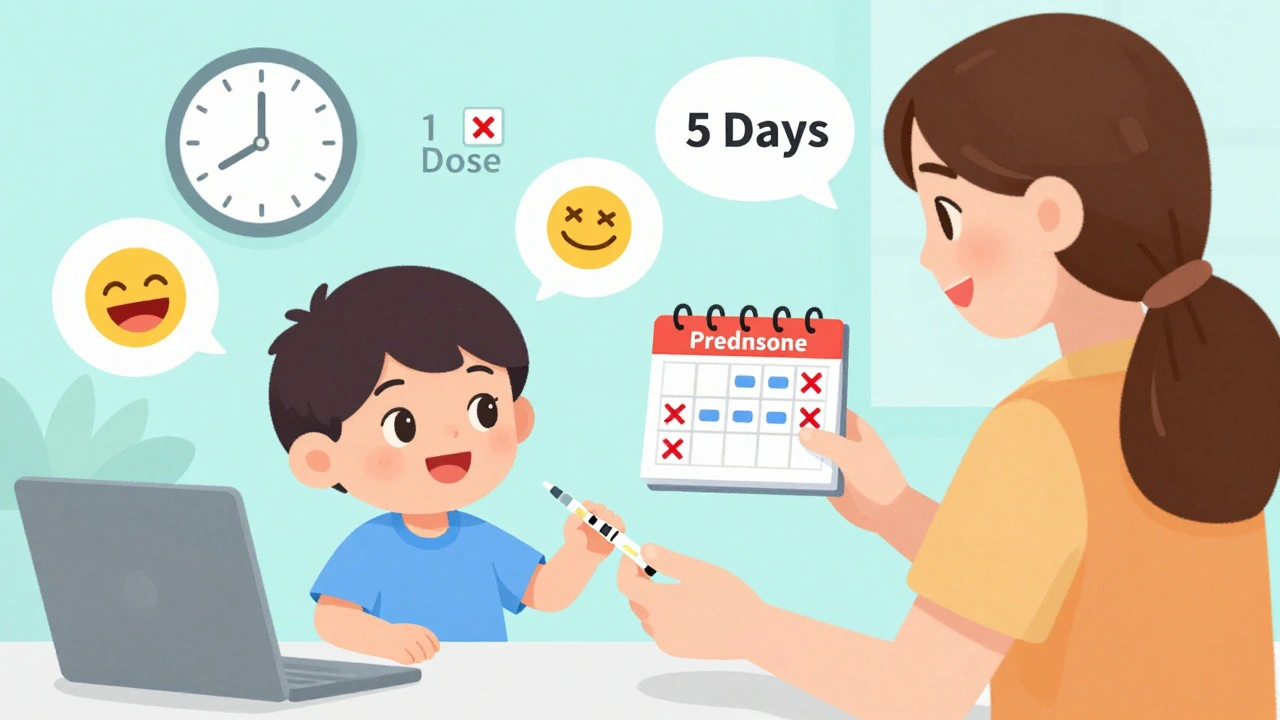
Doctors use this difference in practice. For example, in asthma attacks in kids, a single dose of dexamethasone (0.6 mg per kg) works just as well as five days of prednisone. That’s a game-changer for parents trying to get their child to take medicine daily. One shot. One pill. Done.
How Long Do They Last?
Duration matters as much as strength. Prednisone sticks around for about 12 to 36 hours. Dexamethasone? It lasts 36 to 72 hours. That’s why dexamethasone is often called a long-acting steroid, while prednisone is intermediate-acting.
This affects how often you need to take it. With prednisone, you might take a pill once or twice a day. With dexamethasone, you might take it just once every day-or even less. That’s why it’s the go-to for conditions like brain swelling or spinal cord compression in cancer patients. One dose can hold the line for days.
But there’s a flip side. A single 10 mg dose of dexamethasone floods your body with steroid activity for nearly a week. That’s the same as taking 60 mg of prednisone every day for five days straight. That kind of prolonged exposure increases the risk of side effects, especially if you’re not supposed to be on steroids long-term.
Side Effects: Are They Different?
Both drugs cause the same kinds of side effects: weight gain, high blood sugar, mood swings, trouble sleeping, weakened bones, and increased infection risk. But because dexamethasone is stronger and lasts longer, the way these side effects show up can be different.
For example, in a 2019 study in the Journal of Clinical Psychiatry, people on dexamethasone were 29% likely to have insomnia compared to 22% on prednisone. Mood swings were also more common with dexamethasone-24% vs. 19%. That makes sense. The longer the steroid stays in your system, the more it messes with your brain chemistry.
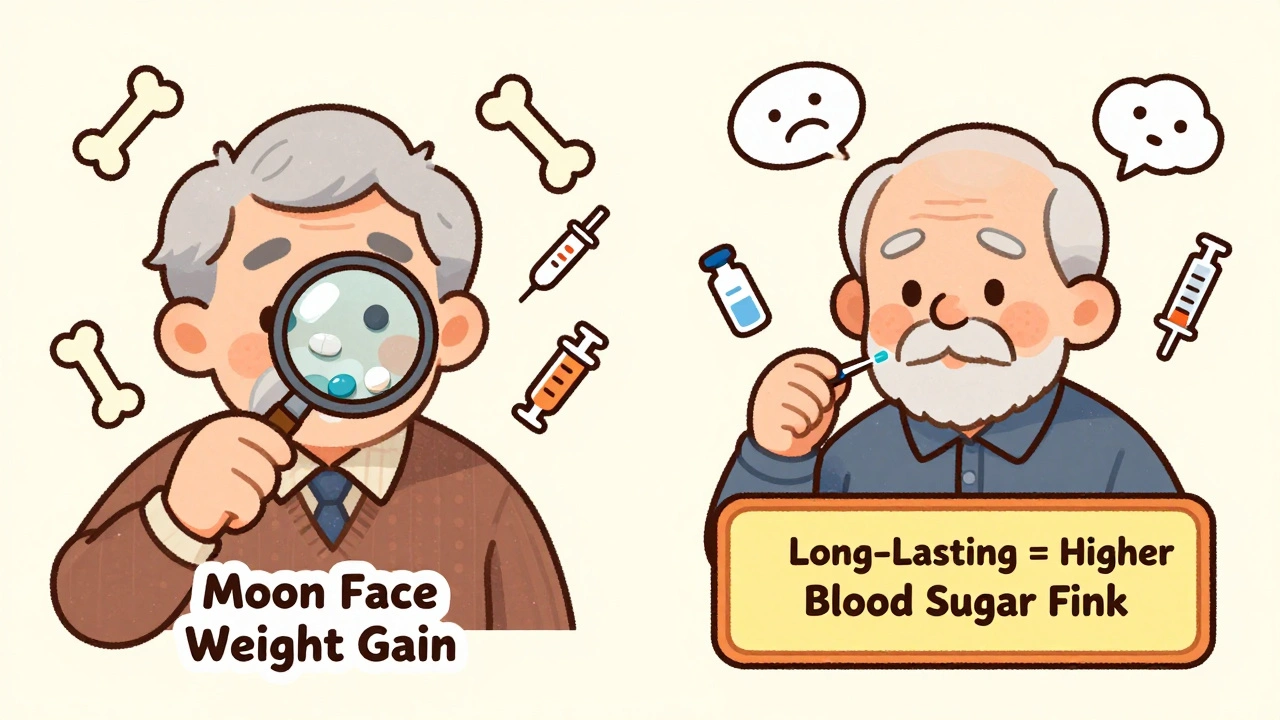
On the other hand, prednisone seems to cause more visible changes. Reviews from over 1,200 users on Drugs.com show that 42% of prednisone users reported "moon face"-that rounded, puffy look-compared to 31% on dexamethasone. Weight gain was also more common with prednisone: 58% vs. 45%. Why? Because prednisone is usually taken daily for weeks or months. Dexamethasone is often used for short bursts. So even though dexamethasone is stronger, you’re exposed to it for less time.
There’s also a bigger risk of high blood sugar with dexamethasone. A 2021 meta-analysis found that at equal anti-inflammatory doses, dexamethasone raised blood sugar levels 18% more than prednisone. That’s a serious concern for people with diabetes or prediabetes.
When Do Doctors Pick One Over the Other?
It’s not about which is "better." It’s about the situation.
Dexamethasone wins when you need:
- Quick, powerful control of inflammation in a short time
- A single dose or short course (like for asthma, croup, or allergic reactions)
- Brain swelling or nerve compression from cancer
- Patients who can’t take medicine daily (kids, elderly, people with memory issues)
For example, during the COVID-19 pandemic, dexamethasone became a lifesaver. The RECOVERY Trial showed it cut death rates by up to one-third in hospitalized patients on oxygen. Why? Because it suppressed the body’s dangerous overreaction to the virus-and it worked with just one daily dose.
Prednisone wins when you need:
- Long-term control of chronic conditions like rheumatoid arthritis or lupus
- More precise dose adjustments (you can cut a 5 mg pill in half; dexamethasone comes in 0.75 mg or 4 mg, which is harder to tweak)
- Lower risk of blood sugar spikes over time
- Patients who need to taper slowly
That’s why the American College of Rheumatology still recommends prednisone for rheumatoid arthritis. You need to be able to lower the dose gradually. Dexamethasone’s long half-life makes that harder. If you stop too fast, your body can crash.
Cost and Accessibility
Both are generic. Both are cheap. But there’s a twist.
A 30-day supply of generic prednisone 20 mg costs about $8.47. Generic dexamethasone 4 mg runs around $12.89. At first glance, prednisone looks cheaper. But because you need so much less dexamethasone, the actual cost per treatment is often the same.
For a child with croup: one 0.6 mg/kg dose of dexamethasone costs less than $2. A five-day course of prednisone? Maybe $5-$8. The difference is negligible. But the convenience? Huge.
What About Children and Older Adults?
For kids with asthma or croup, dexamethasone is now the first choice in most guidelines. It’s easier to give, just as effective, and reduces the chance of hospital visits. A 2006 study found kids on dexamethasone were 24% less likely to return to the ER within a week.
For older adults, both drugs are risky. The American Geriatrics Society warns that any steroid over 7.5 mg of prednisone-equivalent daily for more than three months increases the chance of fractures, infections, and muscle loss. Dexamethasone’s potency makes it especially dangerous if used long-term. That’s why it’s rarely prescribed for chronic conditions in seniors. Prednisone is preferred-if it’s needed at all.
Bottom Line: Which Should You Take?
If you’re getting a short course-maybe for an allergic reaction, asthma flare, or sinus infection-dexamethasone is likely the better option. One dose. Less hassle. Just as effective.
If you’re managing a chronic disease like arthritis, lupus, or inflammatory bowel disease, prednisone gives you more control. You can adjust the dose slowly. You can taper off safely. The side effects are still there, but they’re easier to manage.
Neither drug is "safe." Both can cause serious problems if misused. That’s why they’re prescription-only. Always take them exactly as directed. Don’t stop suddenly. Watch for signs of infection, mood changes, or high blood sugar. And talk to your doctor about alternatives if you’re on steroids for more than a few weeks.
The real takeaway? Strength isn’t always better. Sometimes, the right steroid is the one that fits your life-not just your lab results.
Is dexamethasone stronger than prednisone?
Yes, dexamethasone is significantly stronger. It’s about 9 to 10 times more potent than prednisone on a milligram-for-milligram basis. That means a 0.75 mg dose of dexamethasone can do the same job as a 5 to 10 mg dose of prednisone.
Which steroid has fewer side effects?
Neither has fewer side effects overall-they’re similar. But because dexamethasone is stronger and lasts longer, it can cause more insomnia and mood swings. Prednisone tends to cause more visible side effects like weight gain and moon face, especially with long-term use. The key is duration: short courses of dexamethasone often mean less total exposure, which can reduce side effects.
Can I switch from prednisone to dexamethasone?
You should never switch on your own. The dosing is not one-to-one. Switching requires medical supervision because of the difference in potency and half-life. A doctor will calculate an equivalent dose based on your condition and current dose. Abrupt changes can cause adrenal insufficiency or worsen your condition.
Why is dexamethasone used in COVID-19?
Dexamethasone was shown in the RECOVERY Trial to reduce death rates in hospitalized COVID-19 patients who needed oxygen or a ventilator. It works by calming the body’s dangerous overreaction to the virus-called a cytokine storm. Its long-lasting effect meant one daily dose was enough, making it practical for large-scale use.
Is dexamethasone better for asthma than prednisone?
For acute asthma attacks, especially in children, dexamethasone is now preferred. One or two doses work just as well as five days of prednisone. It’s easier to give, improves adherence, and reduces the chance of hospital return visits. For chronic asthma management, prednisone is still used when daily dosing is needed.
Do both drugs cause high blood sugar?
Yes, both can raise blood sugar, but dexamethasone has a slightly higher risk. A 2021 meta-analysis found that at equivalent anti-inflammatory doses, dexamethasone increased blood sugar levels 18% more than prednisone. People with diabetes need to monitor their levels closely when taking either drug.
Can I take these steroids with other medications?
Many medications interact with both dexamethasone and prednisone. Common ones include blood thinners, diabetes drugs, seizure medications, and certain antibiotics. Always tell your doctor about everything you’re taking-including supplements and OTC meds. Some combinations can increase side effects or reduce effectiveness.
What happens if I stop taking these steroids suddenly?
Stopping abruptly can cause adrenal insufficiency-your body stops making its own cortisol. Symptoms include fatigue, nausea, dizziness, low blood pressure, and even shock. This is especially dangerous if you’ve been on steroids for more than a few weeks. Always taper off under medical supervision.

13 Comments

Tejas Bubane
Dexamethasone isn't even a real drug it's just prednisone with a fancy name and a higher price tag. Doctors love it because it looks like they're doing something advanced when really it's just chemistry magic. Same side effects, just compressed into a smaller pill.

Ajit Kumar Singh
Look I dont care what the studies say if you give me dexamethasone I will feel it in my bones and you can tell me all day about half life and receptor binding but I know what my body tells me and it says prednisone is the real deal

Angela R. Cartes
Can we just admit that dexamethasone is the steroid version of a luxury car? It's powerful, sleek, and looks impressive on paper... but do you really need it if your daily commute is 10 miles? Prednisone is the reliable sedan that gets you there without the ego inflation.

Lisa Whitesel
Anyone who thinks dexamethasone is safer is delusional. Longer half-life means longer exposure. Longer exposure means more damage. End of story. The fact that people still use it for anything beyond emergency situations is medical malpractice waiting to happen.

Larry Lieberman
Just read the RECOVERY trial again and now I’m crying 😭 I mean… one pill saved lives during a global pandemic? That’s not science, that’s a miracle. Why don’t we celebrate this more? 🙏💊

Sabrina Thurn
The pharmacokinetic profile of dexamethasone makes it uniquely suited for acute inflammatory cascades where rapid glucocorticoid receptor occupancy is critical. Prednisone’s intermediate half-life allows for titratable modulation in chronic autoimmune conditions. The choice isn’t about potency-it’s about therapeutic window optimization and patient-specific pharmacodynamic alignment.

Courtney Black
It’s funny how we reduce everything to numbers-milligrams, half-lives, meta-analyses-when the real question is: who are we trying to help? A child who can’t swallow five pills? An elderly man who forgets his meds? A dying patient in a hospital bed? The steroid isn’t the hero. The human is. And the drug just… fits.

iswarya bala
omg i just had a croup attack last week and they gave me dex and i was like wow this is so much easier than the prednisone syrup my kid had to take for 5 days… like why do we even make people suffer with multiple doses???

Simran Chettiar
One must contemplate the ontological implications of pharmaceutical potency: if a molecule possesses greater binding affinity and prolonged receptor residence time, does it not thereby assume a higher moral responsibility? The body does not distinguish between dexamethasone and prednisone-it only knows disruption. Thus, the physician becomes not merely a prescriber, but a steward of equilibrium.

Anna Roh
So dexamethasone is stronger but you use it less? So it's like… a sniper rifle vs a shotgun? But both kill. And both mess you up. So why are we even debating this?

Tiffany Sowby
Of course Americans love dexamethasone-quick fix, no follow-up, just pop a pill and go back to your 30-hour workweek. Meanwhile, in real countries, people actually taper. We don’t treat medicine like a fast-food menu.

Asset Finance Komrade
One might argue that the preference for dexamethasone in acute settings reflects not clinical superiority, but systemic inertia-hospitals favor single-dose protocols for logistical efficiency, not therapeutic precision. The real issue is not which steroid is better, but why we rely on steroids at all.

Stacy Tolbert
I’ve been on prednisone for 8 years. My bones are dust. My mood is a rollercoaster. And now you want to tell me dexamethasone is the better option? I don’t want better. I want out.


Write a comment