Steroid-Induced Hyperglycemia: How to Adjust Diabetes Medications Safely
Steroid Hyperglycemia Insulin Calculator
Why Steroids Make Blood Sugar Spike
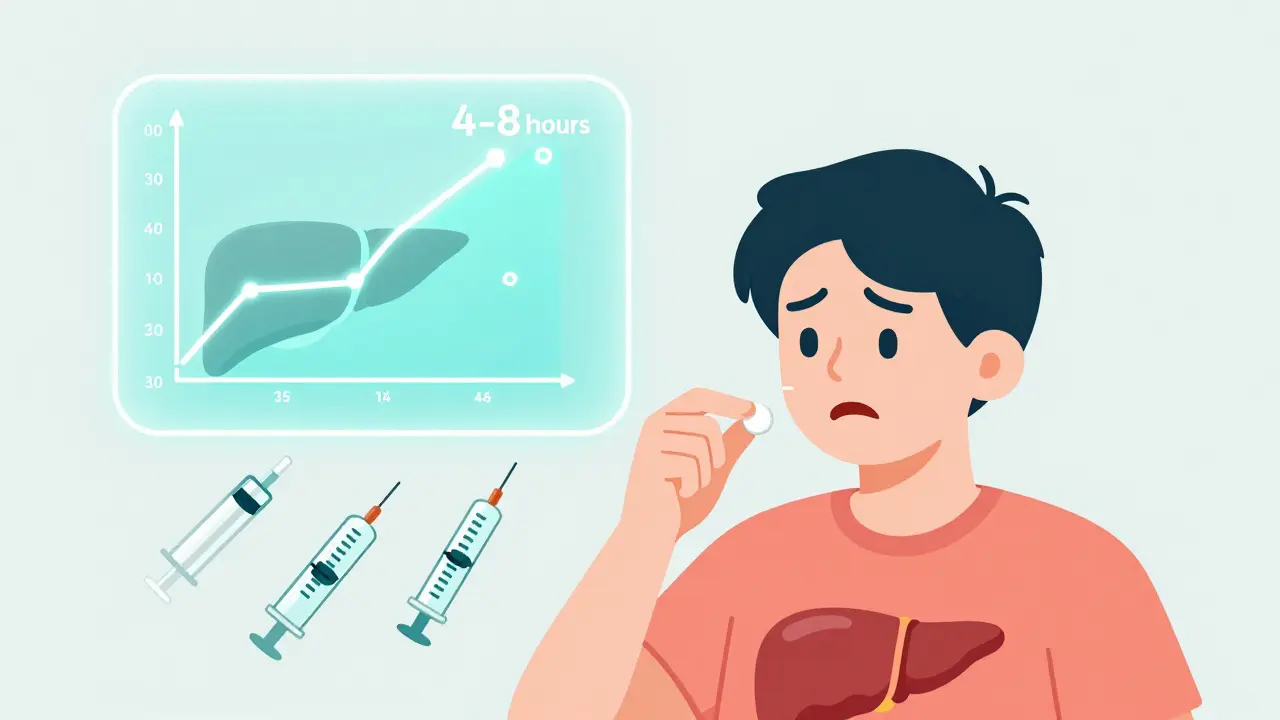
When you take steroids like prednisone or dexamethasone, your body doesn’t just fight inflammation-it also starts pumping out more glucose. This isn’t a side effect you can ignore. It’s a direct metabolic shift. Steroids make your liver produce more sugar, block insulin from doing its job, and even dull your pancreas’s ability to respond. The result? Blood sugar climbs, often within hours of taking the dose. For someone with diabetes, this isn’t just inconvenient-it’s dangerous. Studies show 20% to 50% of people on moderate to high steroid doses develop hyperglycemia, and in hospitals, that number jumps to 40%.
The timing matters. Blood sugar typically starts rising 4 to 8 hours after taking the steroid, peaks around 24 hours, and stays high until the steroid is fully cleared. If you’re on dexamethasone, which lasts 36 to 72 hours, your blood sugar might stay elevated for days. With prednisone, it’s more predictable-18 to 36 hours. But if you don’t adjust your diabetes meds, you’re flying blind.
Insulin Is the First-Line Tool
For most patients, especially those in the hospital or on high-dose steroids, insulin is the only reliable way to control blood sugar. Oral meds like metformin or DPP-4 inhibitors might help a little in mild cases, but they’re not enough when steroids are in full force. Insulin works fast, it’s adjustable, and it doesn’t wait for your body to respond.
The starting dose? Around 0.1 units per kilogram of body weight, given at the same time as the steroid. So if you weigh 70 kg, that’s about 7 units total. This isn’t a one-size-fits-all number-it’s a baseline. You’ll need to adjust based on your blood sugar readings. If your pre-meal glucose is between 11.1 and 16.7 mmol/L (200-300 mg/dL), add 0.04 units per kg as a correction. If it’s above 16.7 mmol/L, use 0.08 units per kg. These aren’t guesses. They’re backed by clinical guidelines from the Joint British Diabetes Societies and the American Diabetes Association.
Basal insulin needs more attention. If your fasting glucose stays above 11.1 mmol/L for two or three days in a row, increase your long-acting insulin by 10% to 20%. Some teams use 2-unit increments if you’re not comfortable with percentages. The key is to move slowly. Too much insulin too fast leads to crashes later.
Match the Insulin to the Steroid
Not all steroids are the same. And not all insulins are interchangeable. You need to match the insulin’s timing to the steroid’s half-life.
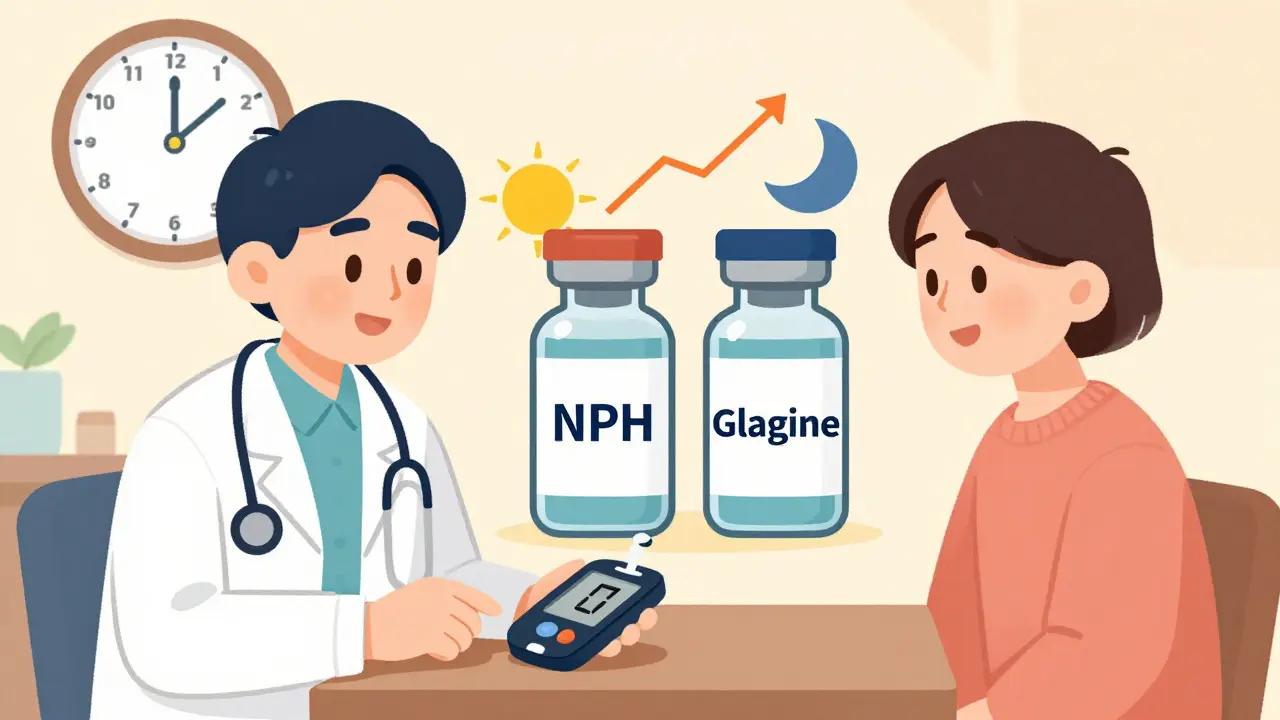
If you’re on prednisone-taken in the morning-NPH insulin is often the best choice. It peaks 4 to 12 hours after injection and lasts 12 to 36 hours. That lines up perfectly with prednisone’s 18- to 36-hour window. Giving NPH in the morning covers the sugar spike without overlapping into the night, where it could cause a low.
Dexamethasone? That’s different. It sticks around for days. For that, you need a long-acting analogue like glargine or detemir. These last 24 hours or more and don’t have a sharp peak. Giving them in the morning ensures steady coverage without the rollercoaster effect.
And here’s a real-world tip: if you’ve taken dexamethasone before and needed 20 extra units of insulin, start with only 10 the next time. Tapering up is safer than overdosing. You can always add more later.
Watch Out for Sulfonylureas
If you’re on a sulfonylurea like glimepiride or glyburide, stop. Now. These drugs force your pancreas to keep releasing insulin, even when your body doesn’t need it. Steroids make your liver dump sugar, so you need insulin. But when the steroid dose drops-say, from 40 mg to 20 mg-your liver slows down. Your pancreas, however, is still pumping out insulin because the sulfonylurea is still active. That’s a recipe for a severe, delayed low. A Johns Hopkins study found that 27% of patients on sulfonylureas during steroid therapy ended up in the ER for hypoglycemia. Only 8% of those on insulin-only regimens did.
Switching to insulin isn’t a failure. It’s smart. It gives you control. And when the steroid tapers, you can turn it down-safely.
The Tapering Trap
The biggest mistake? Not reducing insulin when the steroid does.
Steroids don’t vanish overnight. Even after you stop taking them, their effects linger for 3 to 4 days. But if you keep your insulin at the high dose you used during peak steroid levels, your blood sugar will crash. A 2023 survey of 1,200 patients showed that 42% had at least one hypoglycemic episode during tapering. One Reddit user, Type1Since99, wrote: “I needed 50% more basal and 75% more bolus on 40mg prednisone. When I dropped to 20mg, my endo didn’t cut my insulin fast enough. I had three lows in two days.”
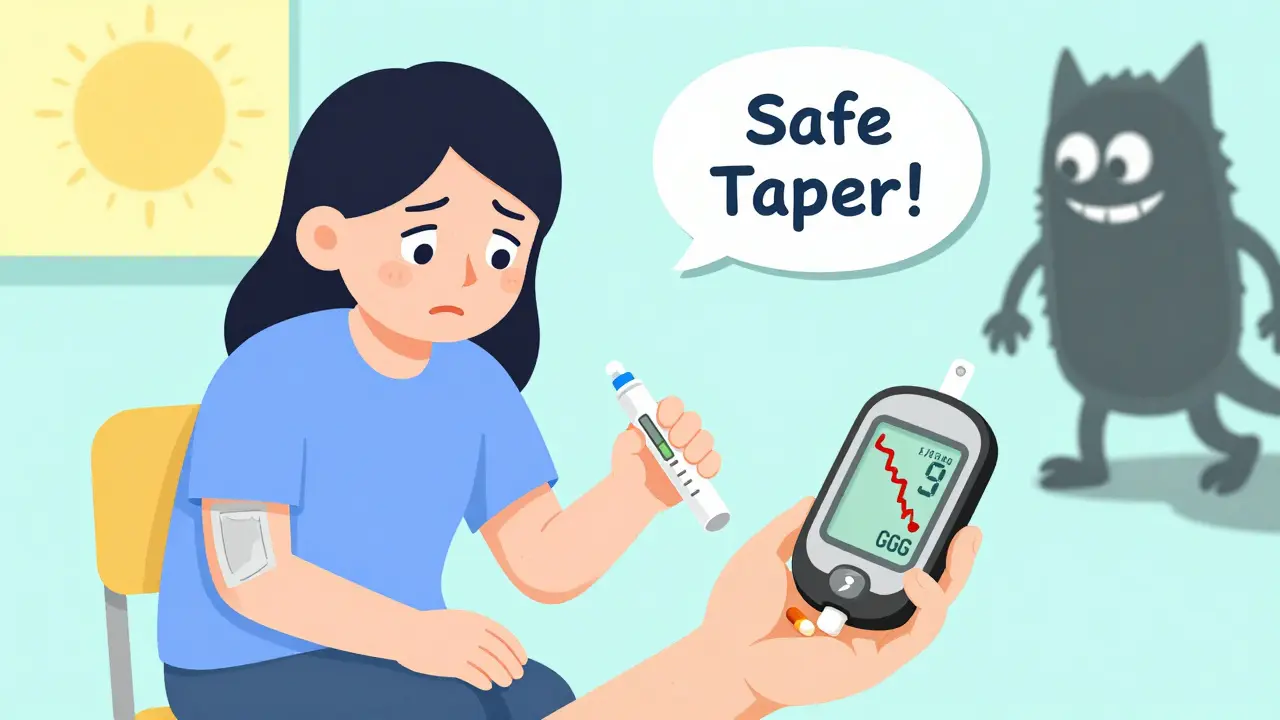
The solution? Reduce insulin in sync with steroid dose drops. If you’re cutting your prednisone by 5 mg every few days, cut your insulin by 10% to 15% each time. Don’t wait for a low to happen. Don’t assume your doctor will do it for you. Track your glucose. If your fasting numbers are consistently below 7 mmol/L (126 mg/dL), you’re probably over-dosed.
For patients on insulin pumps, the same rules apply. Increase basal rates by 25% to 50% during peak steroid effect. Then, dial them back as the steroid fades. Many pumps now let you set temporary profiles-use them.
Monitoring Is Non-Negotiable
You can’t manage what you don’t measure. The Joint British Diabetes Societies require at least four daily checks: before meals and at bedtime. If your steroid dose changes or your blood sugar spikes, check every 2 to 4 hours. That’s not optional. That’s safety.
Continuous glucose monitors (CGMs) are game-changers. They show you trends, not just snapshots. You can see when your sugar starts rising after your steroid dose, how long it stays high, and when it drops too fast. The goal? Spend more than 70% of your time between 3.9 and 10.0 mmol/L (70-180 mg/dL). Less than 4% of your time below 3.9 mmol/L. That’s the target. And with real-time CGMs, you can adjust insulin before you crash.
What About Newer Oral Meds?
For outpatients on low-dose steroids (like 5-10 mg prednisone daily), non-insulin options can work. Metformin helps with insulin resistance. GLP-1 agonists like semaglutide reduce liver glucose output and slow digestion. DPP-4 inhibitors are gentle and low-risk for lows. But these aren’t first-line for hospitalized patients. They’re too slow. They don’t respond fast enough to sudden spikes. And they’re not reliable when steroid doses are changing daily.
Insulin is still the gold standard for acute control. Oral meds can be added later, once the steroid is stable and the risk of rapid swings is lower.
What Hospitals Are Doing Differently
Hospitals that use structured protocols have better outcomes. A 2023 survey found that 68% of U.S. hospitals now have formal SIHG guidelines-up from 42% in 2019. The best ones include automatic insulin dosing tools built into the electronic health record. You enter the steroid name, dose, and timing. The system suggests insulin doses based on weight, glucose trends, and past responses. It even flags when tapering might cause lows.
Some hospitals are even testing machine learning models. One 2023 study showed an algorithm using steroid dose, body weight, and baseline HbA1c could predict insulin needs with 85% accuracy. That’s not science fiction. It’s coming to your clinic soon.
Final Takeaway: Anticipate, Match, Adjust
Steroid-induced hyperglycemia isn’t a mystery. It’s predictable. It’s manageable. But only if you act before the numbers climb. Start insulin early. Match it to the steroid’s timing. Monitor constantly. And when the steroid comes down-bring your insulin down with it. The biggest danger isn’t high sugar. It’s the low that comes after.
If you’re on steroids and have diabetes, don’t wait for your doctor to say something. Ask: “What’s my insulin plan?” “When should I reduce it?” “Should I get a CGM?” These aren’t extra steps. They’re essential ones. Because when steroids are in your system, your body isn’t just sick-it’s in metabolic chaos. And only you, with the right tools, can bring it back into balance.
How soon after taking steroids does blood sugar rise?
Blood sugar typically starts rising 4 to 8 hours after taking a steroid dose, peaks around 24 hours, and stays elevated for as long as the steroid is active. With prednisone, this lasts 18-36 hours. With dexamethasone, it can last 36-72 hours.
Should I stop my diabetes pills when on steroids?
Don’t stop them without talking to your provider. But if you’re on sulfonylureas (like glyburide or glimepiride), you should switch to insulin. These pills can cause dangerous lows when steroids taper. Metformin or DPP-4 inhibitors may be safe for mild cases, but insulin is the most reliable option during active steroid therapy.
What insulin should I use for prednisone vs. dexamethasone?
For prednisone (half-life 18-36 hours), use NPH insulin in the morning-it matches the steroid’s timing well. For dexamethasone (half-life 36-72 hours), use long-acting analogues like glargine or detemir. These provide steady, prolonged coverage without peaks.
How do I know when to reduce my insulin during steroid tapering?
Start reducing insulin 3-4 days after your steroid dose drops. For every 5 mg reduction in prednisone, cut your insulin by 10-15%. Check your fasting glucose daily. If it’s consistently below 7 mmol/L (126 mg/dL), you’re likely over-dosed. Never wait for a low to happen before acting.
Is continuous glucose monitoring necessary?
It’s not mandatory, but it’s highly recommended. CGMs show you real-time trends, help you avoid highs and lows, and make adjustments more precise. The JBDS 2021 guideline suggests using CGM for at least 48 hours during high-dose steroid therapy. If you’re on insulin, it’s one of the safest tools you can use.

15 Comments

Lily Steele
I was on prednisone for 3 weeks last year and my blood sugar went nuts. Started with NPH in the morning like they said and it saved my life. No more 3 a.m. panic checks.

Rohit Kumar
The real issue isn't insulin or steroids-it's that doctors treat diabetes like a side note when someone's on steroids. You're not a diabetic patient with a side condition. You're a metabolic crisis waiting to happen. The system ignores this until someone ends up in DKA.

Jodi Olson
I appreciate the clinical precision here but I have to say the real challenge is patient education. Most people don't know what a half-life is let alone how to adjust basal rates. We need simple visuals and plain language not medical jargon.

Carolyn Whitehead
I got a CGM during my steroid cycle and it was a game changer. Seeing the spike after my pill made me feel less scared. Like I had control. Small wins matter.

Amy Insalaco
While the algorithmic insulin dosing models cited are statistically compelling, one must interrogate the epistemological foundations of such predictive frameworks. The reductionist quantification of metabolic flux through linear regression ignores the phenomenological lived experience of glucocorticoid-induced dysregulation. Are we pathologizing adaptation or optimizing intervention?

Katie and Nathan Milburn
I'm a nurse in a med-surg unit. We started using the hospital's SIHG protocol last year. Before that, we were guessing. Now we have a checklist. Fewer lows, fewer calls to endo. Simple changes, big impact.

Marc Bains
For anyone reading this and thinking 'I can handle it on metformin'-you’re not wrong, but you’re also not safe. Steroids don’t care how fit you are or how long you’ve had diabetes. They rewrite your metabolism. Insulin isn’t weakness. It’s wisdom.

kate jones
The 2023 JBDS guideline update specifically recommends CGM use for >48 hours during high-dose steroid therapy, with target time-in-range of 70-180 mg/dL for >70% of the day. Adherence to these parameters reduces hypoglycemic events by 62% compared to fingerstick-only monitoring.

Yanaton Whittaker
USA still the only country that treats this right. In other places they just tell you to drink more water and pray. Sad.

Kathleen Riley
One must consider the ontological implications of insulin dependency under pharmacologically induced metabolic stress. Is the body’s autonomy compromised when exogenous insulin becomes the sole mediator of homeostasis? Or is this merely a temporary recalibration of physiological equilibrium?

Beth Cooper
You know who really controls this? Big Pharma. They push insulin because it’s profitable. The real fix is stopping steroids altogether. Why are we even prescribing them? They’re just glorified fire starters for your pancreas.

Donna Fleetwood
You got this. I’ve been through this twice. It feels scary but you’re not alone. Just track your numbers, listen to your body, and don’t be afraid to ask for help. You’re stronger than this spike.

Melissa Cogswell
I use an insulin pump and set a temporary basal increase of 40% for 24 hours after my prednisone. Works like a charm. Also set a reminder to reduce it 3 days after each dose drop. Life saver.

Diana Dougan
So you’re telling me I need to do math on my phone just to not die? And my doc just says 'oh just adjust' like I’m a robot. Thanks for nothing.

Bobbi Van Riet
I’m a Type 1 and I was on dexamethasone after surgery. I didn’t know what to do until I found this post. I started glargine in the morning and cut my basal by 15% every time my dose dropped. I checked my glucose every 2 hours. I didn’t have one low. I’m so glad I didn’t ignore it. This stuff matters. Thank you for writing this.
Recent Posts
-

Citalopram vs Escitalopram: Managing QT Prolongation and Dose Limits
-
How to Safely Buy Phenytoin Online: A Complete Buyer's Guide
-
Diphenhydramine Overdose: Recognizing Antihistamine Toxicity and Emergency Care
-

Anticholinergic Medications: Cognitive Risks and Managing Dry Mouth
-
How to Get Prescription Assistance Programs from Manufacturers

Write a comment