Where to Find Detailed Side Effect Information for Your Medications
Medication Side Effect Information Finder
Find where to get the most reliable side effect information for your medication. This tool helps you identify the best source based on the type of information you need.
Best source:
Where to look:
Knowing what side effects a medication might cause isn’t just helpful-it can be life-saving. But where do you go when you need real, detailed, up-to-date information? Not every website gives you the full picture. Some are outdated. Others are too technical. A few even hide important details behind paywalls. If you’re looking for trustworthy side effect data on your prescription or over-the-counter drugs, you need to know where to look-and what to trust.
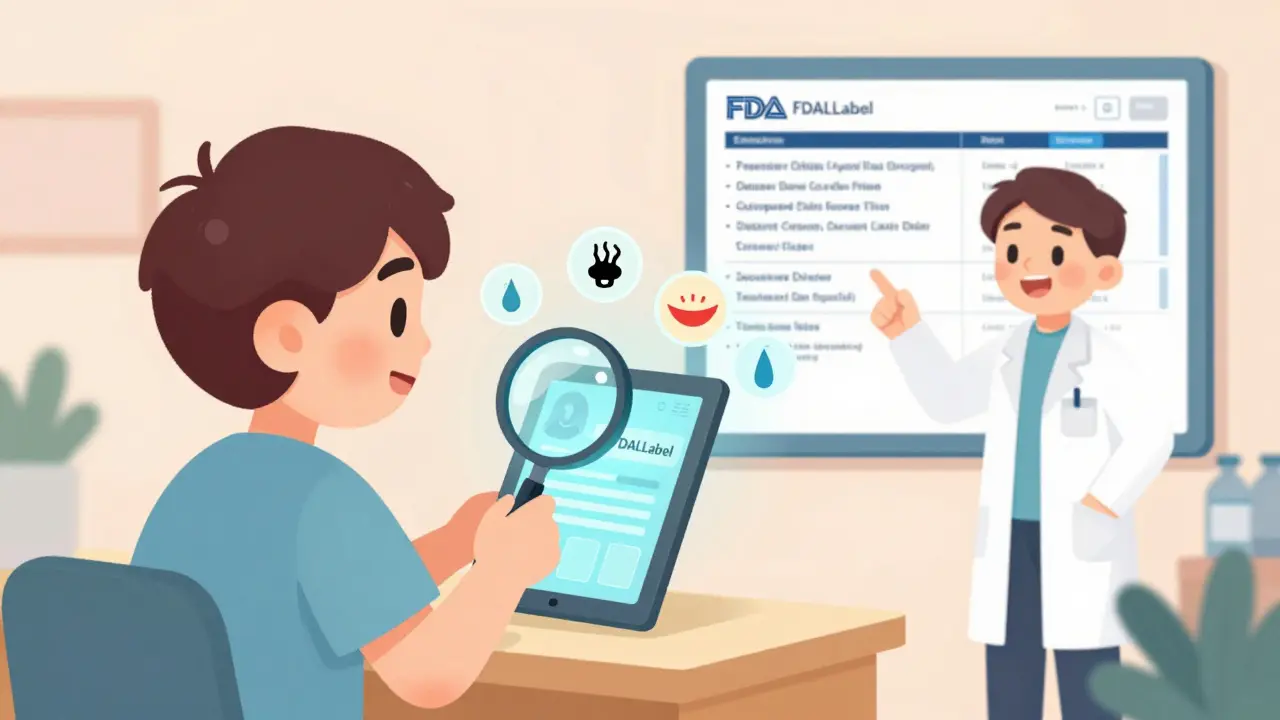
Start with the FDA’s FDALabel Database
The most authoritative source for side effect information in the U.S. is the FDALabel database. This is where the Food and Drug Administration stores the official drug labels submitted by manufacturers. Every prescription drug approved in the U.S. must have its label here, updated as new safety data comes in. It’s not a simplified guide-it’s the raw, detailed document doctors and pharmacists use.
To find it, go to accessdata.fda.gov and search for your drug by name. Once you open the label, scroll to section 6: Adverse Reactions. That’s where the most complete list of side effects appears, broken down by frequency: common, less common, and rare. For over-the-counter drugs, check the Warnings section instead. The FDA updates this database daily, so it reflects the latest safety findings. It’s the gold standard-for what’s officially approved and tested.
But here’s the catch: FDALabel only includes side effects seen in clinical trials or reported during early use. It doesn’t capture everything that happens after millions of people start taking the drug. That’s where other sources come in.
Use DailyMed for Clear, Structured Data
DailyMed is the public-facing version of FDALabel, maintained by the National Library of Medicine. It takes the same official labels and formats them into clean, easy-to-read pages. You’ll find the same side effect data, but without the dense legal language. DailyMed is ideal if you’re not a medical professional but still want accurate, official information.
It’s free, no login needed, and updated in real time. Each drug page includes not just side effects, but also dosage instructions, contraindications, and drug interactions. If you’re trying to understand what your pharmacist is telling you, DailyMed is the best place to double-check. It’s also the source behind many health apps and patient portals.
Check MedlinePlus for Patient-Friendly Explanations
Not everyone wants to read a 50-page drug label. That’s where MedlinePlus comes in. Run by the National Institutes of Health, it translates complex medical data into plain English. Its side effect pages are written for patients, not doctors. You’ll find lists like: "Common side effects include headache and nausea. Serious side effects, though rare, may include chest pain or trouble breathing."
A 2023 survey of 2,891 users found that 87% found MedlinePlus easier to understand than FDA labels. Its readability score was 8.2 out of 10-far higher than most medical documents. It also links to trusted resources, including how to report a side effect and when to call your doctor. If you’re worried about a symptom and need clear guidance, MedlinePlus is your go-to.
Explore OnSIDES for Off-Label and Real-World Effects
Most side effect databases only list what’s on the official label. But what about effects that happen after a drug is widely used? That’s where OnSIDES comes in.
Launched in late 2023 by the nSIDES team, OnSIDES uses advanced AI to scan over 46,000 drug labels from DailyMed and other global sources. It doesn’t just list what’s known-it uncovers hidden patterns. For example, a drug labeled as causing only dizziness might, according to OnSIDES, also be linked to memory lapses or sleep disturbances in real-world use. It has over 3.6 million drug-side effect pairs, covering 2,793 drug ingredients.
One of its biggest strengths? It includes off-label side effects-those not mentioned in the FDA label but reported by patients or clinicians. For instance, the diabetes drug metformin is officially labeled for gastrointestinal issues. OnSIDES shows it’s also associated with vitamin B12 deficiency in over 12,000 cases. This isn’t speculation-it’s data pulled from actual labels and verified with machine learning.
It’s not for casual browsing. You’ll need to visit nSIDES.io and search by drug name. But if you’re a researcher, pharmacist, or someone on multiple medications, this is the most comprehensive free resource available today.
Use VigiAccess for Global Real-World Reports
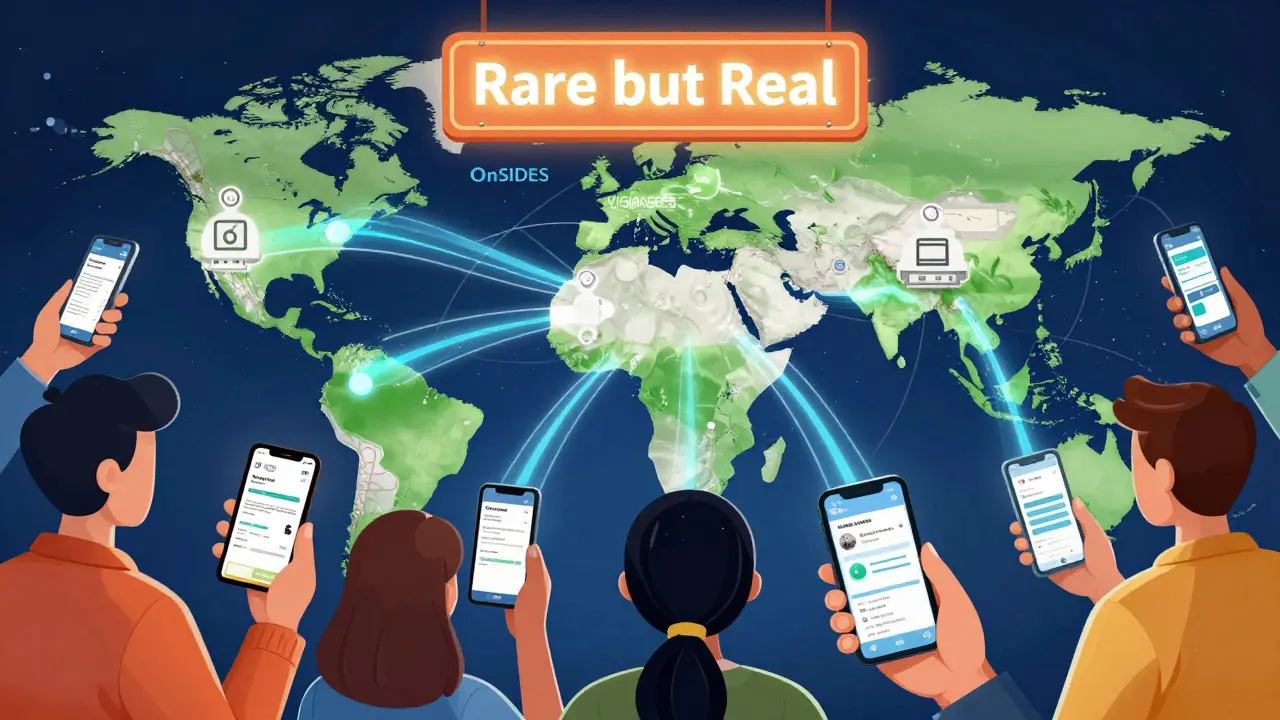
When a side effect happens once in a clinical trial, it might get missed. But if 500 people in 20 different countries report the same issue after taking a drug, that’s a red flag. That’s what VigiAccess tracks.
Run by the Uppsala Monitoring Centre (part of the World Health Organization), VigiAccess gives you access to over 35 million individual case reports from around the world. You can search for a drug and see exactly how many times a side effect like liver damage or heart rhythm changes has been reported.
It doesn’t tell you the risk percentage-just the raw count. So if you see 287 reports of a rare side effect, you don’t know if that’s 287 out of 10,000 users or 10 million. Still, it’s invaluable for spotting signals. A 2023 WHO report noted that 68% of serious side effects emerge only after a drug is on the market. VigiAccess helps catch those.
It’s free, simple to use, and updated monthly. If you’re concerned about a drug you’ve been taking for years, this is where you look for patterns beyond the label.
Avoid Outdated or Biased Sources
Not all databases are created equal. SIDER, once a popular resource, hasn’t been updated since 2015. Its creators say they have no funding to continue. That means it’s missing every new drug approved since then-and all new side effect reports.
Another source to be cautious of is PDR.Net. While it’s been around since 1947 and offers quick drug comparisons, it charges $49.99 per year for full access. Worse, a 2023 review by the American Medical Association found it sometimes omits side effects that aren’t profitable for manufacturers to highlight. It’s useful for quick lookups, but never rely on it as your only source.
What to Do When You Find a Side Effect
Found something worrying? Don’t stop at searching. Here’s what to do next:
- Check if the side effect is listed in multiple sources. If only one database mentions it, it might be an outlier.
- Compare frequency. If a side effect is rare on FDALabel but common on VigiAccess, it may be underreported in trials.
- Talk to your doctor or pharmacist. Bring printouts or screenshots. They’re trained to interpret this data.
- Report it. In the U.S., you can file a report through the FDA’s MedWatch system. Globally, VigiBase accepts reports from anyone.
Side effects aren’t always obvious. A drug might cause fatigue, memory fog, or mood changes-symptoms you might blame on stress or aging. The right data can help you connect the dots.
What’s Changing in 2026
The FDA’s 2023 Modernization Act requires all drug labels to be in standardized digital formats by 2026. This means search engines and apps will soon be able to pull side effect data directly from labels-no more digging through PDFs. AI tools like OnSIDES will become even more accurate as data becomes more consistent.
For now, the best strategy is to use multiple sources: start with FDALabel or DailyMed for official info, check MedlinePlus for clarity, and turn to OnSIDES or VigiAccess when you need deeper insight. No single source has the full picture. But together, they give you the power to make smarter, safer choices.
Can I trust side effect information on drug company websites?
Drug company websites often list side effects, but they’re required to include only what’s in the FDA-approved label. They may downplay or omit less common effects. Always cross-check with FDA, DailyMed, or MedlinePlus for complete, unbiased data.
Why do some side effects appear on VigiAccess but not on the FDA label?
FDA labels are based on clinical trials, which involve thousands of people over months. VigiAccess collects reports from millions of real-world users over years. A side effect that happens in 1 in 10,000 people might never show up in trials but show up clearly in VigiAccess after widespread use.
Is OnSIDES free to use?
Yes. OnSIDES is a free public database. You can search for any drug by name at nSIDES.io without registration or payment. It’s designed for patients, researchers, and clinicians alike.
Should I stop taking my medication if I find a scary side effect online?
Never stop a prescribed medication based on online research alone. Some side effects are rare, mild, or temporary. Talk to your doctor first. They can help you weigh the risks against the benefits of continuing the drug.
How often is DailyMed updated?
DailyMed is updated daily with new or revised drug labels from the FDA. If a manufacturer submits a safety update, it appears on DailyMed within 24 hours. This makes it the most current public source for official drug information.

12 Comments

Charity Hanson
I love how this breaks down the sources so clearly! I’ve been using DailyMed for years but never knew about OnSIDES-game changer for my mom’s polypharmacy. Just checked her meds and found three off-label effects she’s been experiencing. So glad someone finally made this accessible. 🙌

Sneha Mahapatra
Sometimes I wonder if we’re treating symptoms instead of systems. Medications are band-aids on a leaking boat. But still… this is the best map I’ve seen for navigating the storm. Thank you for the clarity.

Vikas Meshram
You forgot to mention RxList. It’s not perfect but it’s way more updated than SIDER. Also, VigiAccess data is useless without context-case reports ≠ causation. Stop giving people false confidence in raw numbers. And FYI, DailyMed isn’t updated daily-sometimes it’s 48 hours. I’ve checked.

bill cook
I’ve been on 7 meds for 12 years and never looked any of this up. Now I’m terrified. What if I’ve been slowly dying and no one told me? This is why I hate modern medicine. They hide stuff. I knew it.

Brandon Vasquez
Appreciate the breakdown. I’ve used MedlinePlus for years and always trusted it. The fact that it scores 8.2/10 on readability says a lot. People need plain language-not jargon. This is how you empower patients.

Jimmy Quilty
Let’s be real-FDA labels are written by pharma lawyers. OnSIDES? Probably funded by Big Pharma too. They want us to think we’re getting transparency, but it’s all curated. VigiAccess? Yeah right. They only show what they want you to see. I’ve seen the redacted reports. Trust no one.

Miranda Anderson
I read this whole thing while sitting in my car after picking up my prescription. I’ve been blaming my brain fog on stress for months. Then I checked OnSIDES and there it was-listed under my antidepressant. Not common. Not even in the FDA label. But real. I cried. Not because I’m scared, but because I finally felt seen. Thank you for writing this. It’s not just info-it’s validation.

Ben Estella
This is why America still leads. No other country has this level of transparency. Europe? They bury side effects under GDPR nonsense. India? Half the drugs there are counterfeit. We’ve got the gold standard. Don’t let anyone tell you otherwise.

Ajay Krishna
I’m a pharmacist in Delhi and I share this with every patient who asks. We don’t have access to all these databases here, but I print out DailyMed and MedlinePlus pages for them. One woman came back last week saying she stopped her BP med because of dizziness-turns out it was listed as rare. We talked, adjusted, and she’s doing great. Knowledge saves lives.

Gigi Valdez
The distinction between clinical trial data and real-world reporting is critical. Many patients conflate statistical significance with personal risk. This resource guide helps bridge that gap. Well-structured and evidence-based. A model for public health communication.

Byron Duvall
I looked up my cholesterol drug. Found 12 weird side effects. One said ‘hallucinations.’ I’ve been seeing squirrels talk since last year. Coincidence? I don’t think so. I’m filing a report. And I’m telling everyone. This is a cover-up. They don’t want us to know.

Eimear Gilroy
I just checked VigiAccess for my ADHD med. 47 reports of insomnia. I thought I was the only one. Turns out it’s common enough to show up globally. I’m telling my doctor tomorrow. This is why we need more public access.

Write a comment