Common Myths About Medication Side Effects Debunked
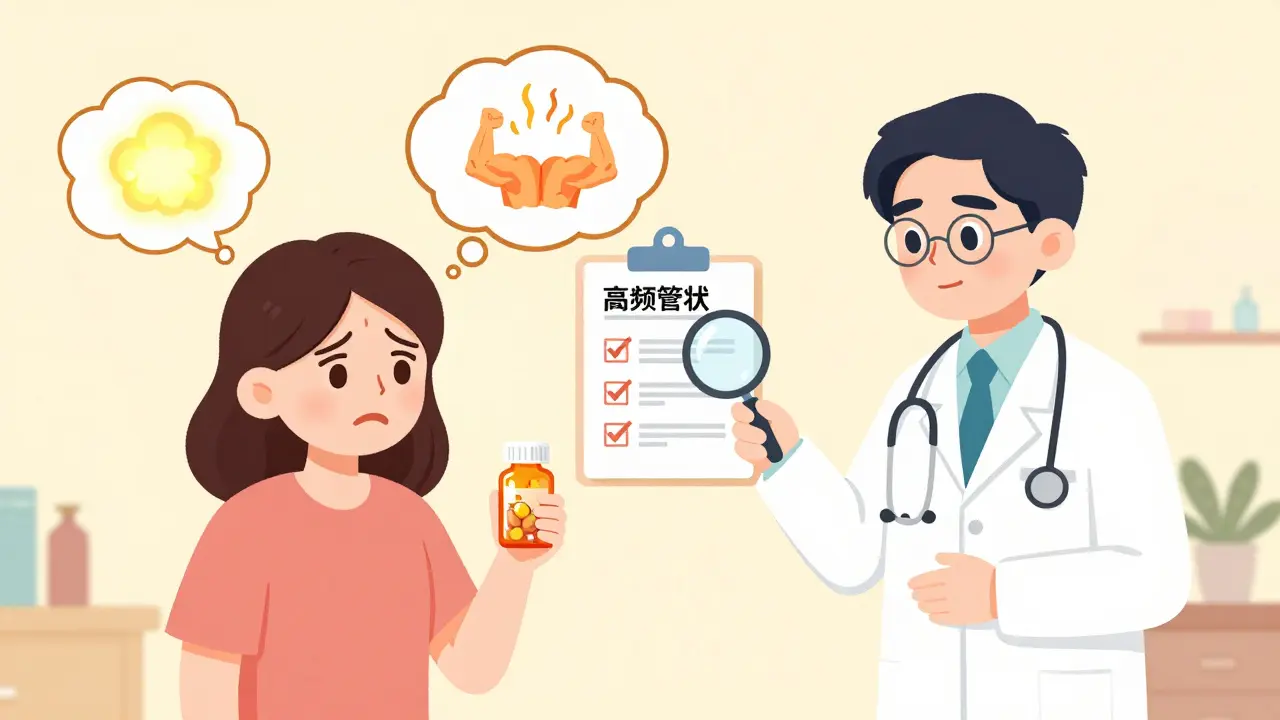
It’s easy to assume that if a medication makes you feel bad, it’s not right for you. But what if the feeling you’re blaming on the drug isn’t even caused by the drug at all? Millions of people stop taking their prescriptions because of myths about side effects-myths that aren’t just wrong, they’re dangerous. You don’t need to suffer through nausea, fatigue, or muscle aches to stay healthy. You just need the right information.
Myth: If You Feel Worse, Stop Taking the Medication
One of the most common-and deadly-mistakes people make is quitting their meds the moment they feel off. A 2022 analysis from AdhereTech found that 37% of patients with chronic conditions stop taking their drugs because of side effects. But here’s the truth: most side effects aren’t reasons to quit. They’re temporary, manageable, or even imagined.
Take antibiotics. Nausea is a common complaint. But a 2020 study in the Journal of Clinical Pharmacy and Therapeutics showed that taking them with food cuts nausea by 68%. Yet 42% of patients still stop the course anyway, according to a JAMA Internal Medicine survey. That’s not bravery-it’s ignorance. Stopping antibiotics early doesn’t help you feel better faster. It makes resistant infections more likely.
And it’s not just antibiotics. Antidepressants? Stopping them cold turkey can trigger dizziness, brain zaps, and insomnia in over half of users, as shown in a 2019 review in the Journal of Clinical Psychiatry. Heart patients on beta-blockers? A 2022 Circulation study found that those who quit within 90 days were 3.2 times more likely to have another heart attack. These aren’t side effects you should tough out alone. They’re signals to call your doctor-not your pharmacist, not your friend, not Google. Your doctor.
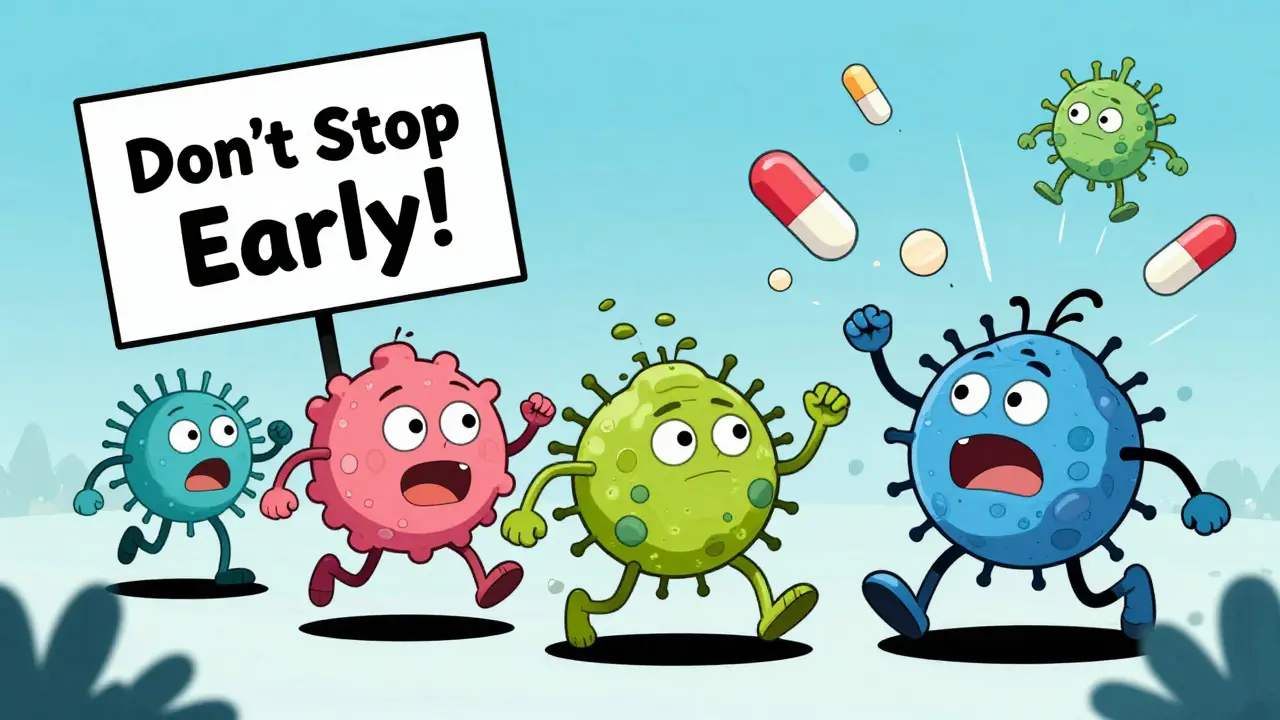
Myth: You Can Stop Antibiotics When You Feel Better
This one’s been around for decades. “I’m feeling fine, so I’m done.” Sounds logical, right? But bacteria don’t care how you feel. They care about survival. When you stop antibiotics early, you don’t kill all the bad bugs. You kill the weak ones. The strong ones? They survive. And they multiply.
The CDC estimates 2.8 million antibiotic-resistant infections happen in the U.S. every year, with 35,000 deaths. A 2020 Lancet Infectious Diseases meta-analysis showed that just one early stop increases your chance of a resistant infection by 17%. The Infectious Diseases Society of America is clear: symptom relief ≠ bacterial eradication. Most infections need 7 to 14 days of treatment to wipe out 99.9% of the bacteria. Skipping the last few pills doesn’t save you time-it puts you and everyone around you at risk.
And it’s not just about “superbugs.” It’s about your next infection. What if you get pneumonia next winter? If you’ve trained bacteria to resist antibiotics, your treatment options shrink. That’s not hypothetical. It’s happening right now.
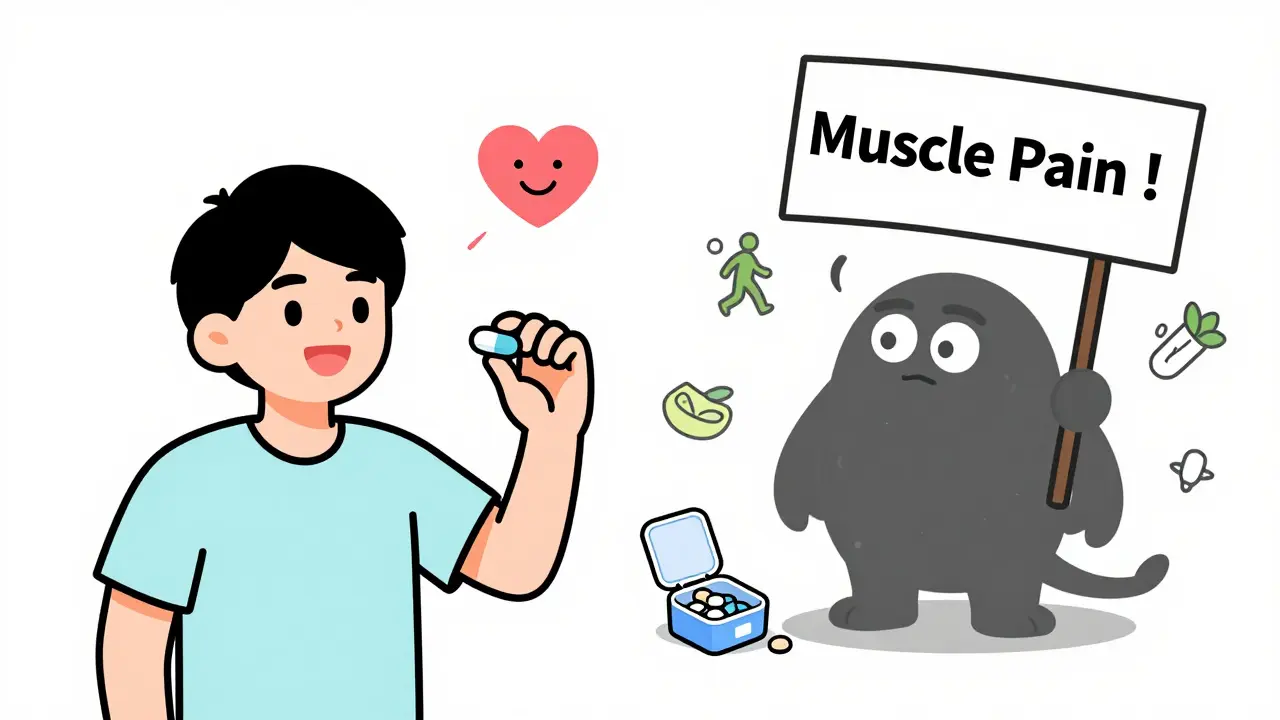
Myth: Statins Always Cause Muscle Pain
Statins save lives. They lower cholesterol, prevent heart attacks, and reduce strokes. But 74% of people who start them quit within a year, according to a 2021 American Journal of Cardiology study. Why? They blame muscle pain. But here’s what the data says: the Cholesterol Treatment Trialists’ Collaboration looked at 174,000 patients across 27 trials. Only 0.9% more people on statins reported muscle symptoms than those on placebo. That’s less than 1% difference.
And here’s the kicker: a 2018 New England Journal of Medicine study found that 90% of people who think they can’t tolerate statins can actually take them-once they’re tested in blinded trials. That means most of the time, the pain isn’t from the drug. It’s from fear. Or aging. Or being sedentary. Or another condition.
Not all statins are the same. Hydrophilic ones like pravastatin and rosuvastatin penetrate muscle tissue 70% less than lipophilic statins like simvastatin, according to a 2020 Journal of the American College of Cardiology meta-analysis. If you’re having muscle aches, ask your doctor to switch you. Don’t quit. There’s a version of this drug that probably won’t bother you.
Myth: OTC Painkillers Are Just as Good as Prescription Ones
“I’ll just take ibuprofen.” Sounds harmless. But for moderate to severe chronic pain-like arthritis, back pain, or nerve damage-OTC pain relievers often don’t cut it. A 2022 Journal of Pain Research study found that 68% of patients with chronic pain get inadequate relief from maximum daily doses of OTC drugs (1,200mg ibuprofen, 3,000mg acetaminophen).
So what do they do? They wait. The American Academy of Pain Medicine found that 41% of chronic pain patients try OTC meds first. That delays proper treatment by nearly 15 months on average. And while they wait, they’re risking damage. Acetaminophen causes 56,000 emergency room visits a year in the U.S. because people overdose trying to get relief. Liver failure can happen at doses over 4,000mg/day. Ibuprofen? It causes 10,000 hospitalizations annually from stomach bleeding when taken too long or too often.
Pain isn’t a one-size-fits-all problem. Sometimes you need something stronger. Sometimes you need a different kind of treatment-physical therapy, nerve blocks, or even antidepressants for nerve pain. OTC drugs aren’t the solution for everything. Pretending they are? That’s how people end up in the hospital.
Myth: Prescription Drugs Are Safer Than Illegal Ones
It’s a dangerous lie. Many people think if a doctor prescribed it, it’s safe. But prescription opioids killed 18,000 Americans in 2022, according to the CDC. And 30% of those deaths involved people who weren’t even prescribed the drug-they got it from a friend, a relative, or a leftover pill bottle.
The National Institute on Drug Abuse found that 53% of new opioid misuse cases in 2022 started with prescription pills. A 2021 study by the American Society of Addiction Medicine showed that after just 30 days of opioid use, there’s a 23% chance of developing an addiction. That’s not a small risk. That’s a ticking clock.
And mixing prescriptions with alcohol? That’s a recipe for disaster. A 2022 Journal of Clinical Medicine study tracking over 12,000 people found that combining alcohol with medications increases death risk by 47%. Acetaminophen and alcohol? That combo causes 450 liver failure deaths every year in the U.S. alone. Prescription drugs aren’t toys. They’re powerful chemicals. Take them only as directed. Never share them. Never mix them.
What Actually Works: Managing Side Effects the Right Way
So what should you do if you feel off after starting a new drug? First, don’t panic. Second, don’t stop. Third, call your doctor or pharmacist. Most side effects can be fixed without quitting.
Here’s what works:
- Take meds with food if they upset your stomach.
- Switch the time of day-you might feel less dizzy if you take it at night instead of morning.
- Ask about switching to a different drug in the same class. Not all statins, antidepressants, or blood pressure pills are the same.
- Use a pill organizer or adherence app. The Stepping Stone Center found these tools reduce unnecessary stops by 39% by helping people tell real side effects from normal symptoms.
Patients who talk to their providers about side effects are far more likely to stick with treatment. A 2023 Annals of Family Medicine study showed that using the “teach-back” method-where the doctor asks you to repeat instructions in your own words-boosts adherence by 32%. Pharmacists who do medication therapy management reduce side effect-related quits by 41%, according to the American Pharmacists Association.
And here’s the most powerful thing: 63% of patients who stopped meds because of side effects were able to restart them successfully after getting help, according to the PatientsLikeMe 2023 dataset. You’re not alone. You’re not broken. You just need the right support.
What’s Next: Better Tools, Better Outcomes
The future of medication safety is here. Smart pill bottles that alert your doctor if you skip a dose? They cut side effect-related quits by 47%, according to a 2022 JAMA Internal Medicine trial. Ingestible sensors that track if you swallowed your pill? The FDA-approved Proteus Discover system improved side effect management by 63% in a 2023 New England Journal of Medicine study.
The American College of Physicians is pushing for “shared decision-making”-where you and your doctor design a plan together. Early results show 52% fewer people quit their meds when they’re part of the decision. That’s not magic. That’s respect. That’s communication.
You don’t have to suffer. You don’t have to guess. You don’t have to believe the myths. The truth is out there. You just need to ask for it.
Should I stop my medication if I feel side effects?
No. Most side effects are temporary and manageable. Stopping without talking to your doctor can be dangerous. Call your provider first. They can adjust your dose, change the timing, switch your medication, or reassure you that what you’re feeling is normal.
Can I stop antibiotics when I feel better?
No. Feeling better doesn’t mean the infection is gone. Stopping early lets the strongest bacteria survive and multiply, leading to antibiotic resistance. Always finish the full course unless your doctor tells you otherwise.
Do statins really cause muscle pain?
Only in a very small number of cases. Studies show less than 1% more muscle symptoms in statin users than in people taking a placebo. Many people who think they have statin side effects can actually tolerate them after switching to a different type, like pravastatin or rosuvastatin.
Are over-the-counter painkillers safe for long-term use?
Not for chronic pain. Long-term use of ibuprofen can cause stomach bleeding and kidney damage. Acetaminophen can cause liver failure if you exceed 4,000mg per day. If OTC meds aren’t working after a few days, see a doctor. You may need something stronger-or a different kind of treatment.
Is it safe to take prescription drugs that were prescribed to someone else?
No. Prescription drugs are tailored to individual health conditions, weights, and other medications. Taking someone else’s pills can lead to overdose, dangerous interactions, or addiction. In 2022, 30% of opioid overdose deaths involved drugs not prescribed to the person who took them.
Can I drink alcohol while taking my medication?
It depends on the drug. But for many-especially painkillers, antidepressants, and sleep aids-it’s risky. Mixing alcohol with medications increases death risk by 47%, according to a 2022 study. Always check with your doctor or pharmacist before combining alcohol with any prescription or OTC drug.
How can I tell if a side effect is real or just in my head?
It’s not always easy. Some symptoms are caused by the nocebo effect-where expecting a side effect makes you feel it. But the best way to know is to track your symptoms and talk to your provider. Apps and pill organizers help you distinguish between actual side effects and normal symptoms of your condition. Never assume it’s all in your head-but don’t assume it’s the drug either. Get it checked.
If you’re taking medication, you’re not alone. Millions of people face the same fears. But you don’t have to let myths control your health. Ask questions. Track your symptoms. Talk to your doctor. Your life depends on it.

15 Comments

Napoleon Huere
It’s wild how we treat meds like magic bullets or poison pills-no in-between. We don’t think about the body as a system, just a switchboard where drugs either work or break everything. But biology’s messy. It’s not about ‘is this drug evil?’ it’s about ‘how does my body respond, and what can I tweak?’
And yeah, the nocebo effect? Real. I once thought a beta-blocker made me tired-turned out I was just stressed about starting it. Took me three months to realize I wasn’t sick, I was scared.
We need more education that doesn’t sound like a textbook. Like, ‘your anxiety is not a side effect, it’s your brain screaming because it’s unused to change.’ That’s the kind of language that sticks.

Shweta Deshpande
OMG I’m so glad someone finally said this!! I was on statins for 6 months and thought I had to quit because my legs felt ‘heavy’-like, heavy like I’d run a marathon without training. Turns out I was just sitting too much and my muscles were stiff from not moving. My doctor had me switch to rosuvastatin and added daily walks. Now I feel better than ever!!
Also, I started using a pill app called Medisafe and it changed everything. It reminds me when to take stuff AND tells me if what I’m feeling is normal or not. I used to panic over every little thing, now I just check the app and breathe. So many people don’t know these tools exist!!
And don’t even get me started on antibiotics-my cousin stopped hers after 3 days because she ‘felt fine’ and got a super nasty infection a month later. We’re all just winging it with our health and it’s scary. But we can do better!!

Robin Van Emous
Yeah, I get it. I used to think ibuprofen was harmless. Then I had a stomach bleed. Didn’t even know I was at risk. Now I always ask my pharmacist: ‘Is this safe with my other meds?’ And they’re usually like, ‘Oh yeah, don’t do that.’
Doctors don’t always explain the risks. They assume you know. But we don’t. So I’ve learned to ask more. And if I don’t understand, I say so. No shame.
Also, I switched my antidepressant from sertraline to escitalopram because of dizziness. It worked. No big drama. Just a swap. People act like meds are forever. They’re not. It’s trial and error. Like dating, but with chemistry.

James Nicoll
Oh wow. So the real myth is that people are dumb enough to believe everything they read on the internet. And yet here we are, reading a 2,000-word essay about how people read too much on the internet.
Let me guess-the next article is ‘Myth: People Who Read Long Articles Are Actually Just Bored at Work.’
But seriously, if you’re quitting meds because you ‘feel weird,’ you probably should’ve never started them in the first place. Maybe your body’s telling you something. Or maybe you just don’t like being told what to do. Either way, the science doesn’t care about your feelings.

Uche Okoro
While the article presents a compelling narrative grounded in epidemiological meta-analyses, it fundamentally underestimates the ontological weight of subjective phenomenology in pharmacological adherence. The data may indicate a 0.9% statistical variance in myalgia incidence, yet the lived experience of myocellular discomfort-particularly in the context of neuroendocrine dysregulation-is not reducible to population-level metrics.
Moreover, the conflation of ‘nocebo’ with ‘imagined’ constitutes a reductive epistemological fallacy. The placebo/nocebo axis is not a binary of veracity, but a spectrum of embodied signal transduction modulated by cognitive appraisal. To dismiss patient-reported outcomes as ‘just fear’ is to perpetuate medical paternalism under the guise of evidence-based practice.

shivam utkresth
Bro, I was on antibiotics for a sinus infection last year. Felt like crap for 2 days. Thought I’d take the rest when I felt better. Then I got sick again-worse. My mom was like, ‘You’re lucky you didn’t end up in ICU.’
Now I take my pills like they’re sacred. Even if I feel fine. Even if I hate the taste. Even if I forget. I put them next to my toothbrush. Every night. No excuses.
Also, statins? I switched from simvastatin to pravastatin and boom-no more leg cramps. No drama. Just a smarter choice. My doctor didn’t even charge extra. Just asked me what I felt. That’s all it took.

John Wippler
Let me tell you something real: most people don’t quit meds because they’re dumb. They quit because they’re exhausted. Tired of feeling off. Tired of being told ‘it’s all in your head.’ Tired of being treated like a statistic.
But here’s the secret: you’re not alone. And you don’t have to suffer in silence.
I helped my sister restart her antidepressant after she quit because of brain zaps. We called her psychiatrist. They lowered the dose. Added a tiny bit of lithium. Gave her a journal. Three weeks later, she was sleeping again. Not because the drug ‘fixed’ her-but because someone listened.
It’s not about willpower. It’s about support. And if your doctor doesn’t give you that? Find another one. Your life isn’t a clinical trial. It’s yours.

Aurelie L.
My ex took his blood pressure meds until he passed out in the shower. Then he blamed the drug. He didn’t tell anyone. He just stopped. Then he died.
Don’t be that guy.

Joanna Domżalska
So let me get this straight: the article says ‘don’t stop your meds,’ but also says ‘switch meds if you feel bad.’ So… which is it? Are you a patient or a lab rat?
Also, why are we pretending doctors are infallible? They prescribe statins like candy. Then they act shocked when people get side effects. And now we’re supposed to trust them more?
And who funded this? Pharma? Because the ‘90% can tolerate statins’ stat sounds like something a marketing team cooked up after a focus group.
Real talk: if you feel bad, stop. Then figure out why. Don’t let someone in a white coat tell you what your body is feeling.

Josh josh
man i took my antidep for like 3 weeks and felt like a zombie so i quit
then i felt better
so maybe the drug was the problem
not me
just sayin

bella nash
It is imperative to acknowledge that the prevailing discourse surrounding pharmaceutical adherence is predicated upon a positivist epistemological framework that privileges quantitative metrics over qualitative lived experience. While the cited studies demonstrate statistically significant correlations, they fail to account for individual neurochemical variance, psychosocial context, and the phenomenological integrity of somatic perception. Consequently, the prescriptive imperative to ‘consult your physician’ functions as an institutionalized mechanism of epistemic erasure, wherein patient subjectivity is subsumed under clinical authority.
One must interrogate not only the efficacy of medication, but the hegemony of the medical gaze.

SWAPNIL SIDAM
Bro, I was scared to take my blood thinner. Thought it’d make me bleed out. But my grandma told me: ‘Son, if you don’t take it, you’ll be the one in the box.’
I took it. I’m still here.
Don’t let fear write your story. Talk to someone. Ask questions. Don’t be proud. Be alive.

Geoff Miskinis
How quaint. A 2022 JAMA Internal Medicine trial showing smart pill bottles reduce non-adherence by 47%? How very… bourgeois. The real issue is that pharmaceutical capitalism has turned health into a product to be managed, not a condition to be understood. The ‘Proteus Discover’ system? A glorified surveillance tool for the compliant patient. And we’re supposed to applaud this as progress?
Meanwhile, in the Global South, people are rationing insulin because they can’t afford it. But hey, let’s all pat ourselves on the back for tracking our statin intake with an app.
Capitalism doesn’t cure. It monetizes suffering.

Sally Dalton
i just wanted to say thank you for writing this. i was gonna quit my antidepressant last month because i thought the headaches were from the pill. but i called my pharmacist instead and she said it was probably from dehydration + stress. she gave me a free water bottle and told me to drink more. i did. headaches gone.
it’s not about being brave or dumb. it’s about asking. and people like you make that easier.
thank you. really.
Napoleon Huere
That’s the thing, isn’t it? We’re not supposed to ask. We’re supposed to swallow and shut up. But the real rebellion isn’t quitting. It’s asking. It’s saying ‘I don’t feel right, can we try something else?’
That’s the real courage. Not ignoring symptoms. Not trusting blindly. But speaking up. Even when you’re scared. Especially when you’re scared.
My friend’s dad died because he didn’t want to bother his doctor. He thought his fatigue was ‘just aging.’ Turns out it was heart failure. He’d been ignoring it for six months.
Don’t be that guy. Don’t be that girl. Don’t be that person who thinks asking is weak. Asking is how you stay alive.

Write a comment