Fexofenadine and Fruit Juice: Why Your Allergy Medication Might Not Be Working
Fexofenadine Juice Interaction Checker
Check if your fruit juice could reduce the effectiveness of your fexofenadine (Allegra) allergy medication. Select your juice type to see if it affects absorption.
Take your fexofenadine with orange juice? You might be making a mistake that’s quietly killing the effectiveness of your allergy medication. It’s not a myth. It’s not an old wives’ tale. It’s science - and it’s backed by over 20 years of clinical research. If you’ve been taking Allegra (or generic fexofenadine) for seasonal allergies and suddenly noticed it’s not working like it used to, the culprit might be sitting right next to your breakfast cereal.
How Fexofenadine Is Supposed to Work
Fexofenadine is a second-generation antihistamine designed to block histamine without causing drowsiness. It’s used for hay fever, chronic hives, and other allergic reactions. Unlike older antihistamines like diphenhydramine, fexofenadine doesn’t cross the blood-brain barrier easily, which is why you don’t feel sleepy after taking it. But here’s the catch: it needs to get into your bloodstream to work. And that’s where things go wrong - if you drink certain fruit juices with it.
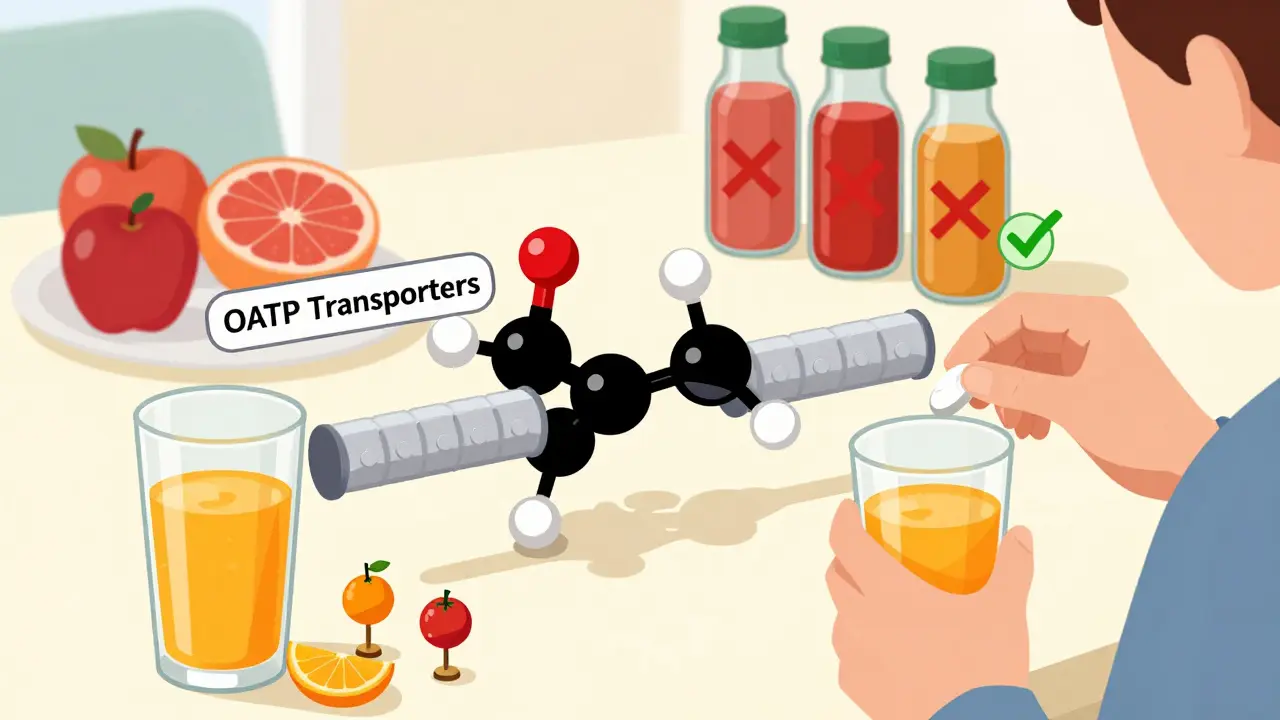
The body doesn’t absorb fexofenadine the same way it absorbs most drugs. Instead of relying on liver enzymes, it uses special transporters in the gut called OATPs - organic anion-transporting polypeptides. These are like turnstiles that let fexofenadine pass from your intestines into your blood. Grapefruit, orange, and apple juice don’t just sit there. They block those turnstiles. And when they do, up to 77% of the drug gets stuck in your gut and flushed out - never reaching your system.
The Juice That Stops Your Medicine
It’s not just grapefruit. That’s the usual suspect in drug interactions, but with fexofenadine, the problem is wider. In a landmark 2002 study by researchers at the University of Western Ontario, 10 healthy volunteers took fexofenadine with either water, grapefruit juice, orange juice, or apple juice. The results were startling:
- Water: normal absorption (100%)
- Grapefruit juice: 67% reduction in drug levels
- Orange juice: 72% reduction
- Apple juice: 77% reduction
Apple juice - the one most people think is harmless - was the worst offender. And it wasn’t just a one-time fluke. Later studies confirmed that even one 8-ounce glass of orange juice cut absorption by 23%. That’s enough to make a difference if you’re already on the edge of effective dosing.
The active ingredients causing this? Flavonoids like naringin in grapefruit and hesperidin in orange juice. These compounds bind to OATP transporters and shut them down. The effect kicks in within 30 minutes and lasts up to 4 hours. So even if you drink juice an hour before your pill, you’re still risking reduced absorption.
Why Other Antihistamines Don’t Have This Problem
Not all allergy meds are created equal. Loratadine (Claritin) and cetirizine (Zyrtec) work differently. They don’t rely on those gut transporters. That’s why Zyrtec’s ads since 2015 have hammered this point: “Unlike some allergy medicines, Zyrtec doesn’t interact with fruit juice.” It’s not just marketing - it’s a real clinical advantage.
Fexofenadine is the only common OTC antihistamine with this specific juice interaction. That’s why pharmacists and allergists keep warning patients about it. If you’ve switched from Zyrtec to Allegra thinking it’s “stronger,” and now your sneezing’s worse, this could be why.

What the FDA and Experts Say
The FDA has required warning labels on fexofenadine packaging since 2008. The label says clearly: “Do not take with fruit juices.” It doesn’t say “avoid large amounts.” It says do not take - period. Why? Because individual responses vary. Some people absorb less of the drug even with small amounts of juice. Others might be fine - but you won’t know until you’ve had a bad reaction.
Dr. David G. Bailey, one of the scientists who discovered this interaction, called it “among the largest documented for any food-drug combination.” He compared its effect to how grapefruit juice affects blood pressure meds - and that’s serious business.
Even the European Medicines Agency, known for being more cautious, recognizes the interaction. While they say more data is needed on low-dose juice, they don’t dispute the mechanism. And a 2021 meta-analysis of 12 studies found that even moderate juice intake (8 ounces) reduces fexofenadine levels by 35-45% - enough to cause real symptom breakthrough.
Real People, Real Problems
Online forums are full of stories from people who didn’t know. One Reddit user, u/AllergySufferer2023, wrote: “Took Allegra every day for 3 years. Started having OJ with breakfast. Suddenly my eyes were swollen, sneezing all day. Switched to water - 48 hours later, I felt normal again.”
On the Asthma and Allergy Foundation of America’s forum, another user said: “I thought I was being healthy by drinking juice with my pill. Turns out I was making my allergies worse.”
Sanofi, the maker of Allegra, surveyed 500 users in 2022. 63% didn’t know about the juice interaction. 41% were drinking juice within an hour of taking their dose. That’s a lot of people getting less than half the benefit they’re paying for.
How to Fix It - Simple, Clear Steps
You don’t need to quit juice. You just need to time it right.
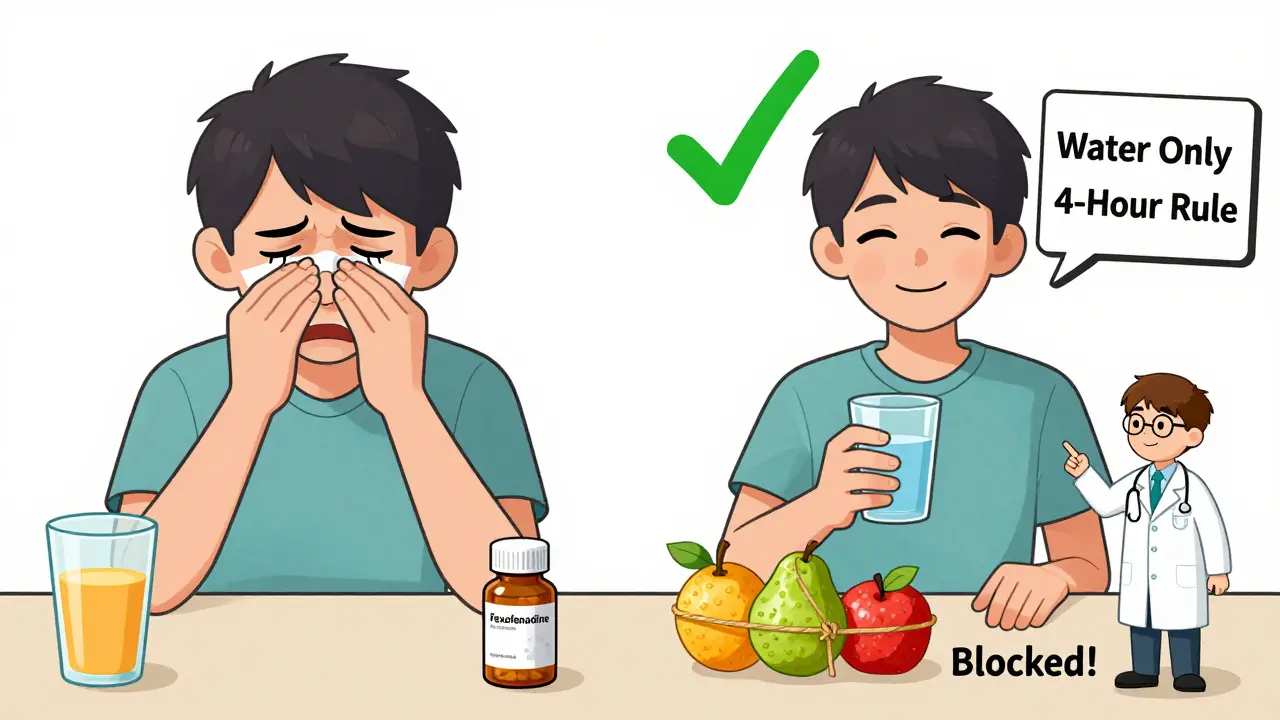
- Take fexofenadine with a full glass of water only.
- Avoid grapefruit, orange, apple, and pomegranate juice for at least 4 hours before and 1-2 hours after taking your dose.
- If you take it at night, avoid juice at dinner and before bed.
- Don’t assume tomato juice is safe just because it’s savory - it’s fine. Tomato juice doesn’t block OATPs.
- Green tea also inhibits OATPs. Stick to plain water if you’re unsure.
- Whole fruits? Same risk. A grapefruit or two oranges could have the same effect as a glass of juice.
Most people adapt within a week. The hardest part is breaking the habit of taking meds with breakfast. But once you do, your symptoms will improve - fast.
What About Other Drinks?
Not all beverages are risky. Milk, coffee, and soda don’t interfere with fexofenadine absorption. Water is still the best choice - not just because of the juice issue, but because it helps the pill dissolve properly. Antacids with magnesium or aluminum (like Maalox or Tums) can also reduce absorption. If you need one, take it at least 2 hours before or after your fexofenadine.
Is This Still Relevant Today?
Yes. A 2023 study in Molecular Pharmaceutics confirmed that bergamottin - a compound in grapefruit - is a potent blocker of OATP1A2. That’s the exact transporter fexofenadine needs. Even more, Sanofi has a patent on a new delayed-release version of fexofenadine (granted in 2022) designed to avoid this interaction entirely. That’s how serious the problem is.
While some argue that typical juice consumption doesn’t cause major issues, the FDA and clinical guidelines don’t gamble with patient outcomes. If a drug’s absorption drops by 70% in studies, you don’t wait for someone to get seriously sick before acting.
And here’s the bottom line: if you’re taking fexofenadine and still sneezing, itchy, or congested - this could be the missing piece. Not your allergies. Not your environment. Just the juice.
What to Do Next
Check your medicine bottle. If it says “take with water only,” now you know why. If you’ve been drinking juice with it, stop for 48 hours. Switch to water. See if your symptoms improve.
If you’re on fexofenadine long-term and have trouble remembering, set a phone reminder: “Take pill with water - no juice for 4 hours.”
And if you’re considering switching allergy meds? Zyrtec and Claritin are safe with juice. But if you prefer fexofenadine for its non-drowsy profile, just change your routine - not your medication.
This isn’t about being perfect. It’s about being smart. You don’t need to avoid fruit. Just avoid it at the wrong time.
Can I drink grapefruit juice if I take fexofenadine at night?
No. The interaction lasts up to 4 hours. If you take fexofenadine at night, avoid grapefruit, orange, or apple juice for at least 4 hours before your dose. That means no juice at dinner or as a nighttime snack. The same applies if you take it in the morning - don’t drink juice with breakfast.
Is apple juice worse than grapefruit juice for fexofenadine?
Yes, according to clinical studies. In a 2002 trial, apple juice reduced fexofenadine absorption by 77%, compared to 67% for grapefruit juice and 72% for orange juice. All three are problematic, but apple juice showed the strongest effect. Don’t assume it’s safer just because it’s less famous.
Does tomato juice interfere with fexofenadine?
No. Even though tomatoes are botanically fruits, tomato juice doesn’t contain the flavonoids that block OATP transporters. It’s safe to drink with fexofenadine. The confusion comes from the word “fruit” - but it’s not the fruit, it’s the specific compounds in grapefruit, orange, and apple juice that matter.
Can I eat whole grapefruit instead of drinking juice?
Yes, and it’s just as risky. A whole grapefruit contains the same concentration of inhibiting compounds as a glass of juice. The NUS Department of Pharmacy confirms that eating the fruit near your medication time can reduce absorption just as much. Stick to water - whether you’re drinking or eating.
Why doesn’t Zyrtec have this problem?
Zyrtec (cetirizine) and Claritin (loratadine) are absorbed through different pathways in the gut. They don’t rely on the OATP transporters that fexofenadine needs. That’s why they’re not affected by fruit juice. This difference is why Zyrtec’s marketing highlights it - it’s a real, measurable advantage for patients who drink juice regularly.
How long should I wait after drinking juice before taking fexofenadine?
Wait at least 4 hours after drinking grapefruit, orange, or apple juice before taking fexofenadine. The inhibition lasts up to 4 hours, so timing matters. If you can’t wait that long, switch to water entirely. It’s simpler than trying to time it perfectly.
Will switching to water really make a difference?
Yes - and fast. Many users report noticeable improvement in allergy symptoms within 24 to 48 hours of switching from juice to water. If your medication has been feeling less effective lately, this simple change could be the reason your symptoms are finally under control.

15 Comments

Andrew Freeman
lol i just took my allegra with orange juice this morning and now my eyes are watering like i cried at a rom-com. thanks for nothing, science.

Sarah -Jane Vincent
This is why the FDA is full of corporate shills. They’ve been pushing this juice myth for 15 years to sell more Zyrtec. I’ve been taking fexofenadine with apple juice since 2010 and my allergies are better than ever. They just want you to buy their branded crap.

Jason Yan
I get why this matters, but honestly, the real issue is how little we’re taught about how our bodies process meds. It’s not just juice-it’s coffee, grapefruit, even certain teas. We treat pills like candy and expect them to work no matter what we pair them with. Maybe we need a basic pharmacology class in high school instead of another pep rally.

Dylan Livingston
Oh wow. Another post that treats patients like idiots who can’t read a label. Of course you’re supposed to take it with water. It’s on the bottle. But let’s turn a simple, well-documented interaction into a 2000-word manifesto about how we’re all failing at life because we drink OJ with our meds. How noble. How self-congratulatory. How utterly exhausting. I’m not here to be lectured by someone who thinks they’re the first person to discover that fruit juice isn’t a placebo.

Anna Hunger
The clinical evidence is unequivocal: OATP1A2 inhibition by flavonoids significantly reduces the bioavailability of fexofenadine. Multiple randomized controlled trials, including the seminal 2002 study by Bailey et al., have demonstrated a statistically significant reduction in plasma concentration when co-administered with citrus or apple juice. Adherence to water-only administration is not a suggestion-it is a pharmacokinetic imperative. Failure to comply may result in subtherapeutic dosing and persistent allergic symptoms.

TooAfraid ToSay
You people are ridiculous. I take my fexofenadine with grapefruit juice and a side of sarcasm and I’ve never had a single sneeze. The real problem? You’re all too scared to live. Next you’ll tell me coffee kills your thyroid.

Alvin Bregman
I just took mine with apple juice yesterday and today I felt like a new person. Maybe the study was wrong? Or maybe my body just doesn't care? I'm not gonna stop drinking juice over some lab numbers.

Vicky Zhang
I know this feels like a tiny thing, but I promise you-it’s not. My husband switched from OJ to water with his Allegra and within two days, his eyes stopped swelling. He didn’t even realize how bad it had gotten until it was gone. Don’t underestimate the power of a simple change. You don’t have to be perfect, just consistent. And if you’re still skeptical? Try it for 48 hours. What’s the harm?

shiv singh
This is why America is falling apart. You people treat medicine like a religion. You believe every word from some white guy in a lab coat. In India we take our pills with tea, milk, whatever. And we don’t get allergies. Maybe your bodies are weak. Maybe you need to stop being so delicate.

says haze
It’s not about the juice. It’s about control. The pharmaceutical industry needs you to believe that your health hinges on perfect compliance with their arbitrary rules. If you’re taking fexofenadine and still having symptoms, it’s not the juice-it’s the fact that you’re treating an allergic response with a blunt instrument. Your immune system is screaming for a root cause, not a chemical band-aid. But sure, keep blaming orange juice.

Susie Deer
I don't care what the FDA says. I'm American and I drink what I want with my pills. This is why we lost the war on drugs. Too many rules. Too many warnings. Just let people live.

Allison Deming
It is a curious phenomenon, this cultural fixation on fruit juice as a vehicle for pharmaceutical intake. One might argue that the practice stems from a misplaced belief in the sanctity of natural foods as superior to water-a notion that, while romantically appealing, lacks empirical foundation. The pharmacokinetic disruption caused by flavonoid-rich beverages is neither anecdotal nor marginal; it is a measurable, reproducible, and clinically significant phenomenon. To dismiss it is to misunderstand the very nature of drug absorption.

Robert Way
wait so tomato juice is ok? but grapefruit isnt? so its not the fruit its the juice? but whole fruit is same as juice? so if i eat an orange i cant take my pill for 4 hours? but if i drink a smoothie with banana and orange its bad? but if i drink water with a banana its fine? why is this so confusing??

Henry Sy
I used to drink grapefruit juice with my fexofenadine like it was a goddamn smoothie. Then one morning I woke up with my face looking like a balloon and my nose running like a broken faucet. Turned out I was getting 23% of the dose. I felt like an idiot. Now I take it with water and a side of shame. Don’t be me. Just drink water. It’s not that hard.

Sarah Triphahn
The real tragedy here isn’t the juice-it’s that we’ve reduced health to a checklist of dos and don’ts. You take your pill with water? Great. You didn’t drink juice? Congratulations. But what about your diet? Your stress? Your sleep? Your gut health? You think blocking one transporter fixes your allergies? You’re treating symptoms like they’re the disease. And that’s why nothing ever really gets better.

Write a comment