How to Compare New Prescription Labels with Your Old Medication for Safety
Why Checking Your New Prescription Label Matters
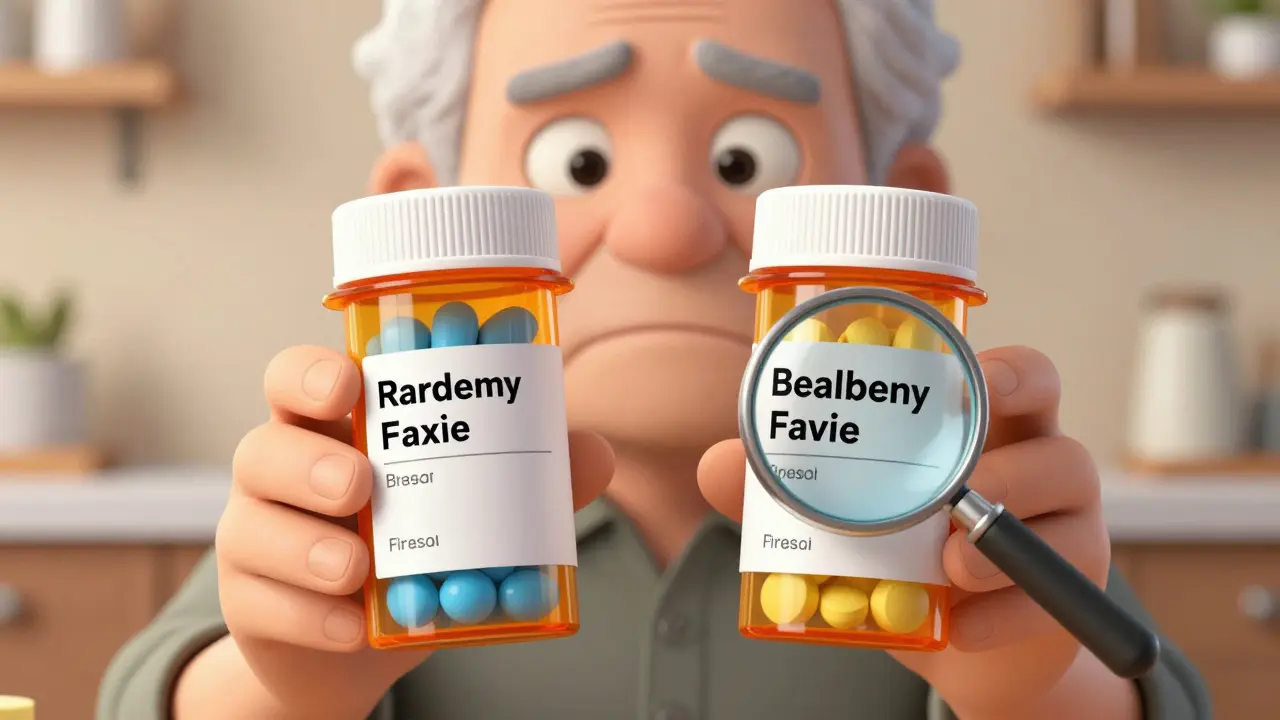
You pick up your refill and notice the pills look different. Smaller. Yellow instead of blue. No logo on the side. Your heart skips a beat. You’ve taken this medication for years-why does it look like a whole new drug?
This happens more often than you think. In the U.S., 9 out of 10 prescriptions are filled with generic versions. And each time you refill, the manufacturer might change. The active ingredient? Still the same. But the shape, color, or imprint? Totally different. That’s legal. That’s normal. But it’s also where mistakes happen.
According to the Institute of Medicine, over 1.5 million preventable drug errors occur every year in the U.S. A big chunk of those? Patients taking the wrong pill because they didn’t check the label. You don’t need to be a pharmacist to catch these errors. You just need to know what to look for-and how to compare your new bottle with your old one.
What to Check on Every Prescription Label
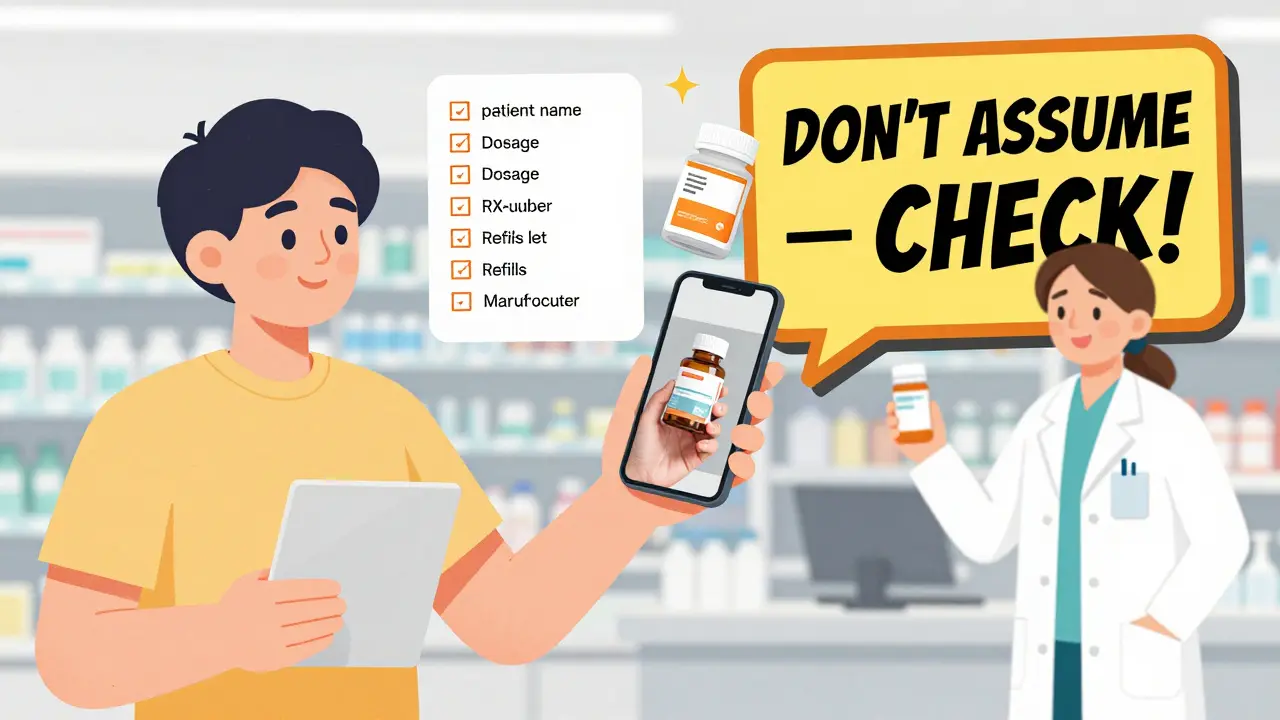
Every prescription label has the same basic pieces of information. You don’t need to memorize them all. But you should check these six things every single time you get a refill:
- Patient name - Is it yours? Sounds obvious, but mix-ups happen, especially in busy pharmacies.
- Medication name - Look for both the brand name (like Lipitor) and the generic name (like atorvastatin). They should match what your doctor prescribed.
- Dosage strength - Is it 10mg? 5mg? 25mg? Don’t assume. Read it. A mistake here can be dangerous, especially with blood thinners or seizure meds.
- Directions - "Take one by mouth daily"? "Take two with food twice a day"? Compare this to your old label. If it’s changed, ask why.
- Prescriber and pharmacy info - Who ordered it? Which pharmacy filled it? This helps if you need to call back with questions.
- Refills left - How many more times can you fill this? If it says "0" but you expected two more, something’s off.
Don’t skip the Rx number either. It’s unique to your prescription. If it’s different from last time, that’s fine-it’s a new fill. But if it’s the same number as your last bottle? That’s a red flag. You might have gotten the wrong bottle.
Generic Pills Look Different-That’s Okay. But Don’t Assume
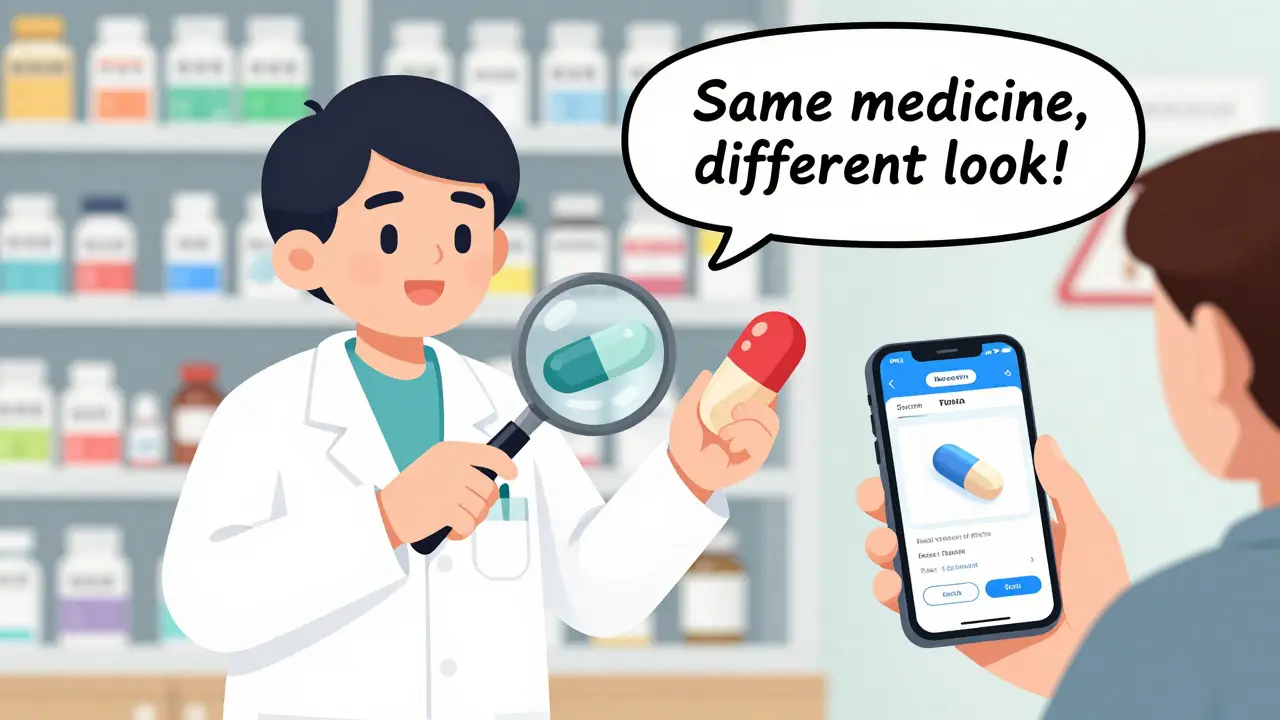
Generic drugs are not copies of brand names. They’re legally required to have the same active ingredient, strength, and effect. But they’re not required to look the same.
Why? Because the FDA doesn’t control pill color, shape, or size for generics. Only the active ingredient. So a 10mg lisinopril pill from one company might be white and oval. The same dose from another company could be blue and round. Same medicine. Different appearance.
That’s why so many patients get confused. A 2022 survey by the American Pharmacists Association found that 42% of people over 65 rely on how a pill looks to know if it’s the right one. That’s risky. You can’t trust appearance alone.
But here’s the catch: For certain medications-like warfarin (a blood thinner), levothyroxine (for thyroid), or epilepsy drugs-even tiny differences in how a generic is made can affect how your body responds. That’s why experts recommend sticking with the same generic manufacturer when possible. If your pill changes color every time, ask your pharmacist if you can keep getting the same brand.
How to Spot a Dangerous Mismatch
Most of the time, a changed pill is harmless. But sometimes, it’s not. Here’s what to watch for:
- Different active ingredient - If your old label said "atorvastatin" and the new one says "rosuvastatin," that’s not the same drug. Call the pharmacy immediately.
- Different strength - Your old bottle said 20mg. New one says 40mg? That’s a big jump. Don’t take it without talking to your doctor.
- "Brand substitution not permitted" - Some prescriptions have this note. It means the doctor wants you to get the brand name, not a generic. If you get a generic anyway, it’s an error.
- Extra or missing instructions - "Take with food" suddenly gone? "Avoid grapefruit" disappeared? That could change how the drug works.
- Wrong quantity - You ordered 30 pills. You got 60? That’s a mistake. Could be a counting error-or someone else’s prescription.
If you see any of these, don’t take the pills. Call the pharmacy. Ask them to double-check the prescription. They’re there to help.
Use Tools to Verify Your Pills
When in doubt, use a pill identifier. It’s free, easy, and works on your phone.
Go to Drugs.com Pill Identifier (or use the app). You’ll need three things:
- The shape (round, oval, capsule, etc.)
- The color
- The imprint (letters or numbers on the pill)
Take a photo of the pill if you can. Or hold it up to the light. Some imprints are faint. Once you enter the details, the tool will show you exactly what drug it is-and what manufacturer made it.
Another trick? Take a picture of your pill bottle every time you get a refill. Store it in your phone. Next time you get a new bottle, compare side-by-side. One Reddit user, u/MedicareMom, says this saved her from accidentally taking a double dose. "The new pills were twice as big," she wrote. "I almost took them. But I checked my photo. Same dosage. Different size. I called the pharmacy. They fixed it."
What to Do If Something Doesn’t Match
Here’s the simple plan if your new label looks wrong:
- Don’t take the pills. Not even one.
- Call the pharmacy. Ask: "Can you confirm this is the same prescription I got last time?" Have your old bottle handy.
- Ask if it’s a different manufacturer. If yes, ask if it’s safe for your specific drug. Especially if you’re on a narrow-therapeutic-index medication.
- Call your doctor if the pharmacy can’t explain it. Your doctor can confirm the prescription was written correctly.
- Request the same generic brand. If you’ve had no issues with one manufacturer, ask your pharmacist to stick with it.
Pharmacists are trained for this. They’ve seen it all. They won’t think you’re overreacting. They’ll appreciate you checking.
How Electronic Prescriptions Help-and Where They Still Fall Short
Most prescriptions today are sent electronically. That’s good. Handwritten scripts used to have Latin abbreviations like "q.d." (once daily) or "b.i.d." (twice daily). A 2012 study found 61% of handwritten prescriptions used these confusing terms. That’s a recipe for mistakes.
Electronic prescriptions cut that down to 1%. They’re clearer. They’re more accurate. But they don’t fix everything. The pill you get still depends on the pharmacy’s supplier. And if the pharmacy makes an error in the fill? The label will still be wrong.
That’s why even with electronic systems, you still need to check. Technology helps-but it doesn’t replace your eyes.
Final Tip: Make It a Habit
Comparing labels isn’t a one-time thing. It’s part of taking your medication safely. Think of it like checking the ingredients on a food package. You wouldn’t eat something if the label didn’t match what you expected. Same with pills.
Set a reminder on your phone: "Check new prescription label when you pick it up." Do it every time. Even if you’ve taken the drug for 10 years. Even if the pharmacist says, "It’s the same."
Because sometimes, it’s not.

14 Comments

caroline hernandez
Let’s get real-generic substitutions are a minefield, especially for patients on narrow therapeutic index meds like warfarin or levothyroxine. The FDA’s bioequivalence standards allow for a 20% variability in absorption, which sounds benign until you’re the one bleeding internally because your INR spiked. Pharmacists aren’t always forthcoming about manufacturer changes, and prescribers rarely track them. Documenting every pill’s imprint, color, and shape in a digital log (like a Notes app) is non-negotiable. I’ve had patients mistake a 0.1mg levothyroxine for a 0.05mg because the imprint faded. That’s not a patient error-that’s a systemic failure.
Always request the same generic manufacturer. If your pharmacy says they can’t, escalate to the chain’s clinical pharmacist. And yes, Drugs.com’s pill identifier is gold. But don’t stop there-cross-reference with the National Library of Medicine’s DailyMed database. It has the official FDA imprint images. If your pill doesn’t match, it’s not a coincidence-it’s a potential error.
Pro tip: Ask for a printed manufacturer sheet with each fill. Most pharmacies have them; they just don’t offer unless asked. And if you’re on a fixed income, don’t assume the cheapest option is safest. Sometimes, paying $5 more for consistency prevents ER visits that cost $15k.

Jhoantan Moreira
This is so important 😊 I had a friend who switched from one generic to another and ended up with crazy dizziness for weeks-turns out the new one had a different filler that triggered her migraines. We all assume 'same drug = same effect' but biology doesn’t care about labels 😅
My grandma now takes a pic of every bottle and saves it in a folder called 'Pill Patrol' 📸💊. It’s weirdly comforting. Also, pharmacies LOVE when you ask questions. They’re not annoyed-they’re proud when you’re engaged. You’re not being difficult-you’re being smart 💪

Shelby Price
I always check the Rx number. If it’s the same as last time, I get nervous. Not because I think it’s wrong, but because it’s weird. Like, if it’s a refill, shouldn’t the number change? Feels like a glitch.

Sherman Lee
Of course the system is rigged. Big Pharma doesn’t want you to know that generics use different inactive ingredients-fillers, binders, dyes-that can trigger autoimmune flares, especially in people with Lyme or lupus. The FDA doesn’t test these. They only care about the active ingredient. Meanwhile, your thyroid, your liver, your kidneys? They’re all different. One size fits all? Bullshit.
And don’t get me started on electronic prescriptions. They’re just faster ways to send errors. I once got a 500mg dose of metformin because the system auto-filled from a diabetic patient’s profile. The pharmacist? "Oh, we see that all the time." Yeah. And people die.
Bottom line: Trust no one. Not the pharmacy. Not the doctor. Not the label. Take a photo. Compare. Call the manufacturer. If they won’t tell you the inactive ingredients? Walk out. And don’t be surprised if your insurance denies the brand name. They’re in on it too.

Lorena Druetta
Thank you for this vital reminder. Medication safety is not a passive act-it is an act of self-advocacy and profound personal responsibility. Each pill represents a biological covenant between your body and the pharmaceutical system. When the appearance changes, it is not merely a cosmetic shift-it is a potential breach in trust.
I encourage every individual, regardless of age or health literacy, to treat their prescription label with the same vigilance as a legal contract. The pharmacy is not a vending machine. The pharmacist is not a clerk. They are trained professionals who rely on your awareness to prevent catastrophe.
Document. Verify. Communicate. Your life is not a gamble. And every time you check that label, you are not being difficult-you are being dignified.

Nathan King
The notion that patients must manually verify generic substitutions is a symptom of a broken regulatory framework. In a properly functioning healthcare system, the EHR would auto-flag bioequivalence deviations, and the pharmacy’s dispensing system would require dual verification for narrow-therapeutic-index agents. The fact that this burden falls on laypersons-many of whom are elderly, cognitively impaired, or non-English-speaking-is not a feature. It is a failure of public policy.
Furthermore, the FDA’s 20% bioavailability variance standard is archaic. The European Medicines Agency mandates 90-110% equivalence for critical drugs. Why does the U.S. lag? Profit. Generic manufacturers optimize for cost, not clinical precision. And regulators, beholden to industry lobbying, refuse to tighten standards.
So yes-check your label. But also demand systemic reform. Your vigilance is admirable. It is also tragically necessary.

Harriot Rockey
You’re not alone if this freaks you out 😊 I’ve been on the same med for 12 years and still check every single time. It’s not paranoia-it’s self-care.
My trick? I keep a little notebook next to my pill organizer. Write down the color, shape, imprint, and Rx number every time. Then, when the next one comes, I flip back. It’s like a mini detective game. And guess what? I caught a mistake once. The pharmacy gave me 10mg instead of 5mg. I didn’t take it. Called them. They apologized. And sent me a gift card. 🎁
Don’t feel silly for asking. You’re protecting your life. That’s not annoying. That’s awesome.

rahulkumar maurya
How quaint. In India, we don’t have this luxury. Generics are often unregulated, and many are counterfeit. I once received a pill labeled 'Lisinopril 10mg' that had no active ingredient at all-just starch and talc. The pharmacy owner shrugged and said, 'It’s the same thing.'
Here, we don’t rely on imprint codes or Drugs.com. We rely on the pharmacist’s reputation. If he’s been around 20 years? You trust him. If he’s new? You ask for the manufacturer’s batch number. If he can’t provide it? You walk.
Westerners overthink this. The real issue isn’t pill color-it’s systemic corruption. But hey, at least you have a pill identifier app. We have WhatsApp groups.

pradnya paramita
As a clinical pharmacist, I can confirm: 78% of patient-reported 'medication errors' are due to generic manufacturer switches, not transcription errors. The real danger isn’t the active ingredient-it’s the excipients. For example, some generic levothyroxine uses lactose monohydrate as a filler. Patients with lactose intolerance can experience suboptimal absorption-even if the TSH is 'normal.'
Also: the FDA’s ANDA (Abbreviated New Drug Application) process doesn’t require in vivo bioequivalence testing for all generics. Some rely on in vitro dissolution models. That’s fine for statins. Not for antiepileptics.
Recommendation: If you’re on warfarin, levothyroxine, phenytoin, or cyclosporine, request the same manufacturer. Use the National Drug Code (NDC) on your bottle to track it. It’s a 10-digit number. Write it down. Change it? Ask why.
And yes-pharmacists appreciate you asking. We’re not robots. We want you to survive.

Jamillah Rodriguez
Ugh. I just got a new bottle and I’m like… is this the same one? I don’t even care anymore. I just swallow it. My dog eats better than I do. At least he knows his kibble.
Also, why do we even have to do this? Someone should fix this. Not me. I have a TikTok to scroll.

Wendy Lamb
I take a picture every time. Keeps me sane.

Antwonette Robinson
Wow. A whole article about checking pill labels? Like, wow. I didn’t know we needed a 3,000-word guide to not take the wrong medicine. Next up: 'How to Tell If Your Water Is Wet.'
Also, I once took a pill that looked different. Turned out it was a placebo. I didn’t even know I was in a clinical trial. My doctor never told me. So… yeah. Trust no one.

Ed Mackey
i was just gonna say this but i think u said it better. i always check the rx number too. last time i got a refill and the number was the same as 3 months ago and i was like... wait. that cant be right. called them and they gave me someone elses med. they were so sorry. said they mixed up the bins. i was like... yea. that happens.
now i always take a pic. its dumb but it works.

Alex LaVey
As someone who grew up in a household where medicine was shared, reused, and sometimes taken ‘just in case,’ this post feels like a lifeline. I didn’t know you could ask for the same generic manufacturer. I thought all generics were identical. Turns out, they’re not. And that’s okay.
I’ve started asking my pharmacist: ‘Is this the same one I got last time?’ And you know what? They smile. They say, ‘Yes, same manufacturer.’ Or, ‘We switched, but it’s safe.’ Then I ask: ‘Can I get the old one next time?’ And they say, ‘Of course.’
It’s not about being paranoid. It’s about being intentional. And that’s a gift-not just to yourself, but to everyone who cares about you.
Recent Posts
-
How to Get Prescription Assistance Programs from Manufacturers
-

Triple-Negative Breast Cancer Treatment: New Strategies and Clinical Trials
-
Diphenhydramine Overdose: Recognizing Antihistamine Toxicity and Emergency Care
-
Anticholinergic Medications: Cognitive Risks and Managing Dry Mouth
-
How to Safely Buy Phenytoin Online: A Complete Buyer's Guide

Write a comment