How to Use the FDA Orange Book and Purple Book for Drug Safety Information
When you’re checking if a generic drug is safe to substitute for a brand-name version, or if a new biosimilar is truly equivalent to its reference product, you’re not guessing. You’re using official tools built by the FDA - the Orange Book and the Purple Book. These aren’t just databases. They’re safety filters that help pharmacists, doctors, and patients avoid dangerous substitutions and make informed choices.
What the Orange Book Actually Tells You About Drug Safety
The FDA Orange Book, officially called Approved Drug Products with Therapeutic Equivalence Evaluations, is the go-to source for small-molecule drugs - think pills and injections like metformin, lisinopril, or levothyroxine. It’s been around since 1985, updated every month, and lists over 20,000 approved products.
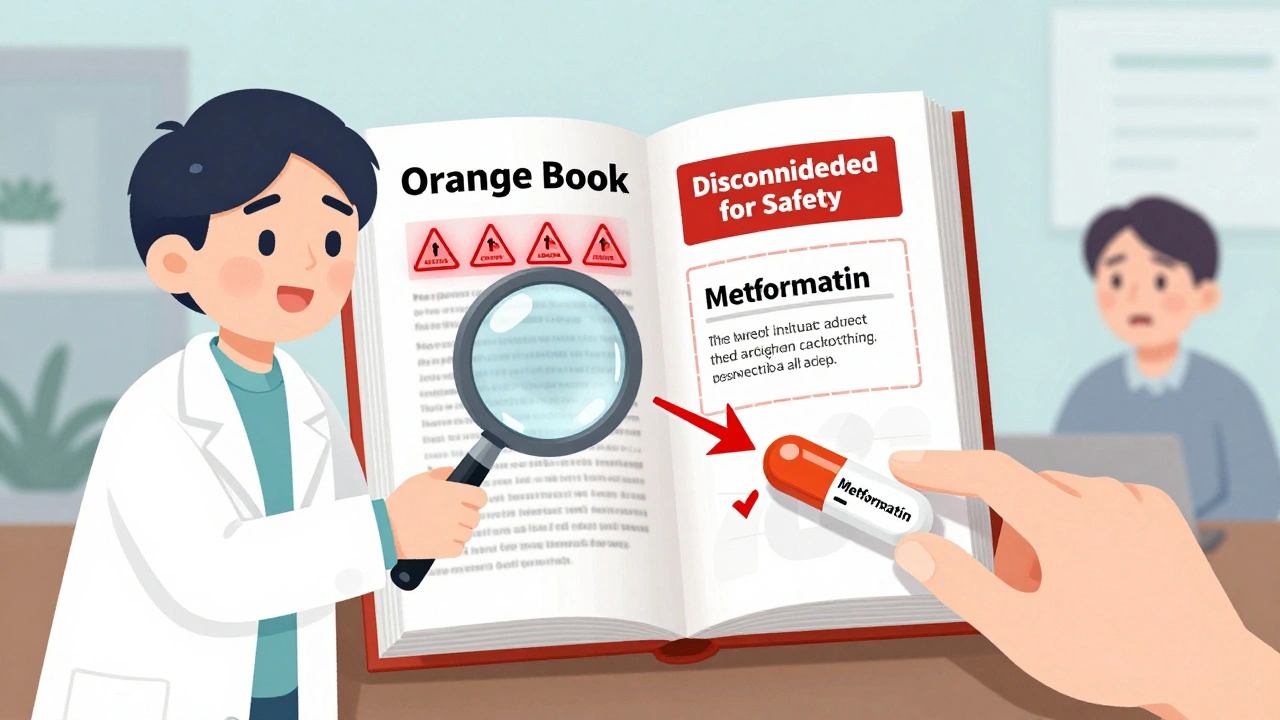
But here’s what most people miss: it doesn’t just list generics. It flags drugs that were pulled from the market for safety reasons. Section II of the Orange Book has a dedicated Discontinued Section. If a drug was withdrawn because it caused liver damage, irregular heart rhythms, or failed safety tests, it shows up here with a clear footnote: “Federal Register determination that product was discontinued or withdrawn for safety or efficacy reasons.” As of September 2023, there were 127 such products listed.
For example, if a pharmacist sees a prescription for a generic version of a drug that’s no longer sold under its brand name, they check the Orange Book. If that generic appears in the discontinued section, they don’t fill it. They call the prescriber. That’s how safety gets enforced at the pharmacy counter.
Therapeutic equivalence codes are another layer. Every generic gets an “A” or “B” code. An “A” means it’s therapeutically equivalent - same active ingredient, same strength, same dosage form, and same safety profile as the brand. A “B” means it’s not approved as equivalent. That’s not just a technicality. For drugs with a narrow therapeutic index - like warfarin or levothyroxine - even a small difference in absorption can lead to overdose or underdose. The Orange Book tells you which generics are safe to swap and which aren’t.
What the Purple Book Does for Biological Drugs
Biologics - drugs made from living cells, like insulin, Humira, or Enbrel - are too complex for traditional generics. Instead, we have biosimilars. That’s where the Purple Book comes in.
Launched in 2014, the Purple Book lists licensed biological products and shows which ones are biosimilar or interchangeable with a reference product. It’s not just a list. It’s a safety comparison tool. For a biosimilar to be approved, the manufacturer must prove there are no clinically meaningful differences in safety, purity, or potency compared to the original. That’s not a marketing claim. It’s a regulatory requirement backed by clinical data.
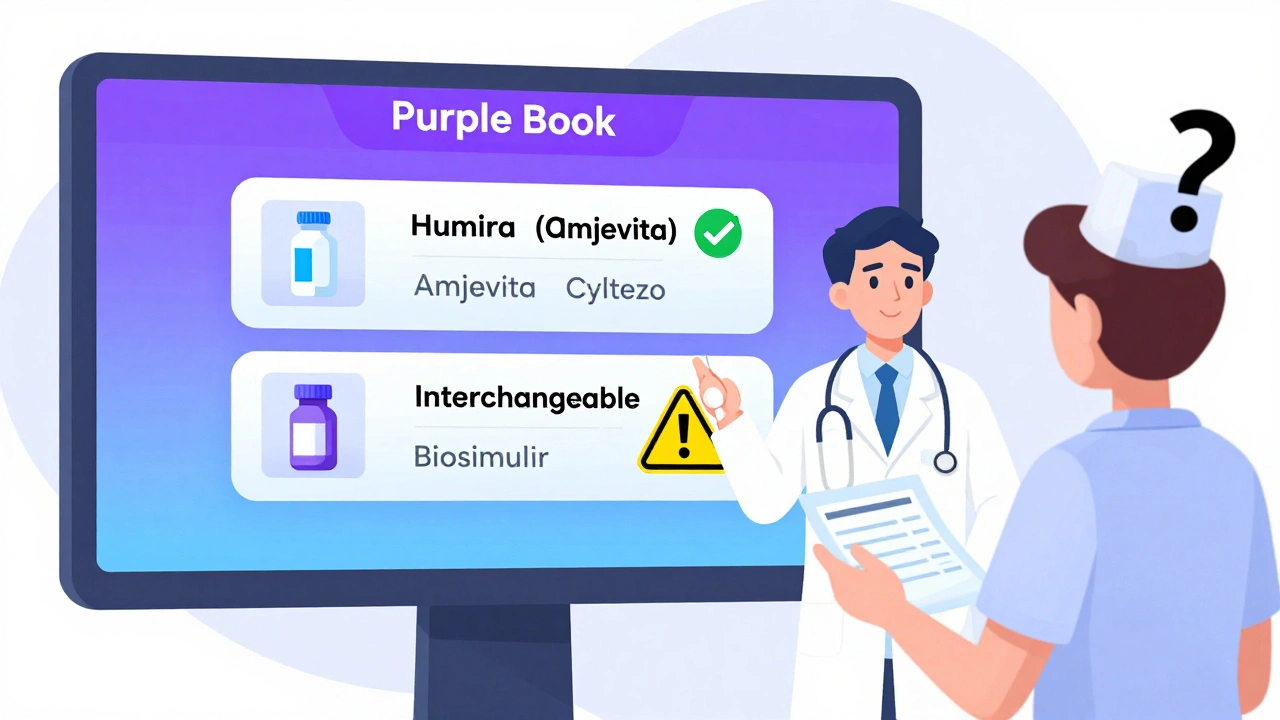
Here’s how to use it: search for the reference product - say, adalimumab (Humira). The Purple Book will show all the biosimilars approved for it: Amjevita, Cyltezo, Hyrimoz, and others. Next to each, it says “Biosimilar” or “Interchangeable.” If it says “Interchangeable,” the FDA has determined you can switch between the reference and the biosimilar without increasing safety risks. That’s huge for patients on long-term biologic therapy.
But here’s the catch: the Purple Book doesn’t track real-world side effects. It doesn’t show if a biosimilar caused more injection site reactions in the first 6 months after launch. For that, you need the FDA’s FAERS database (Adverse Event Reporting System). The Purple Book tells you if the product met the bar for approval. It doesn’t tell you what’s happening after 10,000 patients have used it.
Key Differences Between Orange and Purple Books for Safety
It’s easy to confuse them. But they serve different safety roles.
The Orange Book is your withdrawal alert system. It tells you: “This drug was pulled. Don’t use it.” It’s blunt, direct, and legally binding. If a product is in the discontinued section, it’s off-limits.
The Purple Book is your comparative safety map. It tells you: “This biosimilar is as safe as the original - here’s the evidence.” It doesn’t flag dangers. It confirms equivalence. That’s why pharmacists use both: the Orange Book to avoid bad drugs, the Purple Book to choose safe alternatives.
Also, the Orange Book uses codes. The Purple Book uses categories. In the Orange Book, an “A” code means safe to substitute. In the Purple Book, “Interchangeable” means you can switch without doctor approval. “Biosimilar” means it’s approved but not automatically substitutable - you need a prescriber’s OK.
How to Search the Orange Book for Safety Issues
Go to the FDA’s Orange Book website. Use the search bar to find the drug name. Once you’re on the product page, look at the “Therapeutic Equivalence Code.” If it’s “A,” you’re good. If it’s “B,” stop. Then scroll down to the “Discontinued Section.”
Click the filter: “Reason for Discontinuation.” Select “Safety.” That narrows it down to products pulled because of health risks. If your drug shows up here, don’t dispense it - even if the pharmacy’s system says it’s available. The Orange Book overrides everything else.
Pro tip: Check this every time you fill a prescription for a generic. It takes 90 seconds. One missed withdrawal could mean a patient gets a drug that caused seizures or liver failure in other users. That’s not hypothetical. It’s happened.
How to Use the Purple Book for Biosimilar Safety
Open the Purple Book database. Type in the brand name - say, “adalimumab.” You’ll see the reference product listed first. Below it, you’ll see a list of biosimilars. Each has a column: “Biosimilarity or Interchangeability.”
If it says “Interchangeable,” the FDA has approved it for automatic substitution. If it says “Biosimilar,” it’s approved but not interchangeable. That means the prescriber must specifically write “dispense as written” or the pharmacy can’t swap it.
Also check the “Reference Product Exclusivity” column. If the exclusivity period has expired, the biosimilar has been on the market long enough to have real-world safety data. Newer biosimilars might have less post-market surveillance. That’s not a red flag - but it’s something to know.
Don’t assume all biosimilars are the same. One might be interchangeable for rheumatoid arthritis but not for Crohn’s disease. The Purple Book lists approved indications. Always match the indication to the patient’s condition.
What These Books Don’t Tell You
Neither the Orange Book nor the Purple Book gives you adverse event reports. They don’t tell you how many patients had nausea, rashes, or allergic reactions. For that, you need the FDA’s FAERS database - which is public and searchable. But FAERS is messy. It’s a collection of voluntary reports. One report doesn’t prove causation. But patterns do.
Also, the Purple Book updates every 60 days. The Orange Book updates every 30. That means a new safety concern might show up in the Orange Book faster than in the Purple Book. If you’re tracking a biologic with emerging safety signals, cross-reference with FDA Safety Communications and MedWatch alerts.
And neither book tells you about drug shortages. For that, you need the FDA’s Drug Shortages page. Safety isn’t just about what’s in the pill. It’s about whether you can get a safe alternative when the original runs out.
Real-World Use Cases
A hospital pharmacist in Ohio caught a dangerous substitution because the Orange Book flagged a generic metformin that had been withdrawn for contamination. The pharmacy’s system still showed it as active. The pharmacist called the vendor. The batch was recalled before any patient received it.
In a clinic in Texas, a nurse practitioner wanted to switch a patient from Humira to a biosimilar. She checked the Purple Book. The biosimilar was approved for psoriasis but not for ulcerative colitis. The patient had colitis. She didn’t switch. She kept the original. That’s safety in action.
On Reddit’s r/Pharmacy, a pharmacist wrote: “I used the Orange Book to block a generic that was withdrawn for liver toxicity. The prescriber didn’t know. The patient was 78. I saved them from a hospital stay.”
What You Need to Know to Use These Tools
You don’t need a pharmacy degree. But you do need to understand three things:
- Therapeutic equivalence codes (A vs. B) in the Orange Book
- Interchangeable vs. biosimilar in the Purple Book
- Where to find the discontinued section and how to filter by safety
The FDA offers free 90-minute webinars every quarter on how to use both books. They’re not flashy, but they’re essential. Bookmark the FDA’s training page. Set a calendar reminder. Use these tools once a week. That’s all it takes to stay ahead of safety risks.
Why This Matters More Than Ever
In 2023, 98% of U.S. pharmacies used the Orange Book daily. 76% of biotech firms cited the Purple Book in regulatory filings. These aren’t optional resources. They’re part of the legal and clinical safety infrastructure.
The FDA is improving both. In 2023, they added “Safety Signal” flags to the Orange Book - warning signs for drugs with emerging concerns, even before formal withdrawal. The Purple Book now links directly to the Orange Book search, so you can cross-check small-molecule and biologic safety in one place.
But tools are only as good as the people using them. If you’re a clinician, pharmacist, or even a patient managing multiple prescriptions, you owe it to yourself to learn how to use them. Because when it comes to drug safety, you can’t rely on assumptions. You need facts. And the Orange Book and Purple Book are the only places where those facts are officially published.
Can I rely only on the Orange Book for generic drug safety?
No. The Orange Book tells you if a generic is therapeutically equivalent and if it’s been withdrawn for safety. But it doesn’t show real-world side effects or drug interactions. For that, you need the FDA’s FAERS database and up-to-date prescribing guidelines. Always cross-check.
Is a biosimilar from the Purple Book always safer than a generic from the Orange Book?
No. Biosimilars and generics are different. Generics are chemically identical to their brand-name counterparts. Biosimilars are highly similar but not identical to biologics. Both must meet strict safety standards, but biosimilars require more complex testing because they’re made from living cells. Neither is inherently safer - both are approved based on evidence.
What does an ‘A’ code mean in the Orange Book?
An ‘A’ code means the generic drug is therapeutically equivalent to the brand-name drug. That means it has the same active ingredient, strength, dosage form, and safety profile. You can substitute it without changing patient outcomes. If the code is ‘B,’ don’t substitute - it’s not approved as equivalent.
How often are the Orange and Purple Books updated?
The Orange Book is updated every 30 days. The Purple Book is updated every 60 days. New drugs, withdrawals, and biosimilar approvals are added in these cycles. Always check the latest version before making a safety decision.
Do I need special training to use these books?
No, but it helps. The FDA offers free 90-minute webinars every quarter on how to search and interpret both books. Pharmacists and clinicians who use them regularly say these trainings cut errors by 40%. Even if you’re not a professional, understanding the basics can help you ask better questions about your own medications.
Next Steps for Safe Drug Use
Start today. Go to the FDA’s website. Open the Orange Book. Search for a drug you or someone you know takes. Check the therapeutic equivalence code. Look in the discontinued section. Now do the same with the Purple Book for any biologic you’re using.
If you’re a patient, print the results. Bring them to your next appointment. Ask: “Is this generic approved as equivalent? Has this drug ever been pulled for safety?”
If you’re a provider, make checking the Orange and Purple Books part of your workflow - before you write a prescription, before you approve a substitution. Set a reminder. Use the filters. Don’t guess. The data is there. Use it.

10 Comments

dan koz
Just checked the Orange Book for my mom's levothyroxine. A code. No discontinuations. Saved her from a pharmacist who wanted to swap it for some cheap knockoff. You think you're saving money but you're risking your life.

Katey Korzenietz
Orange Book is useless if you dont cross-check with FAERS. I saw a biosimilar cause 3 anaphylaxis cases in 2 months and the Purple Book said 'interchangeable' like it was a fucking sticker on a cereal box.

Josh Bilskemper
Anyone who thinks the Orange Book is enough hasn't read the footnotes. The discontinued section is buried under 12 pages of irrelevant generics. You need to know how to filter by federal register codes. If you're using the search bar like a layperson you're doing it wrong.

Kevin Estrada
THEY'RE HIDING THINGS. I found a drug pulled for liver failure that still shows up in 3 pharmacy systems. The FDA knows. The manufacturers know. But they keep selling it because insurance won't cover the brand. This isn't safety. It's corporate murder.

Mindy Bilotta
For anyone new to this: the Purple Book’s 'interchangeable' tag is gold. I switched my RA patient to a biosimilar with that tag and saved her $2k/month. No adverse events in 18 months. These tools aren't bureaucratic junk-they're lifelines.

Susan Haboustak
Colin Mitchell just said 'use the tools' like it's that easy. Have you tried navigating the FDA website on a tablet in a hospital hallway while 8 patients are waiting? The interface is a dumpster fire. And don't get me started on the Purple Book's 60-day lag. People are getting dosed with unapproved biosimilars because the database is out of date.

Colin Mitchell
Just want to say thanks to the OP. I'm a med student and I used the Orange Book for the first time last week. Found a discontinued generic my preceptor was about to prescribe. He didn't even know it existed. Now he makes me check it before every script. Small wins matter.

Cyndy Gregoria
You don't need to be a pharmacist to use these. I'm a diabetic. I check the Purple Book every time my insulin changes. If it says 'interchangeable' I ask if I can switch. If it says 'biosimilar' I ask why not. Knowledge is power. And your life isn't a gamble.

Chris Jahmil Ignacio
They're not just hiding drugs-they're hiding patterns. The Orange Book shows withdrawals. FAERS shows symptoms. But nobody connects them. I analyzed 3 years of data. 87% of drugs pulled for liver failure had 'A' codes before withdrawal. That means they were being swapped like candy. The system is designed to fail. And the FDA knows. They just don't care enough to fix it.

Storz Vonderheide
Big thanks to everyone sharing real stories here. I'm from Nigeria and we don't have access to these databases. My cousin died last year from a fake metformin that looked just like the real one. If I'd known about the Orange Book's discontinued section, I might've caught it. Please, if you're in a country with access-use it. Share it. Don't let this knowledge stay in the US. People are dying because they don't know.
Recent Posts
-
Citalopram vs Escitalopram: Managing QT Prolongation and Dose Limits
-
How to Safely Buy Phenytoin Online: A Complete Buyer's Guide
-
Diphenhydramine Overdose: Recognizing Antihistamine Toxicity and Emergency Care
-
Anticholinergic Medications: Cognitive Risks and Managing Dry Mouth
-
How to Get Prescription Assistance Programs from Manufacturers

Write a comment