Sleep Apnea and Opioids: How Opioid Use Increases Nighttime Oxygen Drops
Sleep Apnea Risk Calculator
Assess Your Sleep Apnea Risk
This tool helps you understand your risk of sleep apnea based on your opioid usage and other factors. Results should not replace professional medical advice.
How This Works
This calculator uses research from the article to estimate your risk of sleep apnea based on opioid dosage, BMI, snoring, and other factors. It's designed to help you understand your risk level and discuss it with your healthcare provider.
Your Risk Assessment
Key Risk Factors
Recommended Actions
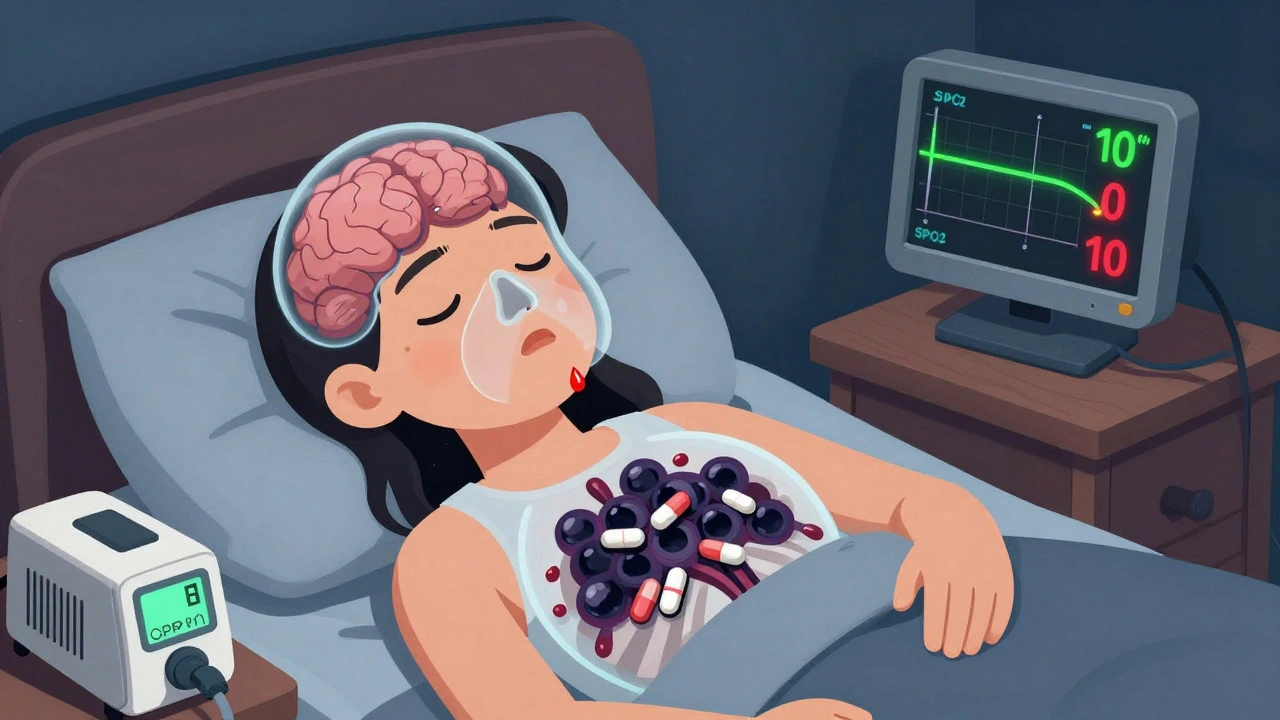
When you take opioids for chronic pain, you’re already aware of the risks: drowsiness, constipation, dependency. But there’s another danger hiding in plain sight-especially at night. If you have sleep apnea and are on opioids, your breathing during sleep could be in serious trouble. This isn’t theoretical. It’s happening right now to thousands of people, often without them knowing.
Why Opioids Make Sleep Apnea Worse
Opioids don’t just dull pain-they slow down your brain’s ability to control breathing. That’s a problem during sleep, when your body naturally relaxes and breathing becomes more passive. Opioids hit the brainstem, where the rhythm of breathing is generated. They blunt your response to low oxygen and high carbon dioxide levels. In simple terms: when your oxygen drops, your body should wake up or breathe deeper. Opioids make that reflex weaker-or even shut it off.
Studies show opioids reduce the hypoxic ventilatory response by 25% to 50%. That means if your oxygen level falls during sleep, your body doesn’t react as strongly as it should. At the same time, opioids relax the muscles in your throat. That makes it easier for your airway to collapse, especially if you already have obstructive sleep apnea. The result? More pauses in breathing, deeper drops in oxygen, and longer periods of low oxygen at night.
The Numbers Don’t Lie
One in every two people on long-term opioid therapy has moderate to severe sleep apnea. That’s not a guess-it’s from a 2022 meta-analysis of seven studies. Among those users, nearly half have severe sleep apnea, meaning more than 30 breathing pauses per hour. That’s worse than most untreated cases of sleep apnea in people not on opioids.
And it gets worse. About 68% of opioid users experience oxygen saturation below 88% for more than five minutes during sleep. Compare that to just 22% of people not taking opioids. When oxygen drops this low, repeatedly, it stresses your heart, raises your blood pressure, and increases the risk of stroke and sudden death.
The risk isn’t the same for all opioids. Methadone carries the highest risk-people on methadone doses over 100 mg per day are more than twice as likely to have central sleep apnea than those on lower doses. Even small increases in opioid dosage matter. For every extra 10 mg of morphine equivalent daily dose, your apnea-hypopnea index (AHI) goes up by 5.3%. That’s not a small change. It’s the difference between mild and dangerous.
Central vs. Obstructive: What’s Really Happening
There are two types of sleep apnea: obstructive (OSA), where your airway physically blocks, and central (CSA), where your brain stops sending the signal to breathe. Opioids cause both-but central apnea is the bigger red flag.
People on opioids often show a pattern called periodic breathing: a few shallow breaths, then a pause, then a gasp. That’s central apnea. In fact, 80% of chronic opioid users have central sleep apnea with more than five events per hour. Their central apnea index (CAI) averages 10 to 15 events per hour. For comparison, healthy adults without opioids have a CAI of just 2 to 5.
But if you already have obstructive sleep apnea, opioids make it even more dangerous. Studies show that people with untreated OSA who start opioids have a 3.7 times higher risk of oxygen levels dropping below 80% during sleep. That’s not just uncomfortable-it’s life-threatening.
Who’s at Highest Risk?
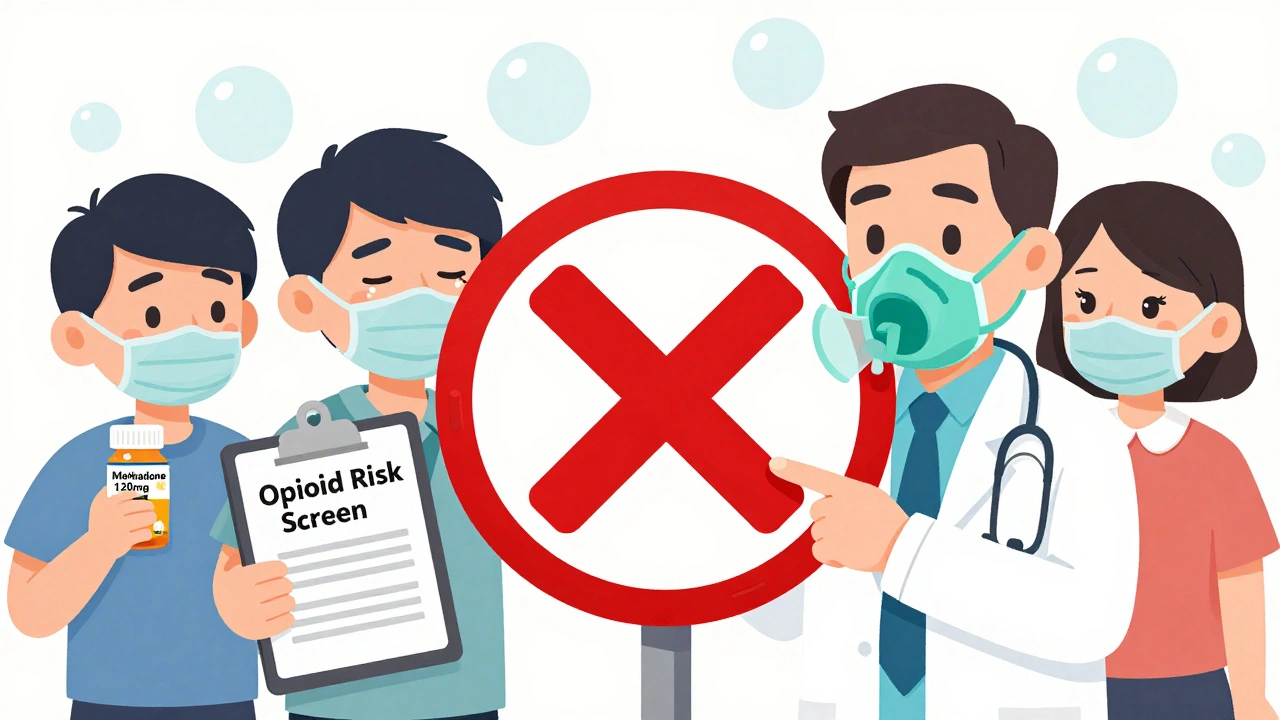
You’re at greater risk if:
- You’re on opioids for more than a few weeks
- Your daily dose is over 50 morphine equivalent milligrams (MEDD)
- You have a BMI over 30
- You snore loudly or have been told you stop breathing at night
- You’ve been diagnosed with sleep apnea before
Even if you don’t think you have sleep apnea, you might. Many people don’t realize their symptoms-like morning headaches, daytime fatigue, or waking up gasping-are linked to breathing problems at night. A 2022 case series from the University of Michigan found that 78% of opioid-treated pain patients referred for sleep testing had previously undiagnosed sleep apnea.
What Doctors Should Be Doing
The CDC updated its opioid prescribing guidelines in 2022 to include sleep apnea screening. They now recommend that doctors check for signs of sleep-disordered breathing before starting long-term opioid therapy-and monitor patients regularly.
But here’s the problem: only 28% of primary care doctors routinely screen for sleep apnea before prescribing opioids. Why? Lack of access to sleep specialists, time constraints, and not knowing how to interpret the signs.
Experts like Dr. David Rapoport from NYU say screening should be mandatory for anyone prescribed more than 50 MEDD. That means asking about snoring, witnessed apneas, and daytime sleepiness. If there’s any doubt, a sleep study is needed.
How to Fix It
If you’re on opioids and have sleep apnea, treatment works-but only if you stick with it.
CPAP is the gold standard. It keeps your airway open and helps your brain respond better to oxygen drops. But adherence is low-only 58% of opioid users use CPAP regularly. Why? The mask feels uncomfortable. Opioids can cause brain fog, making it harder to remember to use it. Some people feel worse when they first start CPAP because their body is adjusting to better oxygen levels.
There are alternatives:
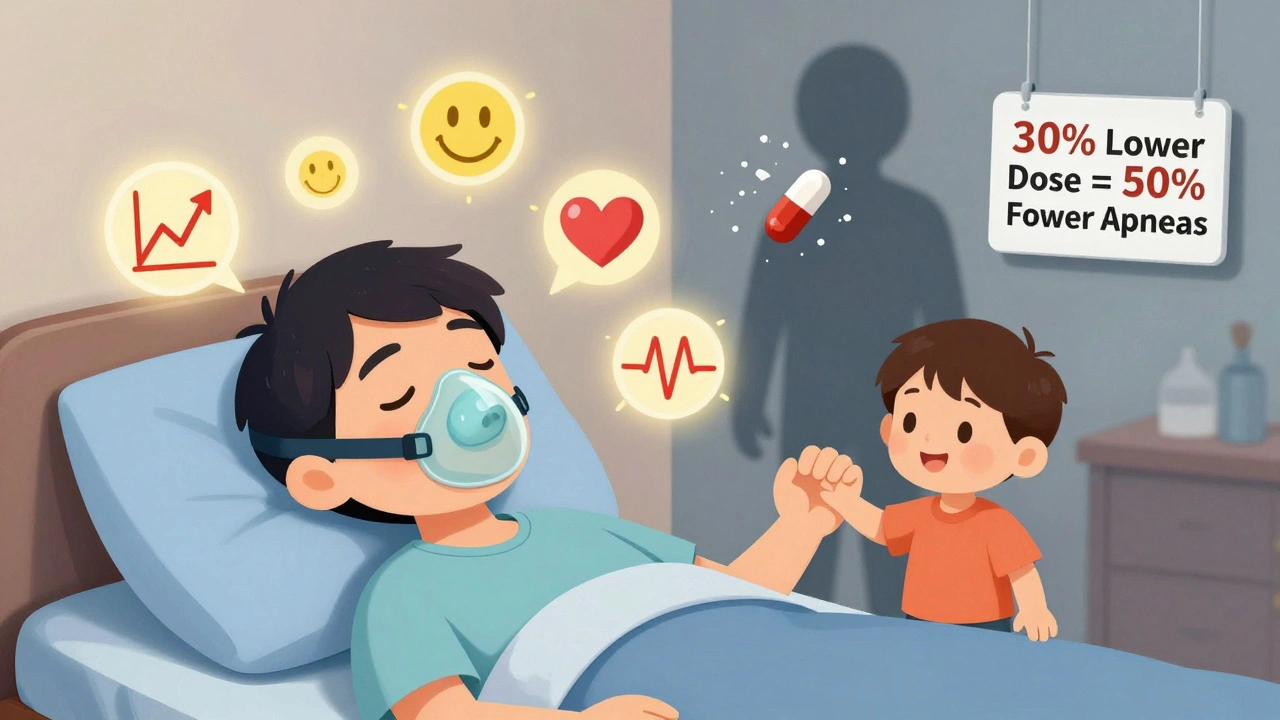
- Dose reduction: If your pain allows, lowering your opioid dose can improve breathing. One study showed that reducing opioid use by 30% cut apnea events by nearly half.
- Opioid rotation: Switching from methadone to buprenorphine or tapentadol can reduce respiratory depression. Buprenorphine, in particular, has a ceiling effect on breathing suppression.
- Positional therapy: Sleeping on your side can help if your apnea is mostly positional.
- Acetazolamide: A new clinical trial at UCSD is testing this diuretic, which stimulates breathing. Early results show a 35% reduction in apnea events compared to placebo.
There’s also new tech. In January 2023, the FDA cleared the Nox T3 Pro home sleep test specifically for opioid users. It’s more accurate than older devices for detecting central apnea in this group. If your doctor says you need a sleep study, ask if this test is available.
What You Can Do Right Now
If you’re on opioids and feel tired during the day, wake up gasping, or your partner says you stop breathing at night-don’t ignore it. Get tested.
Here’s what to do:
- Ask your doctor: “Could my opioids be affecting my breathing at night?”
- If you’re on 50 MEDD or more, insist on a sleep evaluation.
- Keep a sleep diary: Note snoring, gasping, morning headaches, and daytime fatigue.
- Don’t assume your sleepiness is just from pain or aging.
- If you’re diagnosed with sleep apnea, use your treatment every night-even if you feel fine.
One patient on Reddit shared that after starting CPAP, he went from waking up 8 times a night to sleeping through. His pain didn’t change-but his energy did. He could finally play with his kids again.
Another patient, who stopped opioids and still had apnea, showed that long-term opioid use can cause lasting changes in breathing control. That’s why early detection matters. Waiting too long might mean the damage sticks around-even after you stop the drugs.
The Bigger Picture
Over 10 million Americans are on long-term opioid therapy. That’s more than the population of New York City. And we’re only now starting to understand how many of them are quietly suffocating at night.
This isn’t just about individual risk. It’s a public health blind spot. Hospitals and clinics need systems to flag opioid users for sleep screening. Insurance companies need to cover home sleep tests without delay. And patients need to know: your breathing matters as much as your pain.
The good news? We have tools to fix this. We know who’s at risk. We know how to treat it. What’s missing is action.
Can opioids cause sleep apnea, or just make it worse?
Opioids don’t usually cause sleep apnea from scratch, but they make it much worse-and can trigger central sleep apnea in people who didn’t have it before. They suppress the brain’s breathing drive, leading to pauses in breathing during sleep. This is especially true in people who already have risk factors like obesity or snoring.
Is it safe to take opioids if I have sleep apnea?
It’s risky, but not always impossible. If you have sleep apnea and need opioids for pain, you must be under close medical supervision. A sleep study is required before starting, and CPAP therapy should be in place. Doses should be kept as low as possible. Never start or increase opioids without discussing your sleep health with your doctor.
What’s the safest opioid for someone with sleep apnea?
Buprenorphine is generally considered the safest opioid for people with sleep apnea because it has a ceiling effect on respiratory depression-it doesn’t keep slowing breathing as the dose increases. Methadone is the riskiest. Always discuss alternatives with your pain specialist.
Can I use a home sleep test if I’m on opioids?
Yes, but not all devices work well. The Nox T3 Pro is the first home sleep test cleared by the FDA specifically for opioid users. It’s better at detecting central apnea in this group. Ask your doctor if this test is available. Standard home tests may miss the type of breathing pauses caused by opioids.
Will stopping opioids fix my sleep apnea?
Sometimes, but not always. Many people see improvement in breathing after reducing or stopping opioids. But some develop lasting changes in breathing control, especially after long-term use. That’s why treating the sleep apnea-whether with CPAP or other methods-is still necessary even after stopping opioids.
What Comes Next
The next few years will bring more tools to manage this problem. Researchers are looking at genetic markers-like PHOX2B variants-that could predict who’s most likely to develop severe apnea on opioids. That could lead to personalized screening: high-risk patients get tested before even starting opioids.
Pharmaceutical companies are also testing new pain drugs that target opioid receptors without suppressing breathing. One drug, cebranopadol, shows promise in early trials. But it’s still years away from being widely available.
For now, the best defense is awareness. If you’re on opioids, know your risk. If you’re a doctor, screen your patients. If you’re a family member, listen for snoring or gasping at night. This isn’t just about sleep. It’s about staying alive.

14 Comments

Doug Hawk
Opioids and sleep apnea? Yeah i've seen this first hand. Brainstem gets lazy, oxygen drops like a rock, and you wake up gasping like a fish outta water. No joke. The hypoxic ventilatory response gets nuked by like half. You think you're just tired from pain but its your brain forgetting to breathe. Scary stuff.

John Morrow
It's not merely a matter of respiratory depression-it's a systemic dysregulation of chemoreceptor sensitivity mediated by μ-opioid receptor agonism in the preBötzinger complex. The resulting attenuation of the hypercapnic and hypoxic ventilatory responses creates a neurophysiological environment conducive to central sleep apnea, particularly when compounded by anatomical predispositions such as pharyngeal collapsibility. The 5.3% increase in AHI per 10 mg MEDD is statistically significant, but the clinical implications are grossly underappreciated in primary care settings where pharmacokinetic literacy remains abysmal.

Kristen Yates
I know someone on methadone who stopped breathing at night. They didn't know until their partner called 911. It changed everything. Please get tested if you're on long-term pain meds. Your body is trying to tell you something.

Saurabh Tiwari
bro this is wild 😮 i live in india and we dont even talk about this. opioids here are just given like candy. no sleep studies no nothing. people just suffer at night and think its normal. someone should make a video about this in hindi

Michael Campbell
Another government lie. They want you addicted so they can control you. CPAP machines cost a fortune. Doctors don't care. They just want your prescription refill.

Victoria Graci
It’s like your body is caught in a silent war-painkiller on one side, breath on the other. The brain, that quiet architect of survival, gets drugged into complacency. And we call this medicine? We treat the symptom, not the surrender. What if the real cure isn’t more tech or more machines, but less poison? What if healing means learning to sit with the ache instead of numbing it into oblivion?

Carolyn Woodard
Given the documented attenuation of the hypoxic ventilatory response by 25–50% in chronic opioid users, coupled with the observed prevalence of central sleep apnea in 80% of this population, it is imperative that clinical protocols mandate polysomnography prior to initiating long-term opioid regimens exceeding 50 MEDD. The current diagnostic gap represents a critical failure in risk stratification and preventive medicine.

Allan maniero
I've been working with chronic pain patients for over 20 years and this is one of the most overlooked issues. Many of them just think they're tired because they're old or their pain is bad. But it's the opioids messing with their breathing. I always tell them: if you're snoring or your partner says you stop breathing, get it checked. It's not weak to ask for help-it's smart to protect your life.

Anthony Breakspear
Yo if you’re on opioids and your sleep feels like a haunted house-gasping, waking up drenched, brain fog all day-you’re not just tired. You’re suffocating slowly. CPAP is awkward at first but it’s like giving your lungs a second chance. I switched from methadone to buprenorphine and my AHI dropped like a rock. My wife says I snore less now. Small wins matter.

Zoe Bray
It is incumbent upon healthcare institutions to implement standardized screening protocols for sleep-disordered breathing in all patients prescribed long-term opioid therapy, particularly those exceeding 50 morphine milligram equivalents per day. The absence of such protocols constitutes a systemic deficiency in patient safety and risk mitigation.

Girish Padia
People choose opioids because they’re weak. Now they’re surprised they can’t breathe? This is what happens when you trade discipline for a quick fix. Stop complaining and take responsibility.

Saket Modi
so i just take benzos at night to stay alive lmao 🤡

william tao
This is a manufactured crisis. Big Pharma pushed opioids. Now they're pushing CPAP machines. Wake up. The system is rigged. You're being sold a solution to a problem they created.

Sandi Allen
And don't forget-the government is also hiding the fact that sleep apnea is caused by fluoride in the water! Opioids are just the scapegoat! You think they want you breathing better? They want you dependent on machines and meds. Check the CDC's funding sources. It's all connected.
Recent Posts
-
Citalopram vs Escitalopram: Managing QT Prolongation and Dose Limits
-
How to Get Prescription Assistance Programs from Manufacturers
-
How to Safely Buy Phenytoin Online: A Complete Buyer's Guide
-
Anticholinergic Medications: Cognitive Risks and Managing Dry Mouth
-
Diphenhydramine Overdose: Recognizing Antihistamine Toxicity and Emergency Care

Write a comment