Sleep Hygiene: Proven Behavioral Changes to Improve Sleep Quality
Most people think poor sleep is just a matter of being tired. But if you’ve been lying awake for hours, tossing and turning, or waking up exhausted even after 8 hours in bed - it’s not just about how much sleep you’re getting. It’s about how you’re sleeping. That’s where sleep hygiene comes in. Not the kind you do in the bathroom. This is about the daily habits that either help your body fall asleep naturally or sabotage it without you even realizing.
What Sleep Hygiene Really Means
Sleep hygiene isn’t a fancy term for buying expensive pillows or buying lavender spray. It’s a set of simple, science-backed behaviors that train your brain and body to sleep better. The concept was first formalized in the 1970s by sleep researchers at the Mayo Clinic, and today it’s backed by decades of clinical data. The American Academy of Sleep Medicine and the National Sleep Foundation both agree: for most people, improving sleep hygiene is the first and most effective step - before pills, devices, or therapy.
It works because sleep isn’t passive. Your body follows a rhythm - your circadian clock - that’s influenced by light, temperature, food, and routine. When your habits clash with that rhythm, your brain stays alert even when you’re exhausted. Fix those habits, and your sleep improves - often dramatically.
The Four Core Behaviors That Actually Work
Not all sleep advice is created equal. Some tips you’ve heard - like avoiding exercise at night or drinking warm milk - have little proof. But four behaviors have been proven again and again to make a real difference.
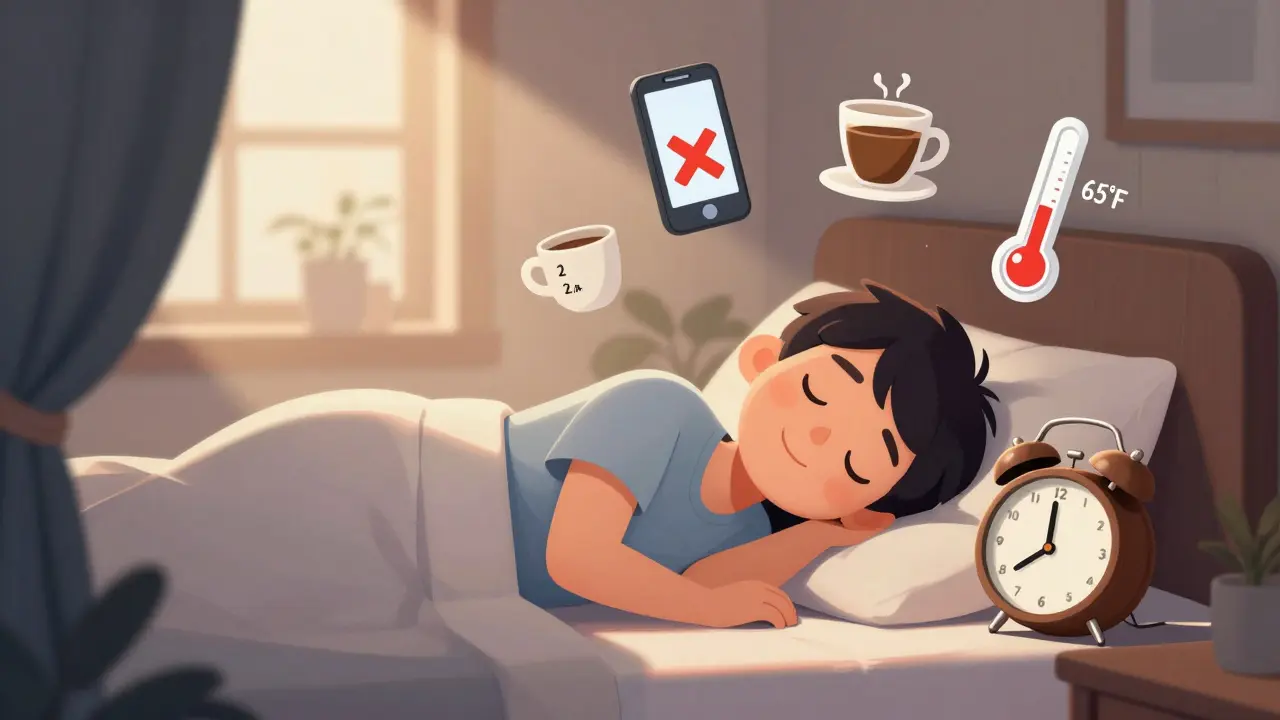
- Consistent wake time: This is the single most powerful habit. Going to bed at the same time every night helps, but waking up at the same time - even on weekends - is what resets your internal clock. A 2023 study found that people who woke up within 30 minutes of their usual time every day cut their sleep onset time in half. If you normally wake at 7 a.m., don’t sleep past 7:30 a.m. on Saturday. That’s it. No exceptions.
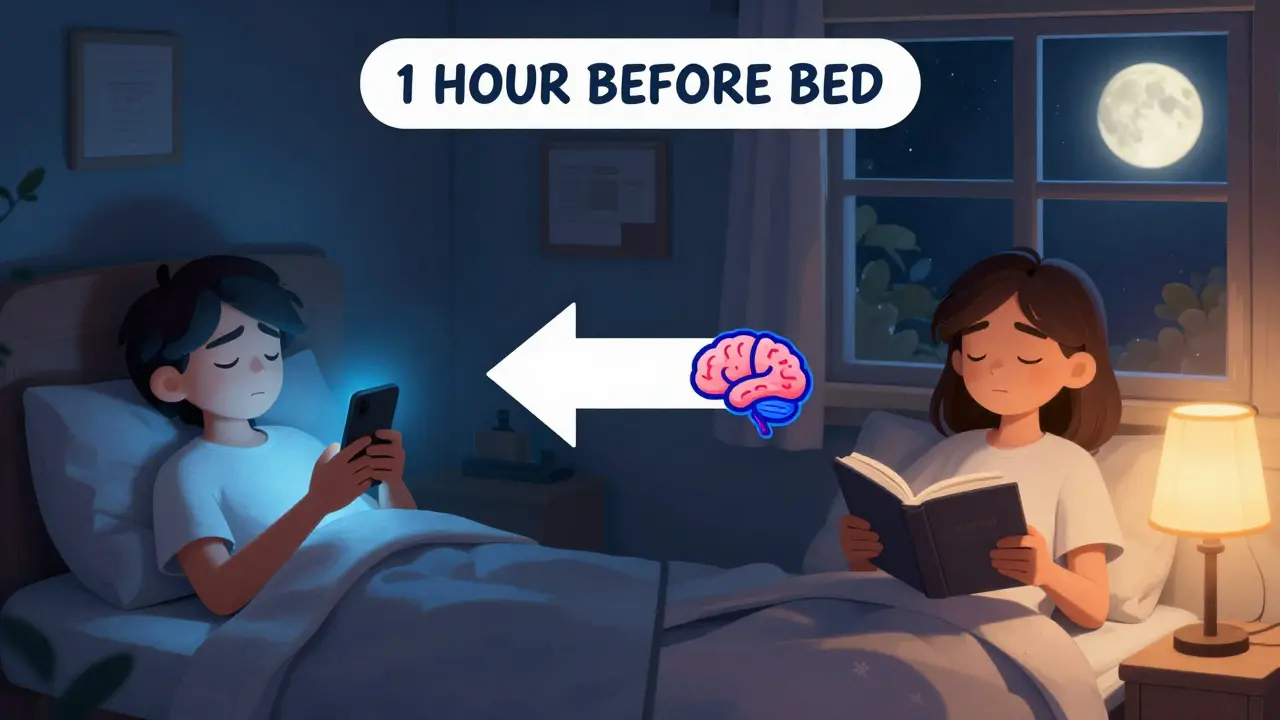
- Limit screen time before bed: Phones, tablets, and TVs flood your eyes with blue light, which tricks your brain into thinking it’s still daytime. The latest research shows blue light filters on phones help a little - but only by 4 to 7 minutes. The real fix? Put the phone down at least one hour before bed. Read a book. Listen to a podcast. Sit in silence. Your brain needs that wind-down signal.
- Keep your bedroom cool and dark: Your body needs to drop its core temperature to fall asleep. The ideal bedroom temperature? Between 60 and 67°F (15.6-19.4°C). Too warm? You’ll wake up sweating. Too cold? You’ll shiver. Use blackout curtains. If you can see your hand in front of your face when the lights are off, it’s too bright. Even a tiny LED from a charger can disrupt melatonin production.
- Avoid caffeine after 2 p.m.: Caffeine lasts in your system for 6 to 8 hours. That afternoon coffee? It’s still in your blood at midnight. A 2022 study of over 1,200 university students found that those who cut caffeine after 2 p.m. fell asleep 21 minutes faster on average. Tea, chocolate, and energy drinks count too. If you’re sensitive, try cutting it after noon.
What Doesn’t Work - And Why You’re Wasting Time
There’s a lot of noise out there. You’ve probably heard:
- “Don’t eat after 7 p.m.” - Not true. If you’re hungry, a small snack like a banana or a handful of almonds is fine. Heavy meals within 3 hours of bed? Yes, avoid those. But going to bed hungry? That can keep you awake too.
- “Avoid exercise at night.” - Actually, recent studies show evening exercise helps most people sleep deeper. The old rule was based on outdated assumptions. If you feel energized after a workout, it’s fine to go to bed 90 minutes later.
- “Take melatonin every night.” - Melatonin isn’t a sleep pill. It’s a timing signal. It helps if your body’s clock is out of sync - like after jet lag or shift work. But for most people with poor sleep habits, it does almost nothing. And long-term use? No one knows the full effects yet.
The biggest myth? That sleep hygiene is about perfection. You don’t need to follow every rule 100% of the time. You need to fix the big three: wake time, screens, and caffeine. The rest is noise.
Why You’re Not Seeing Results (And How to Fix It)
If you’ve tried sleep hygiene and it didn’t work, you’re not alone. Two out of three people give up too soon. Why?
First, it takes time. Most people don’t notice improvement until after 14 to 21 days of consistent effort. That’s because your body needs to relearn how to sleep. You can’t fix years of bad habits in a week.
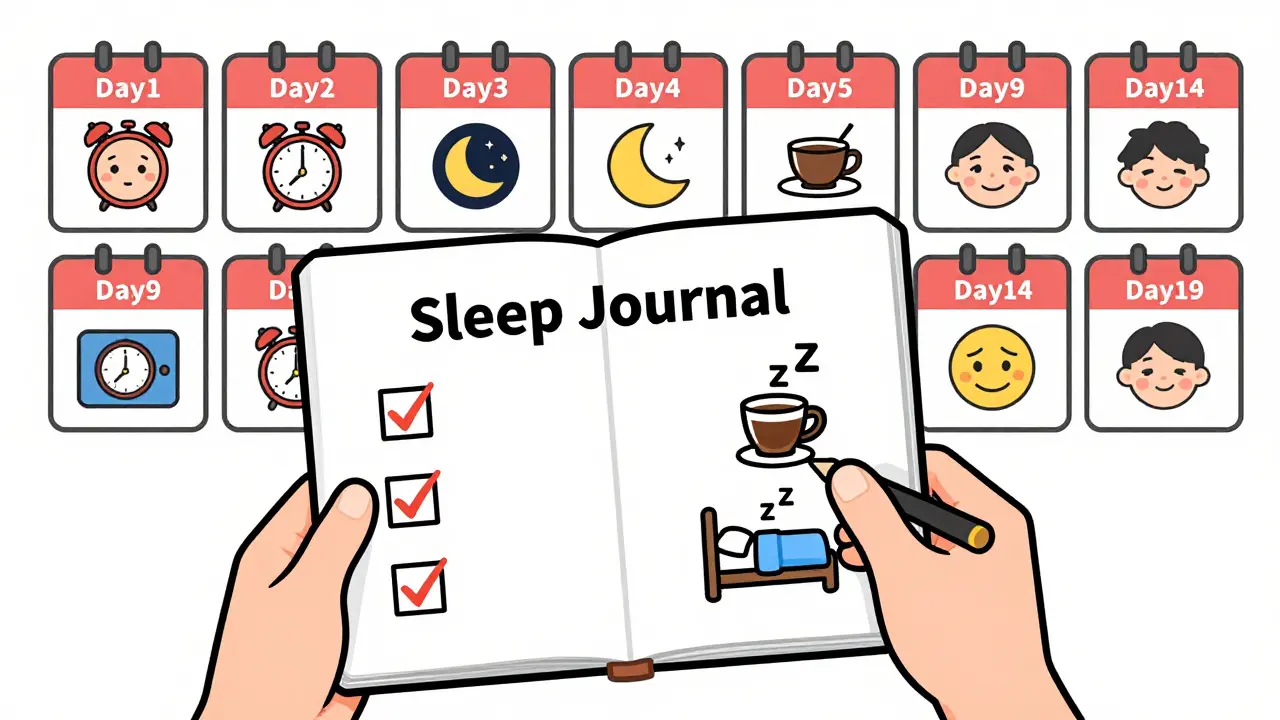
Second, people focus on the wrong things. They obsess over their mattress or buy a $300 sleep tracker. But the real problem? They still scroll through TikTok at 1 a.m. or hit snooze every day. Track your sleep for 7 days with a simple notebook. Write down:
- What time you got in bed
- What time you actually fell asleep
- What time you woke up
- Did you have caffeine after 2 p.m.?
- Did you use a screen in the hour before bed?
After a week, look for patterns. Do you fall asleep faster on days you didn’t check email before bed? That’s your clue.
Real People, Real Results
On Reddit’s r/sleep community, one user, u/NightOwlPhD, wrote: “I used to take 90 minutes to fall asleep. I started waking up at 6:30 a.m. every day - no matter what. In three weeks, I was falling asleep in 25 minutes. No pills. No apps. Just consistency.”
Another user, a nurse working night shifts, said: “I couldn’t sleep during the day. Then I started wearing blue-light-blocking sunglasses in the morning on my way home. I kept my room pitch black with blackout curtains. Now I sleep 6 hours straight. It’s not perfect, but it’s enough.”
These aren’t magic stories. They’re the result of sticking to the basics.
When Sleep Hygiene Isn’t Enough
Sleep hygiene is powerful - but it’s not a cure-all. If you’ve tried it for 4 weeks and still can’t sleep, or you wake up gasping, snore loudly, or feel exhausted even after 8 hours - you might have a medical issue. Sleep apnea, restless legs, or chronic anxiety aren’t fixed by better habits alone.
The American Academy of Sleep Medicine says sleep hygiene alone gets a “weak recommendation” for treating clinical insomnia (when you struggle to sleep at least 3 nights a week for 3 months). In those cases, you need cognitive behavioral therapy for insomnia (CBT-I). But here’s the good news: sleep hygiene makes CBT-I work better. It’s the foundation.
Think of it like brushing your teeth. You don’t brush once and expect never to get a cavity. You do it every day. Sleep hygiene is the same. It’s not a quick fix. It’s a lifelong habit.
How to Start Today - No Apps Needed
You don’t need to buy anything. You don’t need a subscription. Just pick one thing to change this week.
- Set your alarm for the same time every day - even Saturday. No snoozing.
- Put your phone on Do Not Disturb and charge it outside the bedroom.
- Stop drinking coffee after 2 p.m.
- Lower your thermostat to 65°F if you can.
Do just one. Stick with it for 10 days. Then add another. Don’t try to fix everything at once. That’s how people quit.
Most people think better sleep is about sleeping more. It’s not. It’s about sleeping better. And that starts with what you do during the day - not in bed.
How long does it take for sleep hygiene to work?
Most people start noticing improvements after 14 to 21 days of consistent practice. The body needs time to adjust its internal clock, especially if you’ve had poor sleep habits for years. Don’t expect overnight results - but stick with it, and you’ll see a real difference in how rested you feel.
Can I still use my phone before bed if I turn on night mode?
Night mode reduces blue light, but it doesn’t eliminate mental stimulation. Checking emails, scrolling social media, or watching videos keeps your brain active. Even if your eyes are less stimulated, your mind is still racing. The best approach is to avoid screens entirely for at least one hour before bed. If you must use your phone, read a book or listen to calming audio instead.
Is it bad to nap during the day?
Short naps (20-30 minutes) before 3 p.m. are usually fine and can boost alertness. But longer naps or naps later in the day interfere with nighttime sleep. If you’re having trouble falling asleep at night, try cutting naps entirely for a week. Many people find their sleep improves dramatically.
Does alcohol help me sleep better?
Alcohol might make you feel drowsy, but it fragments your sleep cycle. It suppresses REM sleep - the deep, restorative stage your brain needs. You may fall asleep faster, but you’ll wake up more often during the night and feel less refreshed in the morning. Avoid alcohol within 3 hours of bedtime.
What if I work night shifts? Can I still use sleep hygiene?
Yes - but you’ll need to adapt. The key is consistency. Even if you sleep during the day, keep the same sleep and wake times every day, including weekends. Use blackout curtains, wear sunglasses on your way home in the morning, and avoid bright light before bed. Your body can adjust to a reversed schedule - but only if you stick to it.
Can sleep hygiene help with anxiety-related insomnia?
It helps - but not enough on its own. Anxiety keeps your mind racing, and sleep hygiene doesn’t directly calm that. Combine it with mindfulness, journaling before bed, or talking to a therapist. Sleep hygiene creates the right environment, but you also need tools to quiet your thoughts. Together, they’re far more effective.
What Comes Next
If you’ve made these changes and still struggle, don’t blame yourself. Sleep is complex. But you’ve already done the hardest part: you’ve taken control. The next step might be tracking your sleep with a simple journal, talking to your doctor, or exploring CBT-I - a proven, drug-free therapy that’s covered by many insurance plans.
For now, focus on one habit. Wake up at the same time. Put your phone away. Skip the after-work coffee. Do it for 10 days. See how you feel. That’s how better sleep starts - not with a miracle cure, but with a small, consistent choice.

10 Comments

Monte Pareek
Sleep hygiene isn't magic it's biology you ignore your circadian rhythm for years then wonder why you're a zombie
Waking up at the same time every day is the only rule that matters everything else is noise
I used to sleep till noon on weekends then wonder why I couldn't fall asleep Sunday night
Fixed it by setting an alarm for 7am no exceptions not even after a 12 hour shift
Two weeks later I was falling asleep before my head hit the pillow
Stop overcomplicating it stop buying $200 pillows stop chasing sleep trackers
Just wake up on time and your body will do the rest
It's not about discipline it's about consistency your brain doesn't care about your excuses
One hour of screen time before bed is a lie you tell yourself
That phone isn't just blue light it's dopamine hell
You think you're relaxing but your brain is sprinting through notifications
Put it in another room
Read a book or stare at the wall
Your brain will thank you

holly Sinclair
I've spent years studying chronobiology and what you've outlined here is fundamentally correct but I think we're missing the deeper philosophical layer
Sleep hygiene isn't just a set of behaviors it's a surrender to natural order
We live in a culture that glorifies productivity and treats rest as a weakness
But the body doesn't negotiate with willpower
It follows cycles older than civilization
When we force ourselves to stay up scrolling or working or consuming we're not being productive we're fighting entropy
The circadian rhythm isn't a suggestion it's a law written in our DNA
That's why caffeine after 2pm is such a violation
It's not just about the half-life of methylxanthine
It's about rejecting the rhythm that evolved over millions of years
And the worst part
We know this
We've read the studies
We've seen the data
But we still choose distraction over harmony
Because the alternative requires stillness
And stillness terrifies us
So we keep scrolling
Even when we're exhausted
Even when we know better
It's not a sleep problem
It's a spiritual one

Kelly Mulder
Wow. Just wow. I'm genuinely shocked someone wrote this without mentioning the word circadian once
Actually no
They did mention it
But they used it like a casual noun
Not as the foundational neurochemical architecture of human physiology
And they didn't even cite the 2021 meta-analysis from Nature Neuroscience on melatonin receptor polymorphisms
Or the fMRI studies showing prefrontal cortex hyperactivation in poor sleepers
And they call this 'science-backed'?
What a laugh
It's like giving someone a recipe for sushi and calling it 'culinary science' because you mentioned rice
There's a reason sleep medicine is a subspecialty
Not because it's complicated
But because laypeople like you reduce it to memes and slogans
Wake up early
Stop scrolling
What a profound insight
Next you'll tell me water is hydrating

Lynsey Tyson
I tried this for two weeks and honestly it changed everything
I used to lie there for hours thinking about work
Now I just turn off the phone and read a page of a novel
It doesn't feel like a chore anymore
It feels like a gift
I still mess up sometimes
But I don't beat myself up
That's the thing nobody tells you
Perfection isn't the goal
Consistency is
Even one good habit makes a difference
Don't try to fix everything at once
Just pick one
And do it tomorrow too

Edington Renwick
Everyone's acting like this is some groundbreaking revelation
It's not
It's basic human biology
But you people need a 2000-word essay to understand that your phone is bad
And you still won't change
Because you'd rather blame your mattress than your 1am TikTok spiral
Wake up at 7am? No
I need my weekend sleep
Drink coffee at 4pm? Of course
It's my ritual
Don't tell me what to do
Just let me suffer
Because suffering is my identity
And if I fix my sleep
Then who am I?

anthony funes gomez
While the behavioral interventions described are empirically valid
they fail to address the neuroendocrine cascade underlying sleep architecture
Specifically
the downregulation of adenosine A1 receptors
in the basal forebrain
due to chronic circadian misalignment
and concurrent HPA-axis hyperactivity
which elevates cortisol at night
and suppresses melatonin synthesis
via SCN suppression
Thus
while sleep hygiene may improve sleep onset latency
it does not resolve the underlying pathophysiological dysregulation
which requires chronobiotic intervention
or pharmacological modulation
of GABAergic tone
in the VLPO
to restore homeostatic balance
and normalize sleep spindle density
which correlates with restorative sleep
Therefore
the assertion that sleep hygiene is sufficient
is a reductionist fallacy
that ignores the complexity of human neurobiology

Gloria Parraz
I was skeptical
But I did one thing
Put my phone in the kitchen at night
Just one night
And I slept like a baby
Not because I changed everything
But because I stopped the noise
For the first time in years
I didn't check messages
I didn't scroll
I just turned off
And my body finally followed
It's not about willpower
It's about creating space
For your brain to rest
That's all

Kathryn Featherstone
I started tracking my sleep in a notebook like they suggested
Just simple stuff
Bedtime
Wake time
Caffeine
Screens
After a week
I saw a pattern
Every time I checked email before bed
I took 45 minutes longer to fall asleep
It wasn't the light
It was the stress
The mental load
That's what kept me awake
So now I don't touch my laptop after 8pm
It's not perfect
But I'm sleeping better
And that's enough

Mark Able
Bro I tried all this
Woke up at 6am
No screens
No coffee after 2
My room at 65
And still woke up at 3am
Full panic attack
Heart racing
Can't breathe
So I just got up
Watched a movie
Drank tea
Went back to bed
Now I just accept that I'm a night owl
And I don't fight it
My body doesn't care what the internet says
It just wants to be left alone

Dorine Anthony
Just wanted to say thanks for writing this
I've been trying to fix my sleep for years
Always felt like I was failing
But reading this made me realize
I'm not broken
I just needed to know where to start
One thing
One day
That's all
And I'm doing it
Recent Posts
-

Citalopram vs Escitalopram: Managing QT Prolongation and Dose Limits
-
Diphenhydramine Overdose: Recognizing Antihistamine Toxicity and Emergency Care
-
Anticholinergic Medications: Cognitive Risks and Managing Dry Mouth
-

How to Safely Buy Phenytoin Online: A Complete Buyer's Guide
-
How to Get Prescription Assistance Programs from Manufacturers

Write a comment