Foreign Manufacturing of Generics: How the FDA Oversees Drug Quality Abroad
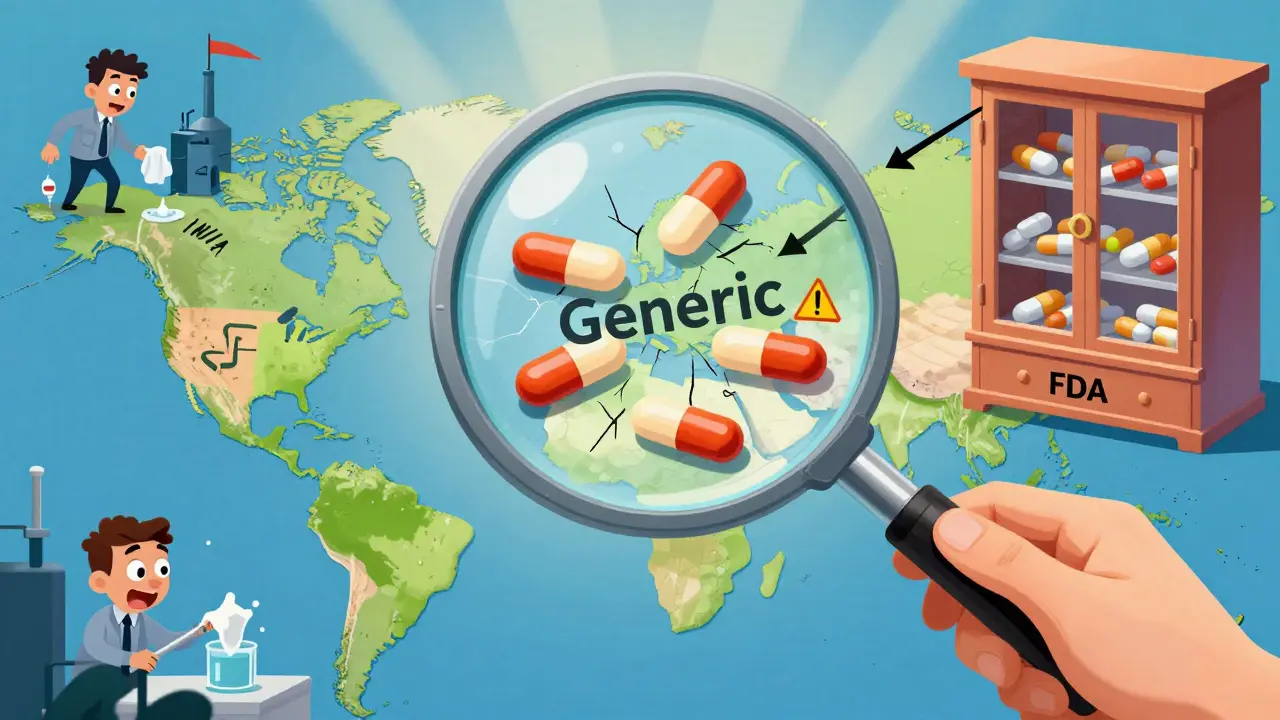
More than 80% of the active ingredients in your generic medications come from factories in India and China. Yet until recently, the U.S. Food and Drug Administration inspected those foreign plants far less often-and with far less surprise-than those in the United States. That double standard is ending. In May 2025, the FDA announced a sweeping shift: at least half of all foreign inspections will now be unannounced. This isn’t just bureaucratic housekeeping. It’s a direct response to rising risks to public health, and it’s changing how hundreds of drugmakers around the world operate.
Why Foreign Manufacturing Matters
The U.S. doesn’t make most of its generic drugs anymore. About 90% of all generic prescriptions filled in America rely on medicines produced overseas. India supplies nearly 40% of the active pharmaceutical ingredients (APIs), while China contributes another 13%. Finished pills, injections, and capsules come from factories in dozens of countries. This global supply chain keeps prices low, but it also creates blind spots. For decades, the FDA treated foreign and domestic facilities differently. Domestic plants got surprise inspections-no notice, no warning. Foreign plants? They often got 8 to 12 weeks’ notice. That’s enough time to clean up, polish records, hide problems, or even temporarily shut down troubled lines. It’s not that the rules were different. The Current Good Manufacturing Practices (CGMP) standards apply equally to every facility, whether it’s in Ohio or Odisha. But the enforcement? That was uneven.What the FDA Actually Checks
FDA inspectors don’t just walk in and look around. They dig into the details. They check training logs to see if workers were properly taught to avoid contamination. They review equipment maintenance records. They trace how samples are tested and whether results were altered. They look at how the facility handles water quality, air filtration, and waste disposal-all critical for preventing harmful particles from getting into pills. During an inspection, they use Form 483 to list any issues they find. These aren’t minor complaints. They’re violations of federal law. Common findings at foreign plants include:- Missing or falsified lab data
- Inadequate cleaning between batches
- Using expired or unapproved ingredients
- Failure to investigate why a batch failed quality tests
The Big Change: Unannounced Inspections
On May 6, 2025, FDA Commissioner Marty Makary made it clear: the old system was broken. “We can’t wait for companies to clean up before we show up,” he said. “We need to see what’s really happening.” The new policy requires foreign facilities to be ready for inspectors at any moment. No more advance notice. No more “inspection prep days.” The FDA plans to increase unannounced inspections from about 15% of total foreign visits to at least 50% by mid-2026. That means factories in Hyderabad, Shanghai, and Bangalore now have to keep their quality systems running perfectly every single day-not just when they think someone’s coming. The impact is immediate. Companies that used to rely on last-minute fixes are scrambling. A survey by the Parenteral Drug Association found 68% of foreign manufacturers expect compliance costs to rise 15-25%. Smaller plants, especially, are struggling to afford the upgrades needed for real-time documentation, automated testing, and 24/7 quality monitoring.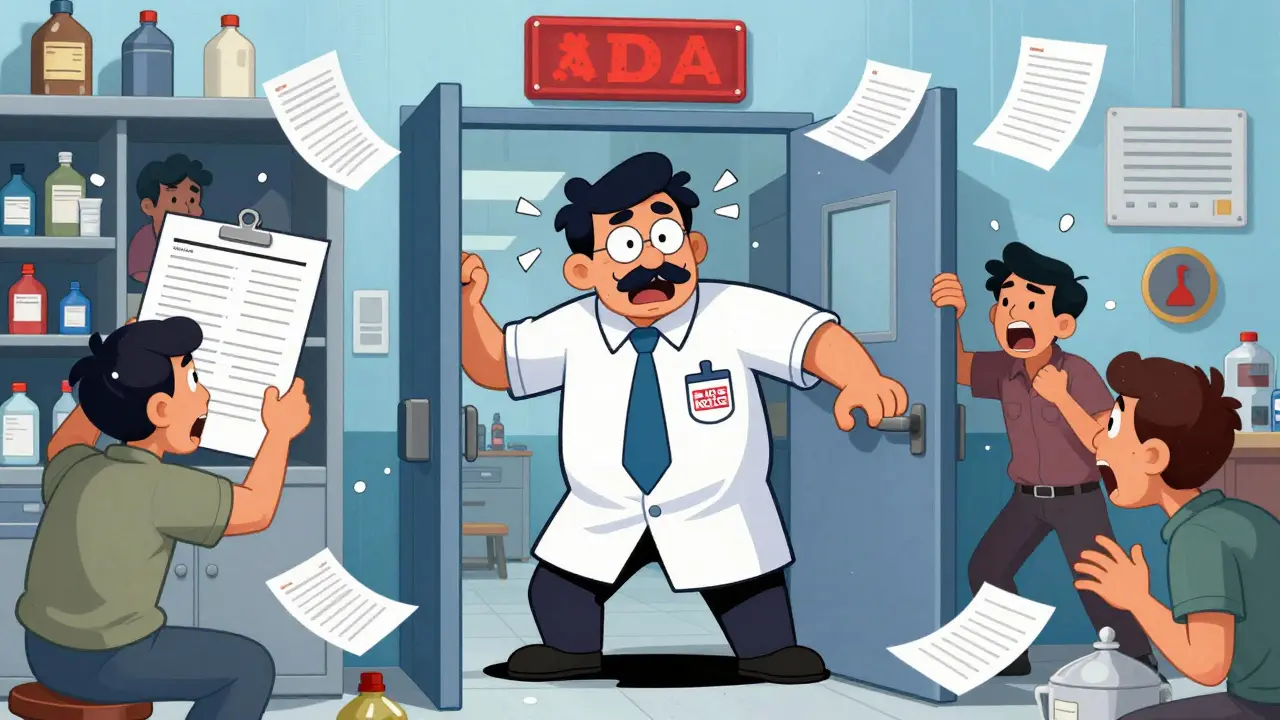
What Happens When a Factory Fails
Failing an inspection doesn’t mean a plant is shut down overnight. But it does trigger consequences. The FDA can issue a warning letter. It can block imports from that facility. In extreme cases, it can ban all products from entering the U.S. market. One notorious example: Sun Pharma’s facility in India. The FDA banned it from exporting drugs in 2021 after finding serious contamination and data falsification. Yet, four drugs from that same facility were still allowed into the U.S. for months afterward. ProPublica’s investigation found that internal FDA reviews had flagged the risks-but enforcement actions were delayed or overridden. That’s why Congress is pushing for change. In April 2025, Senators Kirsten Gillibrand and Tim Scott demanded a full review of FDA’s enforcement decisions, citing cases where safety concerns were ignored to avoid drug shortages. They also raised alarms about potential ties between some foreign manufacturers and forced labor in China-a human rights issue that’s now part of the regulatory conversation.What Foreign Manufacturers Need to Do Now
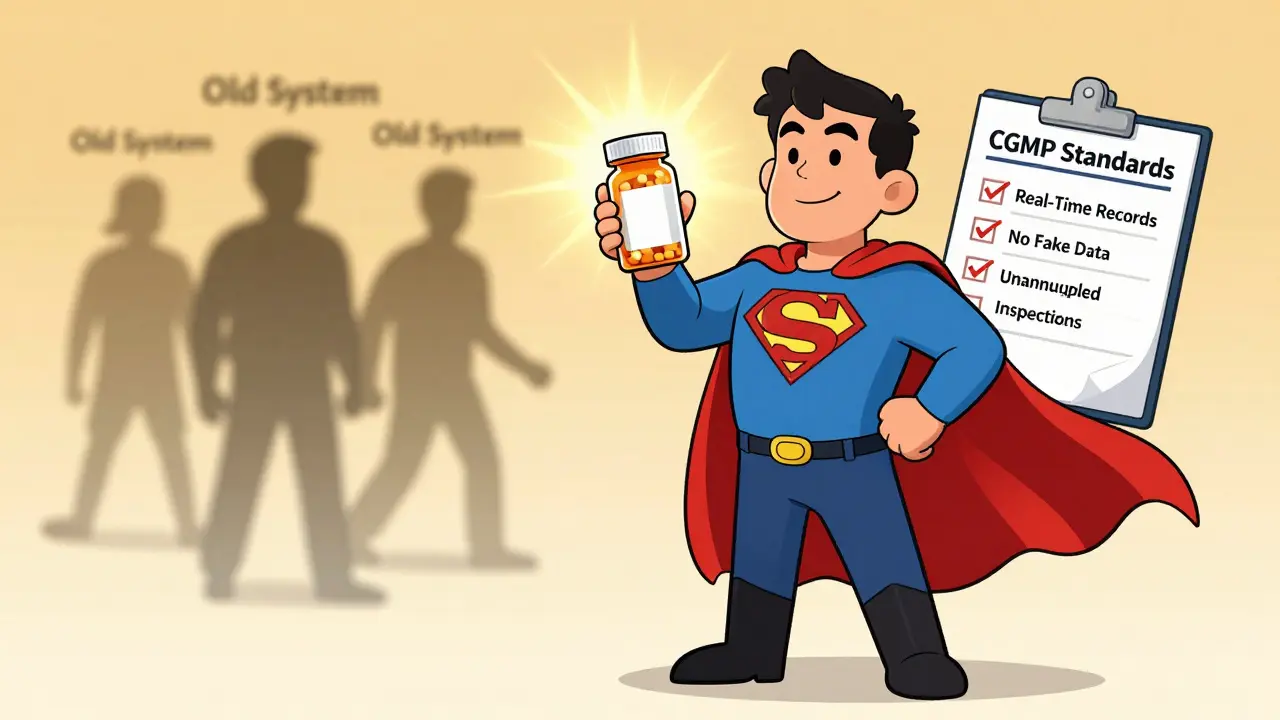
If you’re a drugmaker in India, China, or elsewhere supplying the U.S. market, here’s what you need to do:- Conduct daily quality system audits
- Run mock inspections every quarter with no warning
- Train every employee on proper documentation-no exceptions
- Fix contamination control gaps immediately
- Keep real-time digital records that can’t be altered
Could the U.S. Copy the EU’s System?
The European Union doesn’t just inspect factories. It requires every drug batch to be certified by a “Qualified Person” (QP)-a trained professional who physically signs off before the product leaves the plant. That person is legally responsible. If something goes wrong, they’re on the hook. Brookings Institution researchers argue the U.S. should adopt a similar model. Instead of relying on foreign manufacturers to police themselves, the U.S. could require importers to designate a U.S.-based QP who verifies each shipment meets CGMP standards. That would add a layer of accountability right at the border. It’s not a perfect fix. But it’s a step beyond inspections alone. The FDA’s Foreign Supplier Verification Program (FSVP), which already works for food, could be expanded to drugs. Right now, it’s not.What This Means for You
You take generic medications because they’re affordable. You assume they’re safe. That assumption is now being tested-and strengthened. The FDA’s new approach doesn’t guarantee perfection. But it closes a dangerous loophole. No more hiding. No more fake records. No more waiting for a crisis before acting. By 2026, the FDA plans to hire 200 new inspectors focused solely on foreign facilities. That’s a 40% increase in international inspection capacity. Combined with unannounced visits and stricter documentation rules, the system is finally aligning with the reality of global drug production. The goal isn’t to punish foreign manufacturers. It’s to protect patients. Whether your medicine comes from a lab in New Jersey or a factory in Mumbai, it should meet the same standard. The FDA is finally making that happen.What’s Next?
The FDA’s 2026 budget includes funding for digital inspection tools, AI-assisted data analysis, and real-time monitoring of supply chains. International partnerships are growing too. The FDA now shares inspection reports with Europe’s EMA, Japan’s PMDA, and Australia’s TGA. This isn’t just about U.S. safety-it’s about building global trust. For now, the message is clear: if you make drugs for Americans, you’re no longer operating under a different set of rules. The bar is the same. The scrutiny is the same. And the consequences for falling short? They’re no longer delayed.
11 Comments

Joanna Ebizie
So let me get this straight - we’re trusting our lives to pills made in factories where they still use pens to fake lab results? And we wonder why people are getting sick? This isn’t regulation, it’s a hostage situation with our health as the ransom.
They’ve been cutting corners for decades and now they’re finally ‘caught’? Please. The FDA’s been asleep at the wheel while Big Pharma laughed all the way to the bank.
And don’t even get me started on the forced labor angle. You think they’re just making pills? Nah. They’re making our suffering too.
It’s not a supply chain issue - it’s a moral collapse. We’re outsourcing our safety and pretending it’s ‘affordable.’ It’s not. It’s just cheaper for them.
Someone’s got to pay the price. Why does it always have to be us?

Billy Poling
The structural deficiencies in the global pharmaceutical supply chain are not merely operational but epistemological in nature - the epistemic authority of regulatory agencies like the FDA has been systematically undermined by the commodification of public health, wherein cost-efficiency metrics have replaced risk-averse clinical governance.
The historical disparity in inspection protocols between domestic and foreign facilities reflects a colonial logic of regulatory arbitrage, wherein jurisdictions with lower institutional capacity are treated as permissive regulatory zones - a phenomenon not unlike the outsourcing of environmental degradation to the Global South.
The imposition of unannounced inspections, while procedurally sound, fails to address the root cause: the absence of legally binding, transnational liability frameworks for active pharmaceutical ingredient manufacturers. Without personal accountability - such as the EU’s Qualified Person model - we are merely performing theater under the guise of reform.
Moreover, the notion that increased inspection frequency alone will yield improved outcomes is a statistical fallacy; without real-time data integrity systems and algorithmic anomaly detection, we are simply collecting more noisy data from inherently compromised systems.
It is also worth noting that the financial burden of compliance disproportionately impacts small- and medium-sized enterprises, which may lead to market consolidation and reduced generic competition - the very outcome we seek to avoid.
The FDA’s 2026 hiring initiative, while symbolically significant, is insufficient without parallel investment in international regulatory harmonization and whistleblower protections for factory workers who are often the first to observe systemic failures.
Furthermore, the absence of public access to inspection reports and enforcement timelines undermines democratic accountability. Transparency is not a feature - it is a precondition for legitimacy.
We must move beyond reactive inspections toward proactive, predictive, and participatory governance models that include civil society, frontline workers, and independent scientific auditors in the oversight architecture.
Until then, we are not safeguarding public health - we are performing a ritual of control while ignoring the architecture of failure.

Arun ana
As someone from India, I’m proud of how our pharma industry has grown to serve the world - but I also know the problems are real. Some factories cut corners, yes. But many others? They’re working 18-hour days just to meet standards.
The FDA’s move is tough but fair. We need to stop seeing this as ‘us vs them.’ It’s about quality - no matter where the pill is made.
My cousin works in a plant in Hyderabad. They just installed automated lab systems last month. No more handwritten logs. No more ‘adjusting’ data. It cost them a fortune - but they did it. Because they care.
Let’s support the good ones, not just punish the bad ones. 🙏

Colleen Bigelow
Oh wow, so now we’re gonna trust a bunch of foreign factories to not poison us? How quaint. You know what’s really happening? The Chinese government is running these plants like state-run labs - and they’re not just making pills. They’re making leverage.
Ever wonder why the FDA didn’t shut down Sun Pharma sooner? Because they were too busy kissing up to Beijing to avoid a trade war. This isn’t about safety - it’s about geopolitical cowardice.
And now they want to hire 200 more inspectors? Please. That’s like putting a Band-Aid on a hemorrhage.
Here’s the truth: the FDA is a puppet. The real power lies in Beijing and New Delhi. We’re not regulating pharma - we’re begging for it.
Next thing you know, they’ll be putting QR codes on our pills that say ‘Made in Communist China - Enjoy Your Immunity Boost!’
Wake up. This isn’t healthcare. It’s espionage with aspirin.

Dylan Smith
Why does it always take a crisis before we fix something
we knew this was broken for years
people died because someone didn’t want to spend the money
now we’re gonna make them clean up
but who’s gonna pay for the new machines
and who’s gonna make sure the inspectors aren’t bribed too
we’re just moving the problem around
not fixing it

Randolph Rickman
This is actually one of the most important public health shifts in a decade - and honestly, it’s about damn time.
For years, we’ve treated global drug manufacturing like a cheap side hustle instead of a life-or-death system. Now we’re finally treating it like what it is: critical infrastructure.
Yes, costs are going up. Yes, some small plants will fold. But that’s better than someone’s kid getting a tainted antibiotic because a lab report got ‘edited.’
And to those saying ‘but what about China?’ - the answer isn’t to go back to sleep. It’s to get smarter. More audits. More tech. More transparency.
Let’s not punish the honest manufacturers. Let’s reward them - and make sure the bad ones can’t hide anymore.
This isn’t a threat. It’s a upgrade.
And honestly? I feel safer already.

Mike Smith
Regulatory excellence is not an option - it is a non-negotiable imperative in the domain of pharmaceutical manufacturing. The paradigm shift toward unannounced inspections constitutes a necessary recalibration of the risk governance architecture, aligning procedural rigor with the existential stakes of patient safety.
It is imperative that stakeholders recognize this transition not as punitive enforcement, but as a moral recalibration - a reassertion of the social contract between public health institutions and the global pharmaceutical enterprise.
Furthermore, the adoption of digital audit trails and blockchain-based documentation systems must be accelerated to ensure immutable data integrity - a technical solution that transcends jurisdictional boundaries and mitigates human error or malfeasance.
Collaborative harmonization with the EMA, PMDA, and TGA represents not merely logistical efficiency, but the dawn of a new era of transnational public health sovereignty.
The path forward is clear: institutionalize accountability, incentivize innovation, and eliminate the illusion of regulatory arbitrage.
Let us not mistake urgency for panic - let us embrace it as purpose.

Ron Williams
Love how this is finally happening - but also… kinda weird how we act like this is new news.
I’ve been buying generic blood pressure meds for 10 years. Never thought twice.
Turns out, the bottle says ‘Made in India’ - but the real story is written in the lab logs no one ever reads.
It’s not about nationalism. It’s about dignity. Whether you’re a worker in Bangalore or a nurse in Ohio - you deserve to know your medicine is clean.
Let’s not cheer the FDA for doing their job. Let’s demand they keep doing it.
And maybe next, we ask why our own drug prices are still insane.
Just sayin’.

Kitty Price
Yessss finally 😭
I’ve had two bad reactions to generics in the last 3 years. Both times I thought it was me… turns out maybe it was the batch.
So glad someone’s finally checking the factories.
Also - can we talk about how some of these pills cost 20 cents but still have a 10-year shelf life? 🤔
Something’s off.
Anyway - thank you FDA. 🙏💖

Dave Alponvyr
So… we’re spending billions to inspect factories overseas… but still let Big Pharma charge $500 for a pill that costs 2 cents to make?
Y’all are hilarious.

Elizabeth Bauman
Wait - so the FDA is finally doing its job? After 20 years of letting China and India poison Americans? And you’re all acting like this is some kind of miracle?
Let me guess - next they’ll start testing for Chinese spy chips in the pills.
Oh wait - they already did. And buried the report.
This isn’t reform. It’s damage control. And it’s too little, too late.
My grandma died from a contaminated generic. The FDA knew. They just didn’t care.
Now they’re ‘increasing inspections’? What a joke.
They should be banning ALL imports until every single factory passes a full audit - with no notice - and the results are public.
And until then? Stop pretending this is about safety.
This is about politics.
And we’re still losing.
Recent Posts
-
Diphenhydramine Overdose: Recognizing Antihistamine Toxicity and Emergency Care
-
How to Safely Buy Phenytoin Online: A Complete Buyer's Guide
-

Citalopram vs Escitalopram: Managing QT Prolongation and Dose Limits
-

Anticholinergic Medications: Cognitive Risks and Managing Dry Mouth
-
How to Get Prescription Assistance Programs from Manufacturers

Write a comment