Refill-By Dates vs. Expiration Dates on Prescription Labels: What You Need to Know
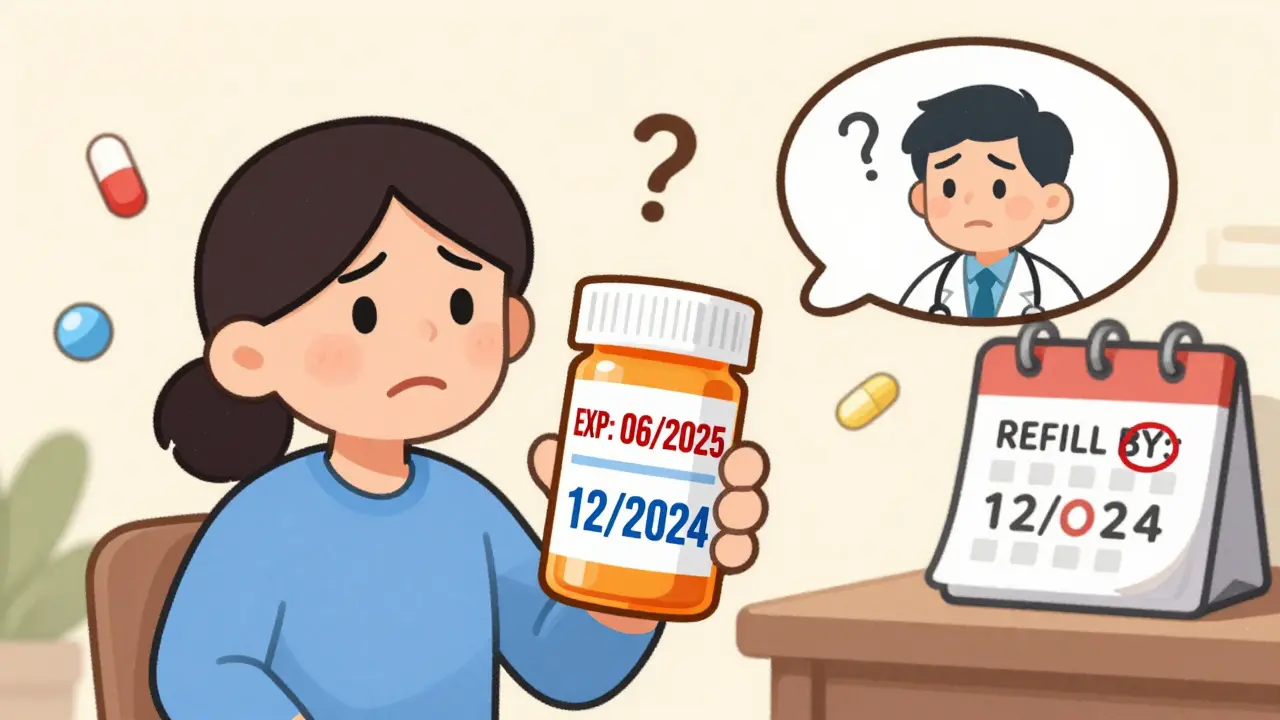
What’s the difference between a refill-by date and an expiration date?
You pick up your prescription, glance at the label, and see two dates. One says Expiration Date, the other says Refill-By Date. You might think they mean the same thing: when the medicine stops working. But they don’t. Confusing them can cost you money, disrupt your treatment, or even put your health at risk.
The expiration date is about safety. It’s the last day the drug is guaranteed to work as intended, based on lab tests done by the manufacturer. After that date, the medicine could lose strength, break down into harmful compounds, or just stop working. The FDA requires this date to be clearly printed on every prescription bottle. Pharmacists can’t legally give you medicine past this date-even if it looks fine.
The refill-by date has nothing to do with the medicine itself. It’s a rule set by your doctor or your insurance. It tells you the last day you can get another refill without needing a new prescription. After that date, the prescription expires administratively. You still have pills in the bottle? Great. But you can’t get more until your doctor writes a new one.
Why do these dates exist-and why do they matter?
These two dates serve completely different purposes. The expiration date protects you from unsafe medication. The refill-by date keeps doctors in control of your treatment.
Think of it this way: Your doctor prescribes 30 days of blood pressure pills with three refills. The expiration date might be two years from now because the pills are stable. But the refill-by date is set for one year from the original fill date. That means you can refill up to three times within that year. After the year ends, even if you have pills left, you can’t refill. You need a new prescription.
This system exists because some medications need regular monitoring. If you’re on antibiotics, opioids, or psychiatric drugs, your doctor needs to check in before letting you keep taking them. Even if your pills are still good, your condition might have changed. The refill-by date forces a check-in.
According to the American Pharmacists Association, 98.7% of U.S. pharmacies now include both dates on labels. But confusion is still common. A Consumer Reports survey found that more than half of people couldn’t tell the difference between the two. That’s dangerous.
What happens if you use medicine after the expiration date?
Some studies show that many drugs stay effective years past their expiration date-if stored properly. The FDA even tested stockpiled medications and found 88% still worked at full strength. But here’s the catch: pharmacies can’t legally dispense expired medicine. And you shouldn’t take it.
Why? Because stability testing is done under controlled conditions. Heat, moisture, light, and time can degrade pills faster than labs predict. Insulin, nitroglycerin, and liquid antibiotics are especially sensitive. Even if your pills look fine, they might not work when you need them most.
One Reddit user reported throwing out $300 worth of unexpired insulin because they thought the refill-by date was the expiration date. That’s the kind of mistake that happens when people don’t understand the difference.
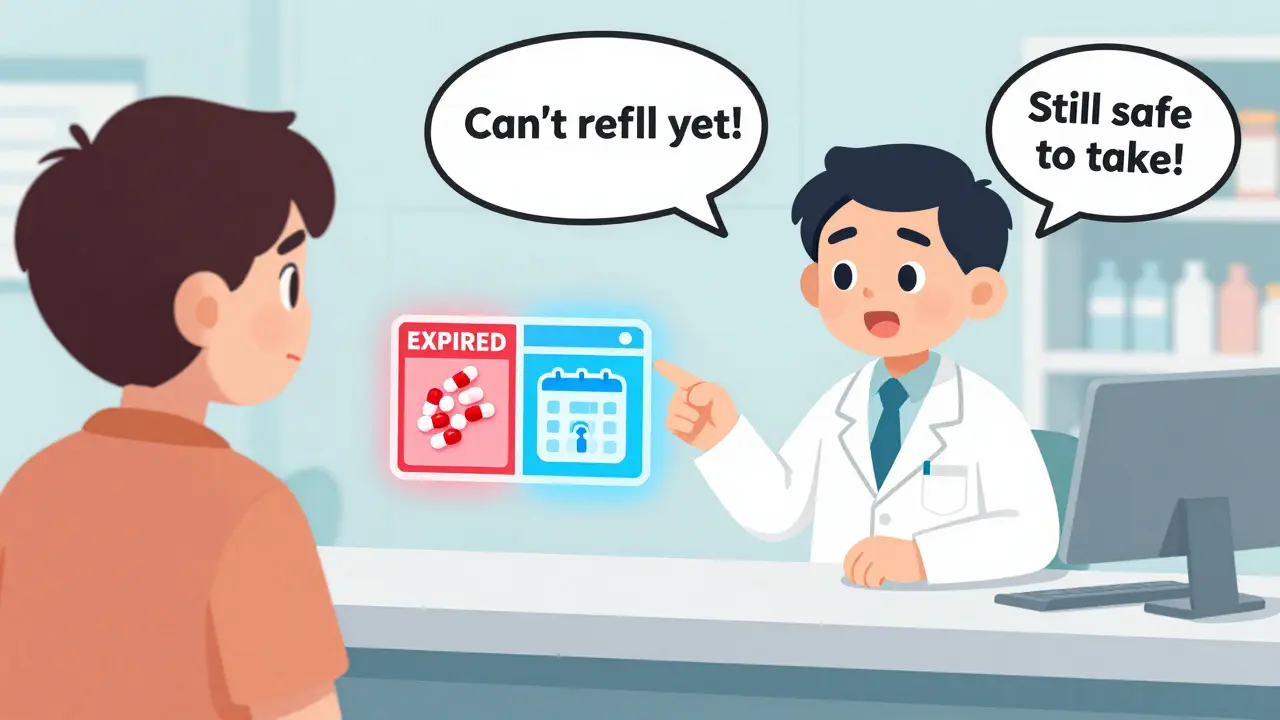
What happens if you try to refill after the refill-by date?
If you wait until after the refill-by date to ask for more, you’ll be turned away at the pharmacy. No matter how many pills are left in the bottle, the system won’t allow it. You’ll need to call your doctor.
That’s not always easy. Doctor’s offices are busy. You might have to wait days for an appointment. If you’re on a chronic medication like thyroid pills or antidepressants, even a short gap can cause symptoms to return. Some patients report anxiety, fatigue, or even hospital visits because they ran out.
Medicare Part D data shows that nearly 24% of beneficiaries experience treatment interruptions because they missed their refill-by date. That’s not because they forgot. It’s because they didn’t know the date existed-or didn’t realize it was separate from the expiration date.
How to avoid confusion: A simple guide
Here’s how to read your prescription label correctly:
- Find the expiration date. It’s usually labeled “EXP” or “Expires.” This is your safety cutoff. Don’t use the medicine after this date.
- Find the refill-by date. It might say “Refill By,” “Refills Expire,” or “Last Fill.” This is your administrative cutoff. You can’t refill after this date, even if you have pills.
- Check the number of refills left. It’s often listed separately: “Refills: 2.” That’s how many times you can refill before the refill-by date.
- Don’t assume anything. If you’re unsure, call the pharmacy. Ask: “Is this medicine still safe to take? And can I still refill it?”
Set phone reminders for both dates. Put the refill-by date on your calendar 7 days before it expires. That gives you time to schedule a doctor’s visit if needed.
Why pharmacies don’t always explain this
Pharmacists are busy. On average, they spend 7.2 minutes per prescription just verifying dates and details. They assume patients know the difference. But most don’t.
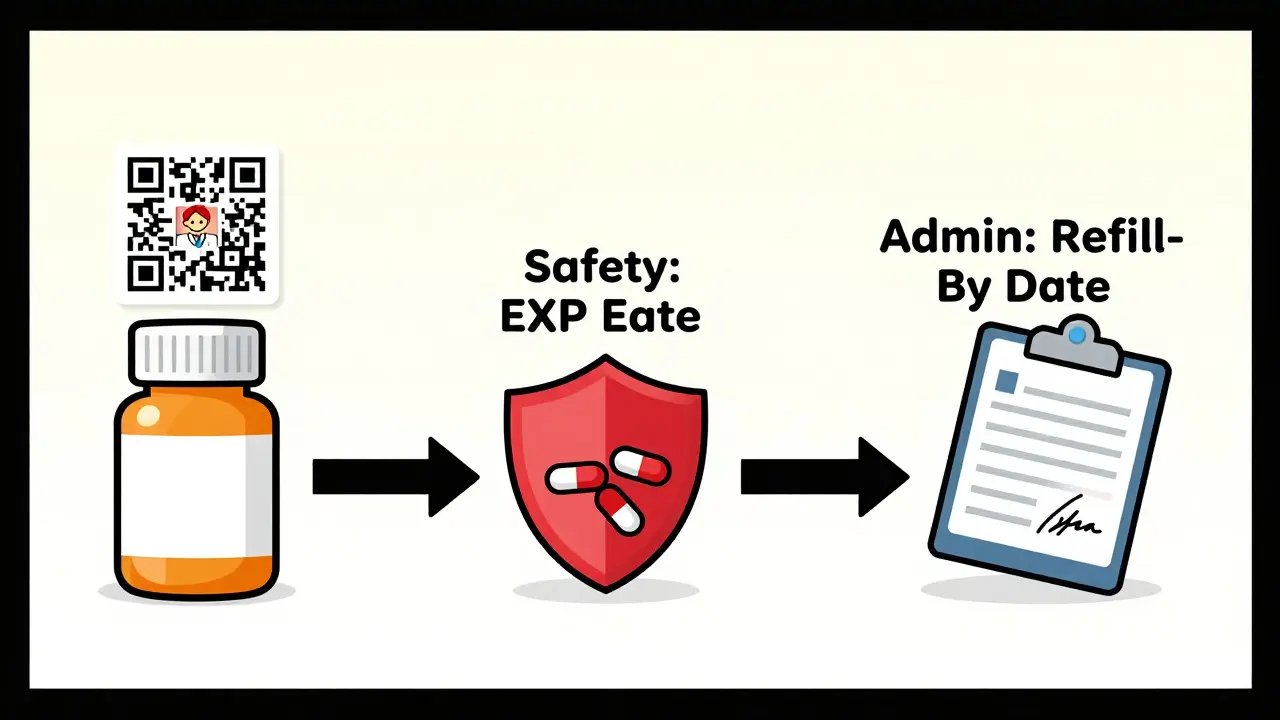
Pharmacy chains like CVS and Walgreens have started using color-coded labels: red for expiration dates (safety), blue for refill-by dates (administration). They’ve also added QR codes that link to short videos explaining the labels. Since rolling this out, CVS reported a 48% drop in patient questions about dates.
But not all pharmacies do this. Independent pharmacies, rural clinics, and mail-order services often still use plain labels. You have to be the one to ask.
What’s changing in 2026?
Regulations are catching up. The FDA’s 2023 draft guidance recommends standardizing how these dates appear on labels-clear wording, consistent placement, and visual separation. Final rules are expected in mid-2024.
By 2025, nearly 80% of prescriptions are expected to include digital labels. Scan the QR code on your bottle, and your phone shows a video explaining the dates, how to store the medicine, and what to do if you run out.
But until then, the burden is on you. Don’t wait for the system to fix itself. Learn to read your label. Ask questions. Keep a simple log: write down both dates for each medication. You’ll never run out again.
Real stories: What happens when people get it wrong
One woman in Ohio stopped taking her cholesterol pills because the refill-by date had passed. She thought the medicine was expired. Her LDL jumped 40 points in six weeks. She ended up in the ER.
A veteran in Texas kept taking his antidepressants past the expiration date because he couldn’t afford a new prescription. He didn’t know the pills were still safe-he just needed them to work. He got sick when they lost potency.
And then there’s the patient who told Healthgrades: “Knowing my refill dates versus expiration dates has kept me from medication gaps for my hypertension treatment for five years.” That’s the difference understanding makes.
Bottom line: Two dates. Two rules.
Expiration date = Don’t take it after this. It might not work-or it might hurt you.
Refill-by date = Don’t refill after this. You need a new prescription.
They’re not the same. They’re not interchangeable. And confusing them can have real consequences. Don’t guess. Don’t assume. Read the label. Ask if you’re not sure. Your health depends on it.

11 Comments

Ed Di Cristofaro
Wow. So let me get this straight - you’re telling me I’ve been throwing out perfectly good meds because I thought the refill-by date meant they were expired? I’m not even mad, I’m just impressed at how badly this system is designed. Someone’s getting paid to keep people confused on purpose.

Bryan Coleman
ive been a pharmacy tech for 12 years and this is the #1 question we get. people think if they have pills left, they can just grab more. nope. the refill-by date is there so your doc doesn’t accidentally let you stay on opioids for 5 years without a checkup. also, insulin? dont wait till it looks cloudy. just throw it out. its not worth the risk.

Sami Sahil
bro this is life changing info!! i was about to stop my anxiety med because i thought the bottle said it expired last month. turned out it was just the refill-by date. called my doc, got a new script, and now i’m sleeping like a baby. thank you for writing this. seriously. someone should make a meme about this.

franklin hillary
Think about it - expiration dates are physics. refill-by dates are bureaucracy. One is science telling you when the molecule breaks down. The other is a system telling you when to come back for paperwork. We treat medicine like a product. It’s not. It’s a lifeline. And we’re letting red tape kill people slowly because no one took five minutes to explain it.
My grandma died because she ran out of heart meds and didn’t know why she couldn’t refill. She thought the pharmacy was being cruel. It wasn’t. It was just broken.
We need labels that scream, not whisper. We need QR codes that play a voice saying ‘THIS IS NOT EXPIRED, YOU NEED A NEW PRESCRIPTION’. We need to stop pretending people are doctors.

Rachel Liew
i never knew the difference until i ran out of my thyroid med and had to wait 3 days for a dr appt. i felt so sick. i wish someone had just told me this when i got the script. please, if you’re on meds, write the two dates on your phone. it’s so easy. and call the pharmacy if you’re not sure. they’re not mad, they just want you to be okay.

Nicki Aries
Why is this not mandatory? Why are we still relying on patients to ‘read the label’? The FDA has the power to enforce clear, standardized labeling - and they’ve known about this problem for over a decade. This isn’t a patient education issue - it’s a systemic failure. Pharmacies are complicit. Insurance companies are complicit. And now people are dying because we didn’t make this simple enough.
I’m not angry. I’m heartbroken.

Deep Rank
Oh wow, so you’re saying people are dumb for not knowing the difference between two dates on a bottle? That’s rich. Let me guess - you’re one of those people who think if you just ‘try harder’ you’ll magically understand pharmacy jargon? Newsflash: not everyone has a medical degree or lives near a pharmacy with a 20-minute wait. Some of us are on SSI, can’t afford to miss work, and don’t have time to decode corporate legalese disguised as health advice. Your ‘guide’ is nice, but it’s not a solution. It’s a band-aid on a severed artery.

Naomi Walsh
Frankly, it’s embarrassing that this even needs to be explained. In Europe, prescription labels have been standardized since 2018. Color-coded, bilingual, with QR codes linking to official health authority videos. Here? We’re still using 1990s font sizes and expecting patients to be pharmacists. It’s not ignorance - it’s negligence. And frankly, if your country can’t get this right, you shouldn’t be trusted with anything more complex than ibuprofen.

Naresh L
It’s interesting how we treat medicine as both a biological entity and a bureaucratic transaction. The molecule doesn’t care about insurance rules. But the system does. There’s a tension here - between science and control. The refill-by date isn’t about safety. It’s about oversight. But oversight without access is just control without care. Maybe the real question isn’t how to read the label - but why the system forces people to navigate it at all.

June Richards
OMG I just realized I’ve been doing this wrong for 3 years 😭 I thought my refill-by date was when the pills went bad. I threw out my antidepressants last year because I thought they were expired. I’m literally crying. This is the worst. I feel so dumb. 🤦♀️

Lu Gao
This is a great post - but you missed one thing: some pharmacies actually change the refill-by date manually if you call and ask. If you’re on a chronic med and the refill-by date is coming up, just call and say, ‘Can you extend the refill-by date for another month?’ Most will do it. No need to see the doctor unless they’re required to. Just ask.
Recent Posts
-
How to Get Prescription Assistance Programs from Manufacturers
-
How to Safely Buy Phenytoin Online: A Complete Buyer's Guide
-
Diphenhydramine Overdose: Recognizing Antihistamine Toxicity and Emergency Care
-

Citalopram vs Escitalopram: Managing QT Prolongation and Dose Limits
-
Anticholinergic Medications: Cognitive Risks and Managing Dry Mouth

Write a comment