Specific IgE Testing: How to Identify Allergens and Understand Your Results

What Specific IgE Testing Actually Measures
Specific IgE testing looks for antibodies in your blood that react to particular allergens. These antibodies, called immunoglobulin E (IgE), are your body’s alarm system for things it thinks are dangerous-like peanut proteins, cat dander, or pollen. When you’re allergic, your immune system overreacts and makes these IgE antibodies on purpose. The test doesn’t measure how bad your symptoms are. It measures how much of these alarm signals are floating around in your blood.
Back in the 1970s, this test was called RAST, and it only told you if you had any IgE at all-like a simple yes or no. Today, we use much more precise tools like ImmunoCAP, which gives you a number: kUA/L. That number tells you how strong your immune response is. A result below 0.35 kUA/L is considered negative. Anything above that is positive, but what that means depends on the allergen and your history.
Why Doctors Don’t Just Order a Full Panel
It’s tempting to ask for a test that checks for every possible allergen. But that’s a bad idea. If you test for 20 things at once, you’re almost guaranteed to get false positives. Why? Because your immune system sometimes reacts to similar proteins in unrelated things. For example, someone allergic to birch pollen might test positive for apples, even if they can eat them just fine. This is called cross-reactivity.
Guidelines from major medical groups say you should only test for things your history points to. If you get hives every time you eat shrimp, test for shrimp-not for every seafood. If you sneeze every spring, test for ragweed and tree pollen-not for dust mites unless you have year-round symptoms too. One study found that 22% of IgE tests ordered in primary care were unnecessary because they weren’t tied to real symptoms.
Some labs even block requests for more than 12 allergens without a doctor’s note explaining why. And food mix tests? Avoid them. They’re unreliable. A mix of peanut, tree nuts, and soy might show a positive result, but you won’t know which one is the real problem. Testing each one separately cuts down the guesswork.
When Blood Testing Beats Skin Testing
Skin prick tests are usually the first choice for allergy diagnosis. They’re fast, cheap, and show real-time reactions. But they’re not always possible. If you have severe eczema covering more than 40% of your skin, you can’t do skin tests-they’ll just flare up. If you’re taking antihistamines, you have to stop them for 3 to 5 days before testing. For kids, that’s hard. For adults on antidepressants or blood pressure meds, it’s often not safe.
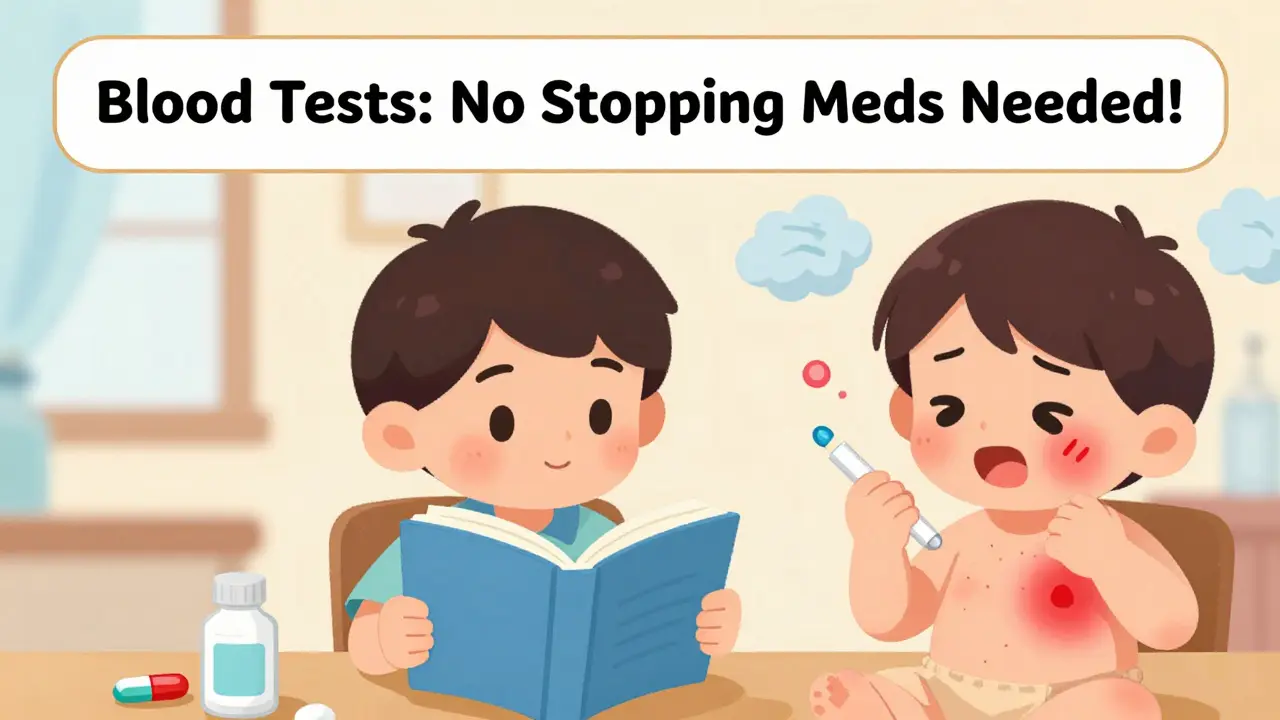
That’s where blood tests shine. You don’t need to stop any meds. You don’t need to avoid scratching your skin. You just get a blood draw. About 27% of pediatric patients get blood tests because they can’t pause their medications. The same goes for people with chronic skin conditions or those who’ve had bad reactions to skin testing in the past.
While skin tests are slightly more sensitive for things like pollen and dust mites, modern blood tests have closed the gap. For peanut allergy, a blood result of 15 kUA/L or higher means you have a 95% chance of having a true reaction. At 0.35 kUA/L? Only a 50% chance. That’s why the number matters.

Understanding Your Numbers: What 0.5 kUA/L Really Means
Seeing a result like 0.5 kUA/L on your report can be confusing. Is that serious? Is it harmless? The answer isn’t in the number alone-it’s in context.
That 0.5 kUA/L could mean different things depending on your total IgE. If your total IgE is 1 kUA/L, then 0.5 is half your body’s total allergy response. That’s significant. But if your total IgE is 100 kUA/L, then 0.5 is just a tiny fraction. That’s why labs now automatically check your total IgE when a specific IgE comes back positive.
Weak positives-between 0.35 and 0.70 kUA/L-are the trickiest. They often mean nothing. Many people with no symptoms at all have these low numbers. But if you have clear symptoms after eating eggs and your egg IgE is 0.6 kUA/L, that’s meaningful. The test doesn’t diagnose you. Your history does. The test just supports it.
What the Results Can and Can’t Tell You
Specific IgE testing can tell you if your immune system has made antibodies to an allergen. That’s it. It can’t tell you:
- How bad your reaction will be
- If you’ll outgrow the allergy
- Whether you’re safe to eat a food in small amounts
- If you need to carry an EpiPen
It also can’t predict reactions in real life. Two people with the same IgE level might have totally different experiences. One gets a rash. The other gets anaphylaxis. That’s why doctors don’t make decisions based on numbers alone.
But here’s what it can do: help confirm if your symptoms match an allergy. If you have asthma every time you’re around cats, and your cat dander IgE is 12 kUA/L, that’s strong evidence. It can also help decide if immunotherapy (allergy shots) is worth trying. If your IgE levels are high for ragweed and you’re miserable every fall, shots might help.
Component-Resolved Diagnostics: The Next Step
Some labs now offer something called component-resolved diagnostics. Instead of testing for whole peanut protein, they test for specific parts of it-like Ara h 2. This is a big deal because Ara h 2 is the part that causes serious reactions. If you’re positive for Ara h 2, your risk of anaphylaxis is high. If you’re only positive for Ara h 1 or 3, you might just have oral allergy syndrome-itchy mouth, no danger.
This technique has improved accuracy from 70% to 92% for peanut and tree nut allergies. It’s also helping doctors distinguish between true allergies and cross-reactions. For example, someone with birch pollen allergy might test positive for hazelnut because of similar proteins. But if they’re negative for the specific hazelnut component that causes real reactions, they can probably eat it safely.
Right now, these advanced tests are mostly used in allergy clinics. They’re expensive and complex to interpret. But as they become more common, they’ll replace the old “all-or-nothing” approach.
What Happens After the Test?
Most results come back in 3 days. Some take longer if they need to go to a specialty lab. But here’s the thing: you won’t get a call the moment your result is ready. Allergy testing isn’t urgent. Ninety-eight percent of these tests are for long-term planning, not emergency care.
Your doctor will look at your result alongside your symptoms. Did you break out in hives after eating shellfish? Is your nose stuffy every time you vacuum? They’ll match the numbers to your life. If the test matches your story, they’ll recommend avoiding the allergen, carrying epinephrine, or starting immunotherapy.
If the test doesn’t match? They’ll say it’s likely a false positive. You don’t need to avoid milk just because your test shows a tiny IgE response-especially if you’ve eaten it without issues for years.
And if you’ve been told you’re allergic to something but have never had a reaction? Don’t assume the test is right. Retesting someone with known tolerance leads to unnecessary fear and dietary restrictions. One study found that 38% of inappropriate tests happen because doctors retest things patients already know they can eat.
What’s Coming Next in Allergy Testing
Technology is moving fast. New platforms like the ImmunoSolid Phase Allergen Chip (ISAC) can test for 112 different allergen components from just one tiny drop of blood. That sounds amazing-but it’s not for everyone. These tests generate so much data that only allergy specialists can interpret them correctly. For most people, they’re overkill.
The future isn’t about testing more things. It’s about testing smarter. Better markers. Better cutoffs. Better ways to link test results to real-world outcomes. For now, the best test is still the one ordered for the right reason, interpreted by the right person, and matched to your symptoms.

10 Comments

Ian Long
I've seen so many people panic over 0.5 kUA/L results. My kid had that for peanuts and we just kept feeding them peanut butter. No reaction in 3 years. Numbers aren't diagnoses - your lived experience is.

Pooja Kumari
I just got my results back and I'm crying because I tested positive for 7 things including apples and almonds but I've eaten them since I was 5. My doctor said it's cross-reactivity with birch pollen but now I'm terrified to eat fruit again. Why does science make me feel like I'm poisoned by everything? 😭

Johanna Baxter
Stop ordering full panels. You're not a lab rat. If you don't break out in hives when you eat shrimp, stop testing for shrimp. You're just wasting money and creating anxiety.

tali murah
Let me guess - you got your IgE numbers and now you're Googling 'anaphylaxis symptoms at 3 a.m.' again. You know what's worse than a false positive? The mental prison you build around yourself because you let a lab report dictate your life. 🤦♀️

Chris Kauwe
The paradigm shift in allergen component resolution represents a quantum leap in immunodiagnostics. The epitope-specific profiling of Ara h 2 versus Ara h 1 fundamentally reconfigures predictive validity metrics, rendering conventional whole-protein assays obsolete in high-risk populations. We are entering an era of precision immunology.

Angela Stanton
I got my ISAC chip results last month. 112 components. 87 positives. My allergist looked at me like I was a science experiment. Now I can't eat anything without checking 12 different databases. It's like my body is a WiFi network with too many devices connected. 🤯

Phil Kemling
The test doesn't measure your fear. It measures your immune system's memory. But who are we to say what memory is valid? Maybe the body knows something we don't. Maybe the number isn't wrong - maybe we're just afraid of what it means.

Lindsey Wellmann
I had a 12.8 kUA/L for cat dander and still adopted three cats. 🐱💕 I cry every time I sneeze but I love them too much to give them up. Allergies are annoying, not a death sentence. Also, I'm basically a cat-shaped allergy now. #CatLadyLife

Diana Stoyanova
You know what’s wild? The fact that we’ve gone from RAST in the 70s to ISAC chips now. We used to guess. Now we have data. But here’s the thing - data doesn’t heal you. Living well does. If you’re eating, laughing, breathing - you’re winning. Don’t let a number steal your joy. You’re not your IgE. You’re your courage.

Jerian Lewis
My doctor ordered a full panel because I mentioned I was 'kinda sensitive' to nuts. Got 4 positives. Turned out I could eat cashews fine. The test didn’t diagnose me - my doctor’s laziness did.


Write a comment