Prior Authorization for Generics: Why Insurance Now Demands Approval for Cheap Medications

It’s 2026, and your doctor prescribes you a generic version of metformin for type 2 diabetes. It’s cheap. It’s effective. It’s been used by millions. But when you get to the pharmacy, the pharmacist says: "We can’t fill this until your insurance approves it." You’re confused. This isn’t a $10,000 specialty drug. It’s a $4 pill. Why does it need approval?
This isn’t a glitch. It’s becoming the norm. Even though generics make up 90% of all prescriptions filled in the U.S., nearly one in five now require prior authorization before insurance will pay. That’s up from just 5% in 2018. What started as a tool to control expensive brand-name drugs is now being used to block the very medications meant to save money.
How Prior Authorization Works - Even for $4 Pills
Prior authorization is a paperwork hurdle. Your doctor writes a prescription for a generic drug. But before the pharmacy can dispense it, the insurance company - or their middleman, the pharmacy benefit manager (PBM) - demands proof that the drug is "medically necessary." That means filling out forms, submitting lab results, sometimes even proving you tried another generic first.
For brand-name drugs, this makes some sense. Insurers want you to try cheaper alternatives before approving the expensive one. But for generics? The logic flips. Now, insurers are asking: "Why are you prescribing this generic instead of another generic?" It’s not about cost. It’s about control.
Doctors spend an average of 43 prior authorizations per week. Nearly 40% of those are for generic medications. That’s not just paperwork. It’s lost time. One clinic reported spending 17.3 hours a week just on generic prior auths - almost half a full-time employee’s workweek. That’s time that could’ve been spent with patients.
Why Are Insurers Targeting Generics Now?
Here’s the uncomfortable truth: it’s not about patient safety. It’s about rebates.
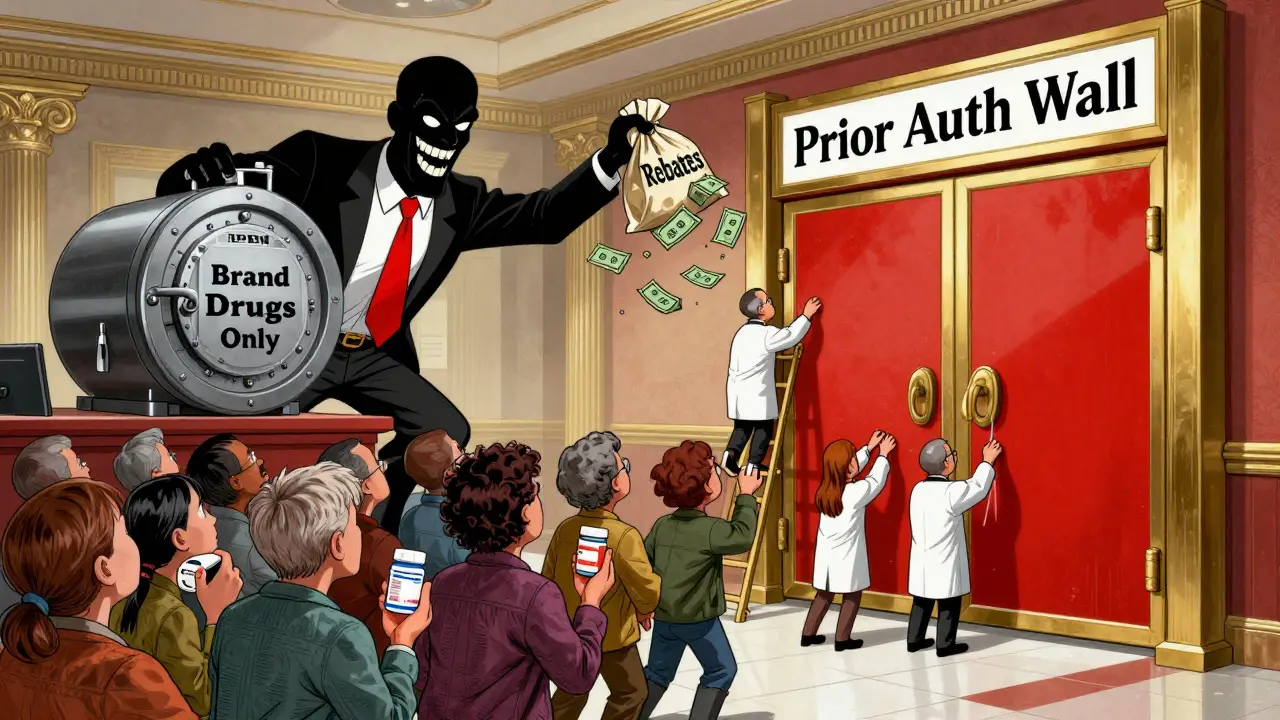
Pharmacy benefit managers (PBMs) collect $138.7 billion a year in rebates and fees from drug makers. Many of these rebates are tied to formulary placement. If a brand-name drug pays a bigger rebate than its generic counterpart, the PBM may push the brand - even if the generic is cheaper for the patient. To make that happen, they block the generic with prior authorization.
For example: A patient with high blood pressure might be prescribed lisinopril, a generic ACE inhibitor. But if the brand-name version, Zestril, pays a larger rebate, the insurer might require prior authorization for lisinopril - forcing the doctor to justify why they didn’t pick the more expensive option. Same effect. Same outcome. Different price tag.
Specialty generics are hit hardest. Oncology generics like capecitabine or methotrexate now require prior authorization in 35% of cases. Cardiovascular generics? Only 12%. Why? Because cancer drugs have higher rebates. And insurers are playing the game.
Who Gets Hurt?
Patients. Doctors. Pharmacists. Everyone except the middlemen.
A Kaiser Family Foundation case study followed a patient with type 2 diabetes who was denied immediate access to generic metformin. The prior auth took 14 days. During that time, their HbA1c - a key measure of blood sugar control - jumped from 6.8% to 8.2%. That’s not just a number. That’s increased risk of nerve damage, kidney failure, vision loss.
On Reddit, threads like "Generic levothyroxine requiring prior auth - what’s next?" have hundreds of comments. People are sharing stories of thyroid meds, blood pressure pills, cholesterol drugs - all held up by paperwork. One user wrote: "I had to wait three weeks for my generic sertraline. My anxiety got worse. I missed work. My doctor had to write a letter. All for a $5 pill."
Doctors aren’t immune. A 2023 American Medical Association survey found that 24% of physicians have seen patients hospitalized because of delays caused by prior authorization. These aren’t rare cases. They’re systemic.

What’s Being Done About It?
Change is coming - but slowly.
In December 2023, Congress passed the Improving Seniors’ Timely Access to Care Act. Starting in 2026, Medicare Advantage plans must process prior authorizations electronically and respond to urgent requests within 72 hours. That’s a win. But it doesn’t cover private insurance.
California’s SB 1024, effective January 2025, bans prior authorization entirely for 47 common generic drugs on the state’s Essential Drug List. That includes metformin, lisinopril, atorvastatin, levothyroxine - the staples of chronic disease care.
Thirty-four states now restrict prior authorization for certain generic classes. And in June 2025, the five largest U.S. insurers - Aetna, UnitedHealthcare, Cigna, Humana, and Blue Cross Blue Shield - announced they’d eliminate prior authorization for 12 common generic medications, including statins, ACE inhibitors, and metformin. Implementation starts January 2026.
These aren’t acts of charity. They’re responses to pressure. Patients are angry. Doctors are fed up. And the math doesn’t add up.
How to Navigate Generic Prior Authorization
If you’re prescribed a generic that needs approval, here’s what to do:
- Ask your doctor upfront. "Is this generic going to need prior auth?" If yes, ask them to submit it electronically. Electronic submissions cut approval time by 32%.
- Get the paperwork right. Insurers want specific ICD-10 codes, lab results, or proof you tried other options. Make sure your doctor includes all of it the first time.
- Request urgent status. If your condition is unstable - high blood pressure, uncontrolled diabetes, worsening depression - ask for "urgent" or "expedited" review. Cigna and others must respond in 72 hours.
- Keep records. Save every denial letter, every phone call, every email. Two-thirds of denials can be overturned with better documentation.
- Appeal if denied. Most insurers have a formal appeals process. Don’t give up. The Crohn’s & Colitis Foundation reports that 67% of generic prior auth denials are reversed on appeal.
And if your insurance denies coverage for a generic you’ve been on for years? That’s a red flag. Ask: "Why now?" Something changed - and it’s probably not your health.
The Bigger Picture
Generics were supposed to be the solution. They’re safe. They’re proven. They’re affordable. Yet, they’re now the ones caught in the system’s crosshairs.
The American Gastroenterological Association says prior authorization for first-line generics increases total healthcare costs by 18% - because delays lead to complications, ER visits, and hospitalizations. That’s the irony. The system designed to save money is costing more.
By 2028, the Congressional Budget Office projects a 40% drop in prior authorization for generics - if current reforms hold. That’s good news. But until then, patients are the ones paying the price - in time, stress, and health.
It’s not just about pills. It’s about trust. When your insurance company makes you jump through hoops for a $4 medication, it sends a message: "We don’t trust you to make the right choice." But you’ve been making that choice for years. You just need the system to catch up.
Why do I need prior authorization for a generic drug?
Even though generics are cheaper, insurance companies sometimes require prior authorization to control which specific version of a drug you get - often because of rebates paid by drug manufacturers. It’s not about safety; it’s about formulary placement and financial incentives.
Which generic drugs commonly require prior authorization?
Common ones include metformin, lisinopril, levothyroxine, atorvastatin, and methotrexate. These are often first-line treatments for diabetes, high blood pressure, thyroid issues, high cholesterol, and autoimmune diseases. Even though they’re low-cost, insurers are increasingly placing them under prior authorization, especially in specialty areas like oncology.
How long does prior authorization for generics take?
Standard requests can take 5 to 10 business days. But if your doctor marks it as "urgent" - for example, if you’re at risk of hospitalization - insurers like Cigna and UnitedHealthcare must respond within 72 hours. Electronic submissions are faster than fax or phone.
Can I appeal a denied prior authorization for a generic?
Yes. About 67% of denials are overturned on appeal if you provide additional clinical documentation - like lab results, treatment history, or a letter from your doctor explaining why the generic is necessary. Don’t accept the first "no."
Is prior authorization for generics legal?
Yes, it’s legal - but it’s being challenged. States like California have banned prior authorization for certain essential generics. Federal law now requires Medicare Advantage plans to process electronic prior authorizations and respond within 72 hours for urgent cases. Many experts argue the practice is counterproductive and violates the intent of cost-saving generics.
What’s changing in 2026?
Starting January 2026, the five largest U.S. insurers - Aetna, UnitedHealthcare, Cigna, Humana, and Blue Cross Blue Shield - will stop requiring prior authorization for 12 common generic medications, including metformin, statins, and ACE inhibitors. Medicare Advantage plans will also be required to use electronic systems and respond faster. These changes are driven by public pressure and evidence that prior auth delays cost more than they save.
What Comes Next?
Right now, you’re stuck between a system that’s broken and a medication that should be simple. But you’re not powerless.
Ask questions. Demand transparency. Keep records. Appeal denials. And if your insurer suddenly starts requiring prior auth for a drug you’ve taken for years - push back. That’s not policy. That’s profit.
The future of generics shouldn’t be paperwork. It should be access. And that’s what’s at stake.

15 Comments

Andrew Qu
Just had to fight through prior auth for my generic metformin last month. Took 9 days. My HbA1c climbed to 8.1 before they finally approved it. My endo had to call twice and submit lab results. It’s insane. This isn’t a $2000 cancer drug - it’s a $3 pill that’s been around since the 70s. The system is broken, and patients are paying the price.

Andrew Short
Of course they do. PBMs are corporate parasites. They don’t care about your health - they care about the rebate check from the brand-name drug maker. This isn’t healthcare. It’s a rigged casino where the house always wins. And you? You’re just the sucker holding the losing ticket.

christian Espinola
Let’s be precise: prior authorization for generics is not merely inefficient - it is a systemic violation of fiduciary duty. Insurance entities, acting as third-party administrators, are incentivized by rebate structures that directly contradict patient welfare. The legal framework enabling this is predicated on opaque contractual arrangements between PBMs and pharmaceutical manufacturers - a structure that is, by any objective standard, ethically indefensible.

Chuck Dickson
Hey - I know this feels overwhelming, but you’re not alone. I’ve been there. My mom waited 11 days for her levothyroxine. She missed work. Her anxiety spiked. But we appealed - and won. You’ve got rights. Ask your doc to mark it urgent. Submit electronically. Save every email. And don’t let them gaslight you into thinking it’s normal. It’s not. We’re fighting back - one appeal at a time. You got this 💪

Robert Cassidy
They’re coming for your pills next. Then your food. Then your freedom. This is how they control the masses. PBMs, Big Pharma, the government - all in bed together. They want you dependent. They want you docile. They want you begging for permission to take a $4 pill that could’ve been yours yesterday. Wake up. This isn’t healthcare. It’s control.

Naomi Keyes
Have you considered, however, that prior authorization may also serve as a safeguard against off-label prescribing or inappropriate polypharmacy? While I agree that the current implementation is flawed - and that rebates are a corrupting influence - the underlying mechanism, if properly regulated, could theoretically prevent misuse… though, frankly, the current system is a disaster.

Dayanara Villafuerte
Bro. I had to wait 3 weeks for my generic sertraline. 😭 My anxiety went from "meh" to "I can't leave the house". My doctor had to write a 3-page letter. The pharmacy called me twice. I cried in the parking lot. And it’s a $5 pill. 💔 This isn’t healthcare. It’s a bureaucratic horror movie. #PriorAuthHell

kenneth pillet
My doc just told me to call the insurance. Said they’d probably deny it anyway. So I didn’t bother. Took the cash price - $12 for a 30-day supply. Cheaper than the copay after all the paperwork. Just saying - sometimes the system’s so broken, the only way to win is to not play.

Jodi Harding
They’re not protecting you. They’re protecting profits. And you’re the collateral damage.

Danny Gray
What if the real issue isn’t prior auth - but the fact that we’ve outsourced healthcare to corporations who see medicine as a commodity? Maybe the solution isn’t reforming the system… but dismantling it. What if we stopped trusting insurers to decide what’s safe for us? What if we just… paid cash and bypassed the whole charade?

Tyler Myers
Did you know the same PBMs that block your metformin also own pharmacy chains? Yeah. They make more money when you buy the brand-name drug from their own pharmacy. So they delay the generic - then sell you the expensive one. It’s not a glitch. It’s a business model. And they’re laughing all the way to the bank.

Zoe Brooks
I’ve been on lisinopril for 12 years. Never had prior auth until last year. My doctor was furious. Said he’s had to spend 10+ hours a week just filling out forms for generics. He’s thinking of retiring early. We’re losing good doctors because of this. It’s not just about pills - it’s about the people who care for us.

Kristin Dailey
America is falling apart because we let corporations run healthcare. This is what happens when you treat medicine like a stock market. Fix it or burn it down.

Wendy Claughton
I just want to say… thank you to everyone who’s speaking up. This issue is so invisible to people who don’t live it. But your stories? They matter. I’ve been sharing this post with my book club. We’re writing letters to our reps. Change is slow - but it’s happening. And you’re not alone. 💛

Stacey Marsengill
They took my metformin. They took my peace. Now they’re coming for my dignity. I’ve been on this pill since 2018. No problems. No complications. Just a $4 lifeline. Then one day - boom - paperwork. They don’t care if I live or die. They care if the rebate is bigger on the brand. I’m not a patient. I’m a spreadsheet.

Write a comment